Anticorps Polyclonal de lapin anti-WDR33
WDR33 Polyclonal Antibody for WB, IP, Indirect ELISA
Hôte / Isotype
Lapin / IgG
Réactivité testée
Humain
Applications
WB, IP, Indirect ELISA
Conjugaison
Non conjugué
N° de cat : 22614-1-PBS
Synonymes
Galerie de données de validation
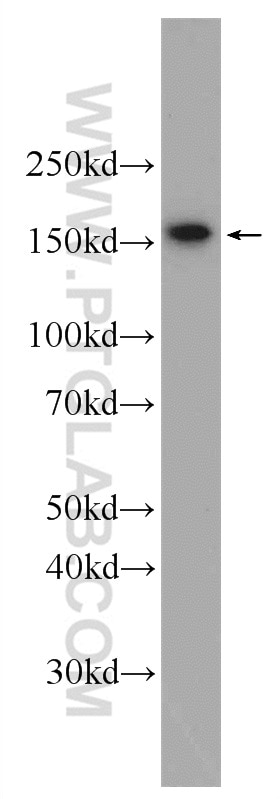
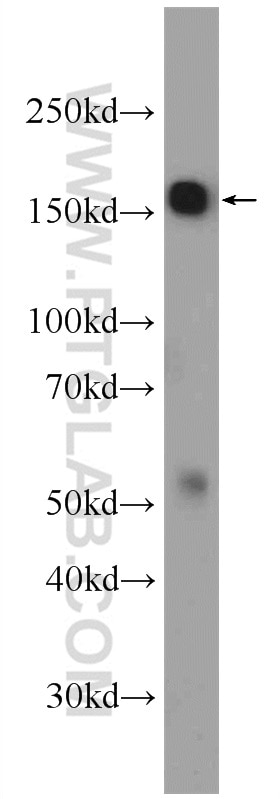
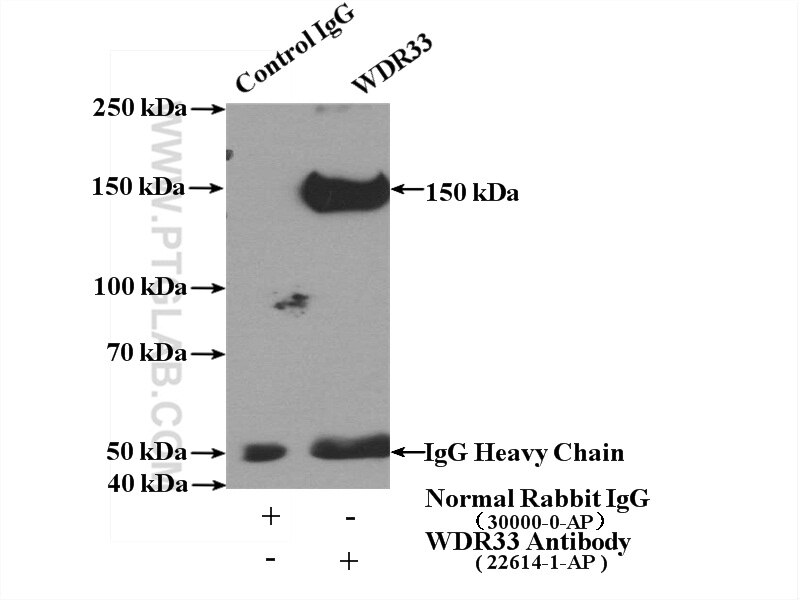
Informations sur le produit
22614-1-PBS cible WDR33 dans les applications de WB, IP, Indirect ELISA et montre une réactivité avec des échantillons Humain
| Réactivité | Humain |
| Hôte / Isotype | Lapin / IgG |
| Clonalité | Polyclonal |
| Type | Anticorps |
| Immunogène | WDR33 Protéine recombinante Ag18382 |
| Nom complet | WD repeat domain 33 |
| Masse moléculaire calculée | 1336 aa, 146 kDa |
| Poids moléculaire observé | 170 kDa |
| Numéro d’acquisition GenBank | BC010283 |
| Symbole du gène | WDR33 |
| Identification du gène (NCBI) | 55339 |
| Conjugaison | Non conjugué |
| Forme | Liquide |
| Méthode de purification | Purifié par affinité contre l'antigène |
| Tampon de stockage | PBS only |
| Conditions de stockage | Store at -80°C. 20ul contiennent 0,1% de BSA. |
Informations générales
WD repeat domain 33 (WDR33), also named WDC146, is a member of the WD repeat protein family. WD repeats are minimally conserved regions of approximately 40 amino acids typically bracketed by gly-his and trp-asp (GH-WD), which may facilitate formation of heterotrimeric or multiprotein complexes. Members of this family are involved in a variety of cellular processes, including cell cycle progression, signal transduction, apoptosis, and gene regulation. This gene is highly expressed in testis and the protein is localized to the nucleus. This gene may play important roles in the mechanisms of cytodifferentiation and/or DNA recombination.This gene encodes a member of the WD repeat protein family. WD repeats are minimally conserved regions of approximately 40 amino acids typically bracketed by gly-his and trp-asp (GH-WD), which may facilitate formation of heterotrimeric or multiprotein complexes. Members of this family are involved in a variety of cellular processes, including cell cycle progression, signal transduction, apoptosis, and gene regulation. This gene is highly expressed in testis and the protein is localized to the nucleus. This gene may play important roles in the mechanisms of cytodifferentiation and/or DNA recombination. Multiple alternatively spliced transcript variants encoding distinct isoforms have been found for this gene. This antibody recognizes the full length WDR33 protein.


