Anticorps Polyclonal de lapin anti-XPOT
XPOT Polyclonal Antibody for WB, ELISA
Hôte / Isotype
Lapin / IgG
Réactivité testée
Humain
Applications
WB, ELISA
Conjugaison
Non conjugué
N° de cat : 12577-1-AP
Synonymes
Galerie de données de validation
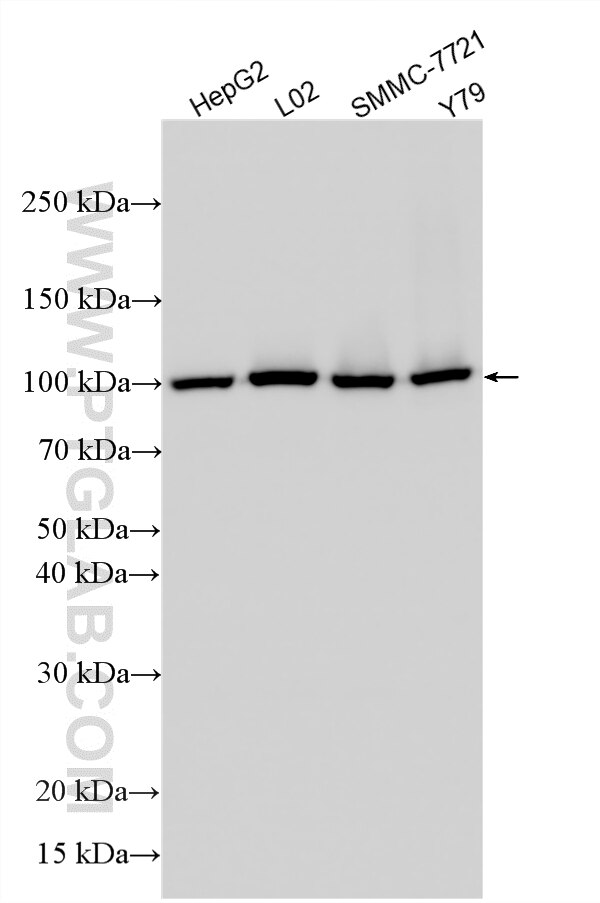
Applications testées
| Résultats positifs en WB | cellules HepG2, cellules L02, cellules SMMC-7721, cellules Y79 |
Dilution recommandée
| Application | Dilution |
|---|---|
| Western Blot (WB) | WB : 1:1000-1:4000 |
| It is recommended that this reagent should be titrated in each testing system to obtain optimal results. | |
| Sample-dependent, check data in validation data gallery | |
Informations sur le produit
12577-1-AP cible XPOT dans les applications de WB, ELISA et montre une réactivité avec des échantillons Humain
| Réactivité | Humain |
| Hôte / Isotype | Lapin / IgG |
| Clonalité | Polyclonal |
| Type | Anticorps |
| Immunogène | XPOT Protéine recombinante Ag3256 |
| Nom complet | exportin, tRNA (nuclear export receptor for tRNAs) |
| Masse moléculaire calculée | 962 aa, 110 kDa |
| Poids moléculaire observé | 100-110 kDa |
| Numéro d’acquisition GenBank | BC020569 |
| Symbole du gène | XPOT |
| Identification du gène (NCBI) | 11260 |
| Conjugaison | Non conjugué |
| Forme | Liquide |
| Méthode de purification | Purification par affinité contre l'antigène |
| Tampon de stockage | PBS with 0.02% sodium azide and 50% glycerol |
| Conditions de stockage | Stocker à -20°C. Stable pendant un an après l'expédition. L'aliquotage n'est pas nécessaire pour le stockage à -20oC Les 20ul contiennent 0,1% de BSA. |
Informations générales
XPOT (also known as Exportin-T) is a key member of the karyopherin-β family of nuclear transport receptors, specifically responsible for the export of a critical class of small non-coding RNAs, transfer RNAs (tRNAs), from the nucleus to the cytoplasm. This process is essential for protein synthesis, as tRNAs must function in the cytoplasm to decode mRNA sequences and deliver amino acids to the growing polypeptide chain. XPOT recognizes mature tRNAs that have been properly processed and aminoacylated in the nucleus, loading them in a RanGTP-dependent manner. Upon translocation through the nuclear pore complex, the hydrolysis of RanGTP to RanGDP in the cytoplasm triggers the release of the tRNA cargo, thereby ensuring that only functional tRNAs are utilized for translation and maintaining the spatial separation of nuclear and cytoplasmic processes.
Protocole
| Product Specific Protocols | |
|---|---|
| WB protocol for XPOT antibody 12577-1-AP | Download protocol |
| Standard Protocols | |
|---|---|
| Click here to view our Standard Protocols |

