Anticorps Polyclonal de lapin anti-ZBTB7B
ZBTB7B Polyclonal Antibody for WB, IF/ICC, IP, Indirect ELISA
Hôte / Isotype
Lapin / IgG
Réactivité testée
Humain, rat, souris
Applications
WB, IF/ICC, IP, Indirect ELISA
Conjugaison
Non conjugué
N° de cat : 11341-1-PBS
Synonymes
Galerie de données de validation
Informations sur le produit
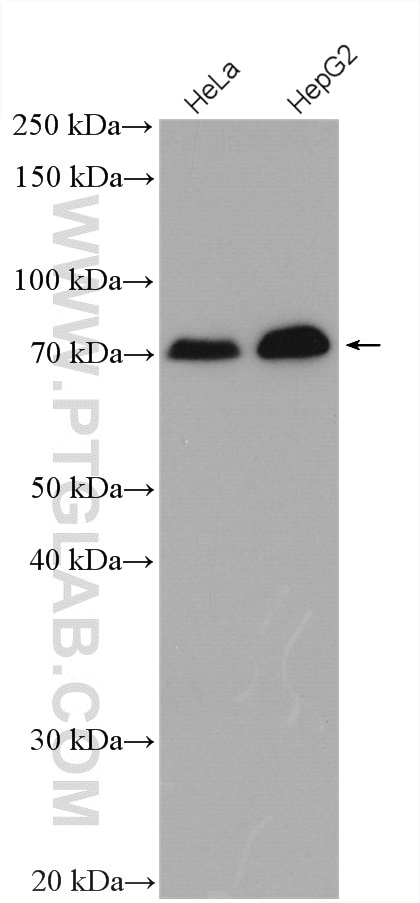
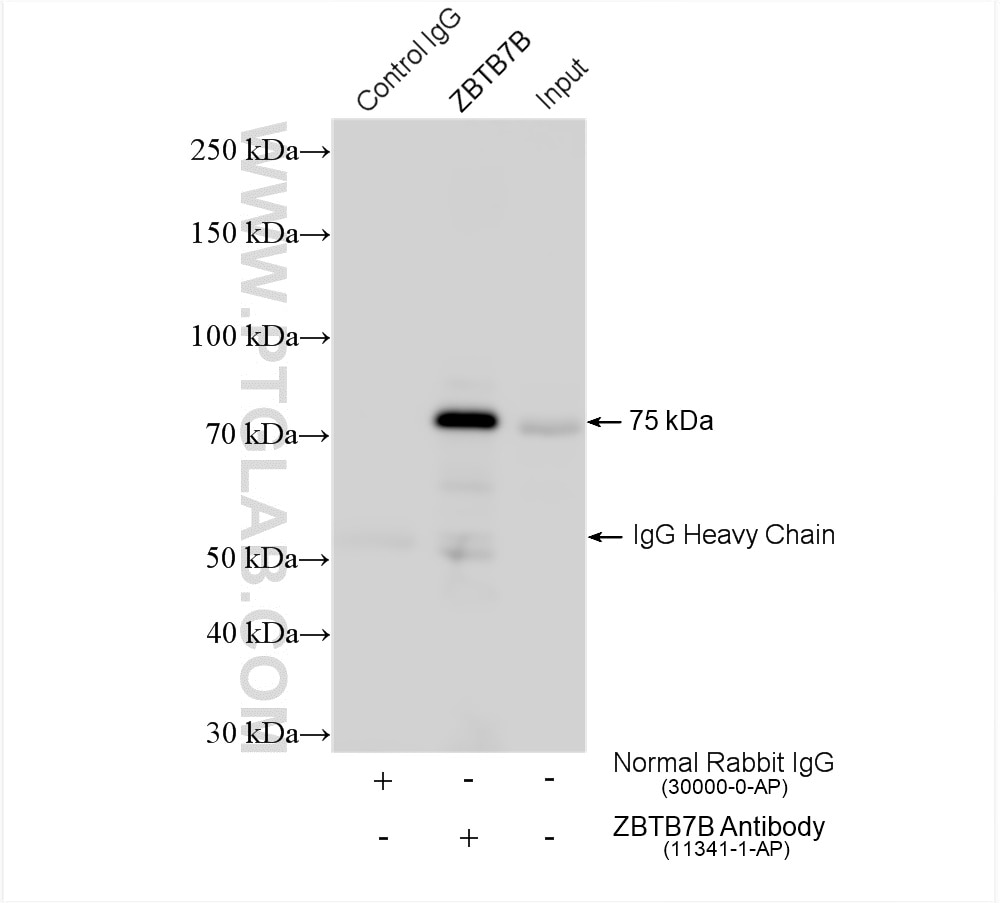
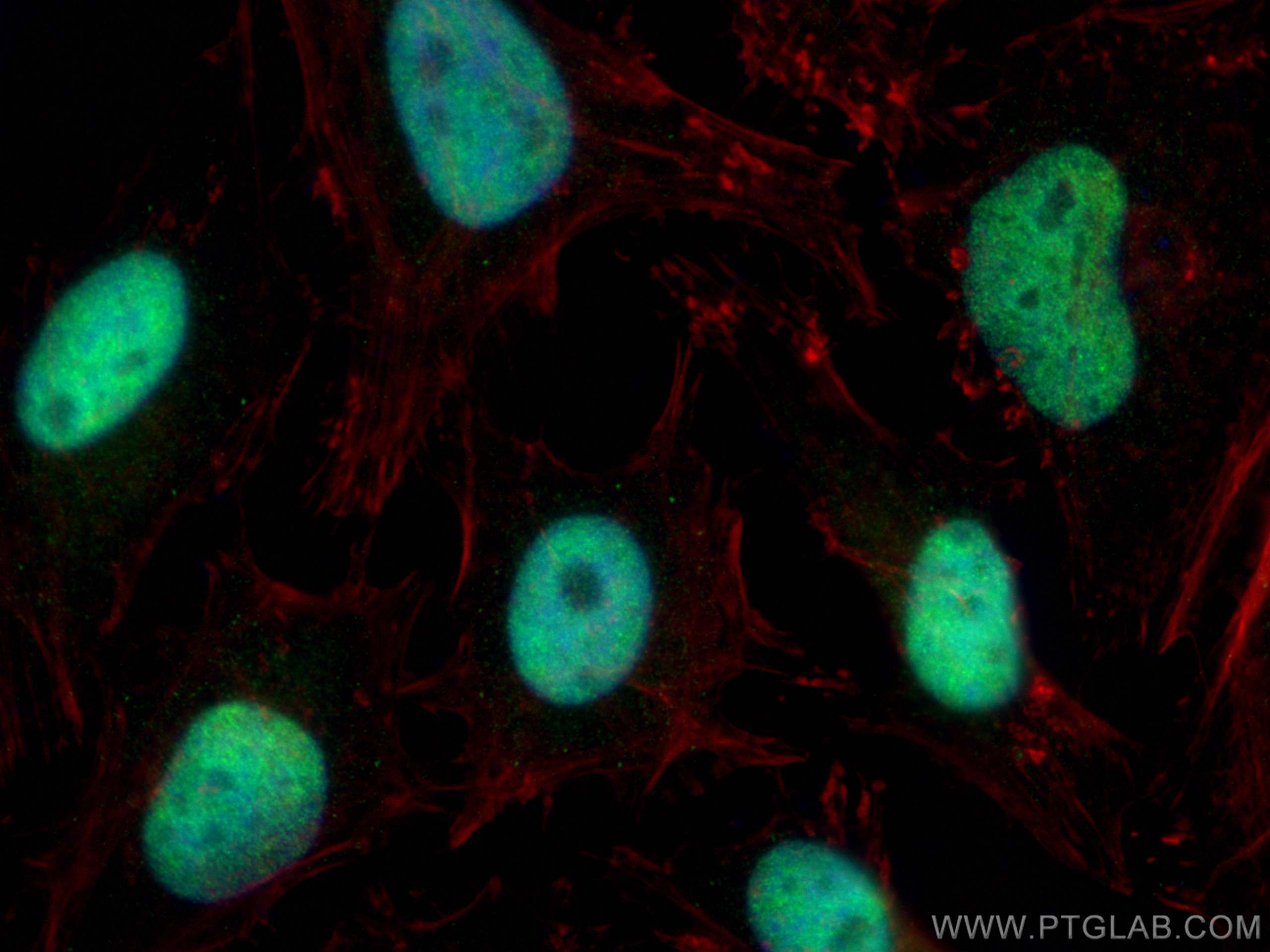
11341-1-PBS cible ZBTB7B dans les applications de WB, IF/ICC, IP, Indirect ELISA et montre une réactivité avec des échantillons Humain, rat, souris
| Réactivité | Humain, rat, souris |
| Hôte / Isotype | Lapin / IgG |
| Clonalité | Polyclonal |
| Type | Anticorps |
| Immunogène | ZBTB7B Protéine recombinante Ag1888 |
| Nom complet | zinc finger and BTB domain containing 7B |
| Masse moléculaire calculée | 539 aa, 58 kDa |
| Poids moléculaire observé | 60-65 kDa |
| Numéro d’acquisition GenBank | BC012070 |
| Symbole du gène | ZBTB7B |
| Identification du gène (NCBI) | 51043 |
| Conjugaison | Non conjugué |
| Forme | Liquide |
| Méthode de purification | Purification par affinité contre l'antigène |
| Tampon de stockage | PBS only |
| Conditions de stockage | Store at -80°C. 20ul contiennent 0,1% de BSA. |
Informations générales
ZBTB7B belongs to a large family of transcription factors, generally acting as repressors, characterized by a carboxy-terminal DNA binding domain made of multiple zinc fingers (four in Thpok) and an amino-terminal BTB-POZ domain that mediates homo- (and possibly hetero-) dimerization [PMID: 17084908]. Zbtb7b is up-regulated by MHC-II-restricted thymocytes during their CD4 differentiation and is a major determinant of CD4 lineage choice. Two properties of ZBTB7B deserve attention. First, although Thpok is expressed in a wide variety of cells, its expression in the thymus is highly lineage-specific : CD4 SP thymocytes (and all CD4 T cells) express Thpok, whereas DP and CD8 SP thymocytes do notSecond, both loss- and gain-of-function experiments indicate that Thpok affects lineage choice but not positive selection [PMID: 15729333, 10550051].


