Anticorps Polyclonal de lapin anti-ZNF706
ZNF706 Polyclonal Antibody for WB, Indirect ELISA
Hôte / Isotype
Lapin / IgG
Réactivité testée
Humain
Applications
WB, Indirect ELISA
Conjugaison
Non conjugué
N° de cat : 32274-1-PBS
Synonymes
Galerie de données de validation
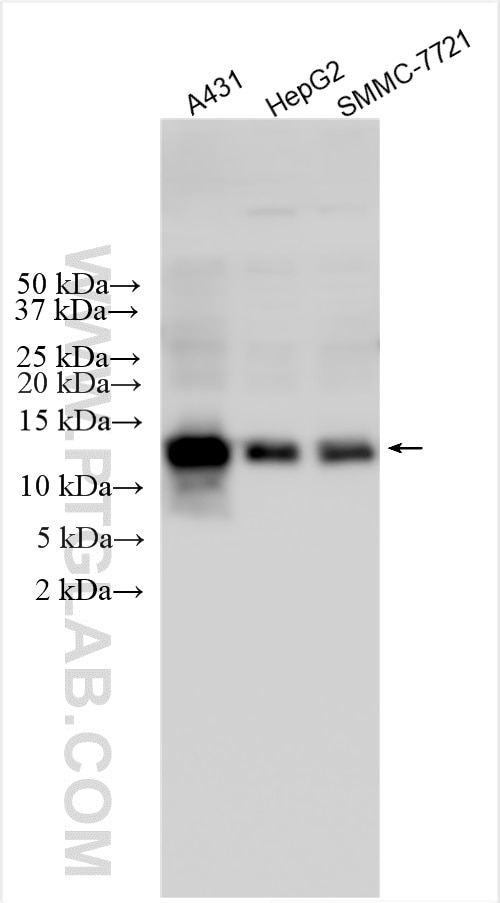
Informations sur le produit
32274-1-PBS cible ZNF706 dans les applications de WB, Indirect ELISA et montre une réactivité avec des échantillons Humain
| Réactivité | Humain |
| Hôte / Isotype | Lapin / IgG |
| Clonalité | Polyclonal |
| Type | Anticorps |
| Immunogène | ZNF706 Protéine recombinante Ag37605 |
| Nom complet | zinc finger protein 706 |
| Masse moléculaire calculée | 76 aa, 8 kDa |
| Poids moléculaire observé | 12 kDa |
| Numéro d’acquisition GenBank | BC015925 |
| Symbole du gène | ZNF706 |
| Identification du gène (NCBI) | 51123 |
| Conjugaison | Non conjugué |
| Forme | Liquide |
| Méthode de purification | Purification par affinité contre l'antigène |
| Tampon de stockage | PBS only |
| Conditions de stockage | Store at -80°C. 20ul contiennent 0,1% de BSA. |
Informations générales
Zinc Finger domains account for 5% of all human proteins and interact with various substrates, such as lipids, DNA, RNA, and post-translational modifications. In addition, zinc finger proteins (ZNFs) are involved in transcriptional regulation, signal transduction, and other cellular processes. Zinc finger protein 706 (ZNF706), encoded by a gene located at chromosome 8q22.3, is a member of the C2H2-type zinc finger transcription factor family, the most abundant transcription factor family encoded by the human genome. And according to the structural analysis of ZNF706, it was definitely predicted to physically bind to DNA through the C-terminal zinc finger domain. In previous studies, it was reported that the expression of ZNF706 is upregulated in gastric cancer and laryngeal cancer. And ZNF706 may be a biomarker for the early diagnosis of rheumatoid arthritis. ZNF706 is a potential oncogene in liver cancer and functions as a ferroptosis regulator by modulating SLC7A11 expression, constituting a potential therapeutic target for HCC (PMID: 38862581).


