
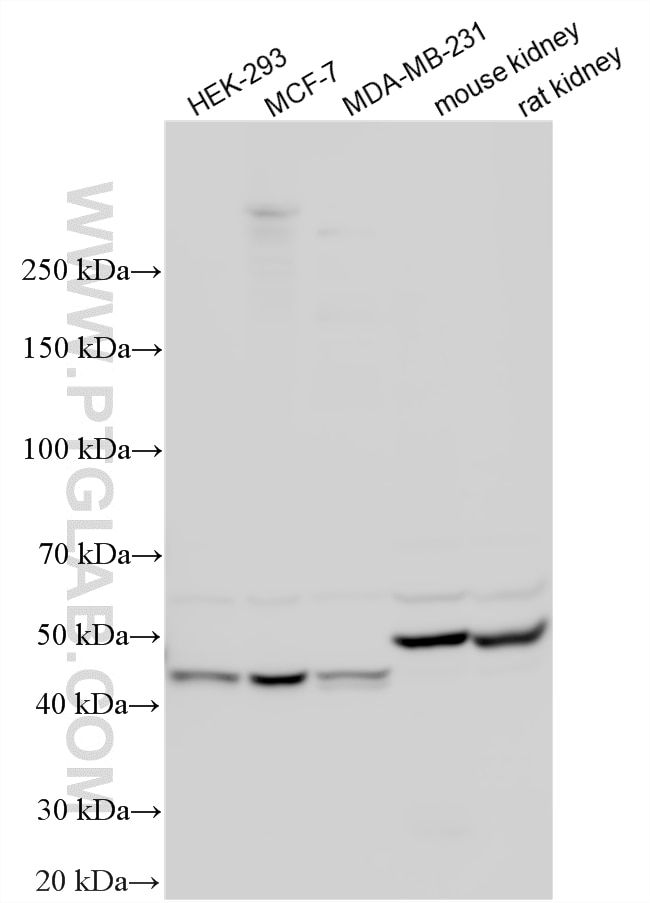
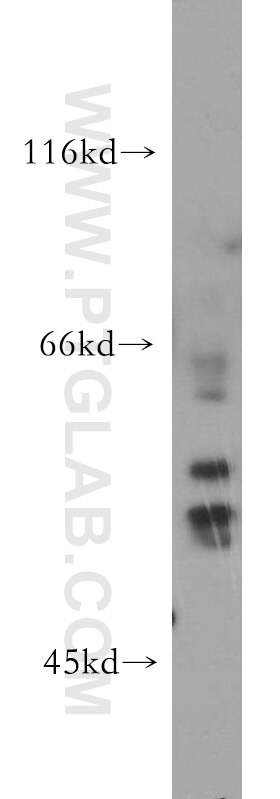
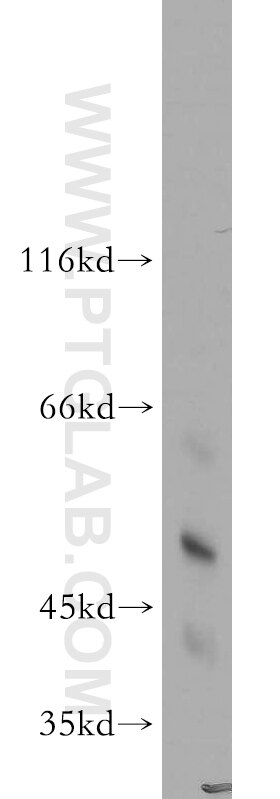
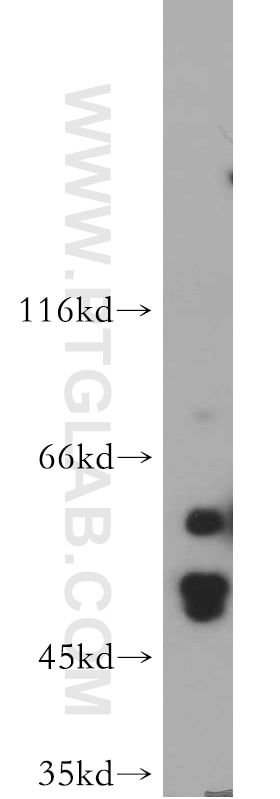
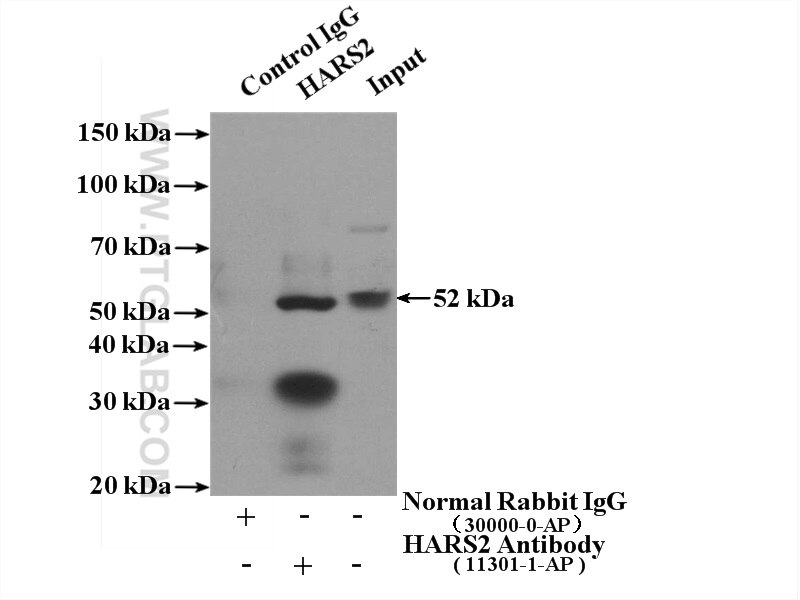

Tested Applications
| Positive WB detected in | HEK-293 cells, human heart tissue, MCF-7 cells, mouse kidney tissue, MDA-MB-231 cells, rat kidney tissue |
| Positive IP detected in | HEK-293 cells |
Recommended dilution
| Application | Dilution |
|---|---|
| Western Blot (WB) | WB : 1:1000-1:4000 |
| Immunoprecipitation (IP) | IP : 0.5-4.0 ug for 1.0-3.0 mg of total protein lysate |
| It is recommended that this reagent should be titrated in each testing system to obtain optimal results. | |
| Sample-dependent, Check data in validation data gallery. | |
Product Information
11301-1-AP targets HARS2 in WB, IP, ELISA applications and shows reactivity with human, mouse, rat samples.
| Tested Reactivity | human, mouse, rat |
| Cited Reactivity | human, mouse |
| Host / Isotype | Rabbit / IgG |
| Class | Polyclonal |
| Type | Antibody |
| Immunogen |
CatNo: Ag1827 Product name: Recombinant human HARS2 protein Source: e coli.-derived, PGEX-4T Tag: GST Domain: 157-506 aa of BC014982 Sequence: WRRESPTIVQGRYREFCQCDFDIAGQFDPMIPDAECLKIMCEILSGLQLGDFLIKVNDRRIVDGMFAVCGVPESKFRAICSSIDKLDKMAWKDVRHEMVVKKGLAPEVADRIGDYVQCHGGVSLVEQMFQDPRLSQNKQALEGLGDLKLLFEYLTLFGIADKISFDLSLARGLDYYTGVIYEAVLLQTPTQAGEEPLNVGSVAAGGRYDGLVGMFDPKGHKVPCVGLSIGVERIFYIVEQRMKTKGEKVRTTETQVFVATPQKNFLQERLKLIAELWDSGIKAEMLYKNNPKLLTQLHYCESTGIPLVVIIGEQELKEGVIKIRSVASREEVAIKRENFVAEIQKRLSES Predict reactive species |
| Full Name | histidyl-tRNA synthetase 2, mitochondrial (putative) |
| Calculated Molecular Weight | 57 kDa |
| Observed Molecular Weight | 50-55 kDa |
| GenBank Accession Number | BC014982 |
| Gene Symbol | HARS2 |
| Gene ID (NCBI) | 23438 |
| RRID | AB_10640530 |
| Conjugate | Unconjugated |
| Form | Liquid |
| Purification Method | Antigen affinity purification |
| UNIPROT ID | P49590 |
| Storage Buffer | PBS with 0.02% sodium azide and 50% glycerol, pH 7.3. |
| Storage Conditions | Store at -20°C. Stable for one year after shipment. Aliquoting is unnecessary for -20oC storage. 20ul sizes contain 0.1% BSA. |
Background Information
HARS2, also named as HARSL, HARSR, HO3 and HisRS, belongs to the class-II aminoacyl-tRNA synthetase family. It is an enzyme that catalyzes the esterification of histidine to its cognate tRNA as an early step in protein biosynthesis. When overexpressed in HIV-1-producing cells, HARS2 was incorporated into wild-type virions but not in ones containing the dilysine-mutated variant of matrix(MA) protein . HO3, through its recognition of MA, plays a role in the life cycle of HIV-1. (PMID: 9445076 ,7755634 ). 1-33aa of HARS2 is transit peptide and this part will be cut in some form(~52kd) of HARS2. This antibody can bind both HARSs for the close sequences.
Protocols
| Product Specific Protocols | |
|---|---|
| IP protocol for HARS2 antibody 11301-1-AP | Download protocol |
| WB protocol for HARS2 antibody 11301-1-AP | Download protocol |
| Standard Protocols | |
|---|---|
| Click here to view our Standard Protocols |
Publications
What published studies show
The HARS2 Polyclonal antibody (Cat# 11301-1-AP) has 4 citations published in Molecular Cell, Cells, Frontiers in Cellular Neuroscience, and Journal of Biological Chemistry. The associated research fields include mitochondrial protein import (TIM22 complex), testicular mitochondrial dysfunction with Perrault protein accumulation, progressive hearing loss linked to cochlear hair cell mitochondrial dysfunction, and mitochondrial histidyl-tRNA synthetase overexpression in deafness-associated tRNA mutations. Applications cited include Western blot in mouse and human samples.
| Species | Application | Title |
|---|---|---|
Mol Cell Sengers Syndrome-Associated Mitochondrial Acylglycerol Kinase Is a Subunit of the Human TIM22 Protein Import Complex. | ||
Cells CLPP Depletion Causes Diplotene Arrest; Underlying Testis Mitochondrial Dysfunction Occurs with Accumulation of Perrault Proteins ERAL1, PEO1, and HARS2 | ||
Front Cell Neurosci Disruption of Hars2 in Cochlear Hair Cells Causes Progressive Mitochondrial Dysfunction and Hearing Loss in Mice.
| ||
J Biol Chem Overexpression of mitochondrial histidyl-tRNA synthetase restores mitochondrial dysfunction caused by a deafness-associated tRNAHis mutation. |






