

Tested Applications
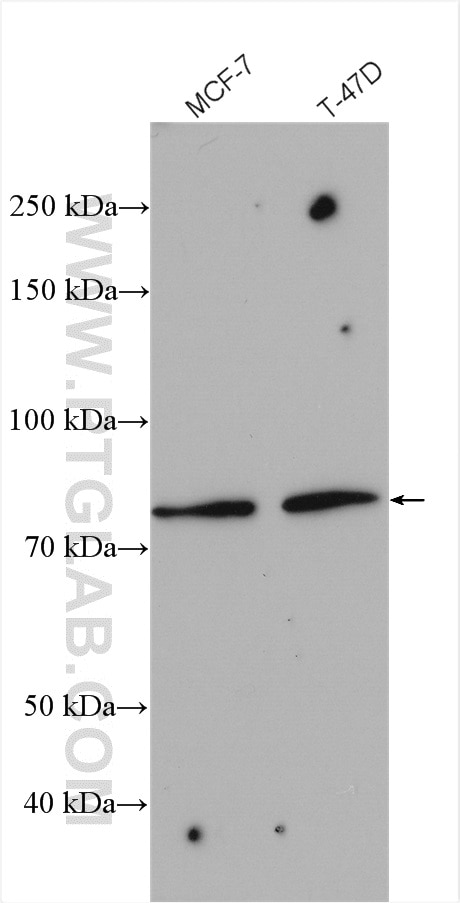
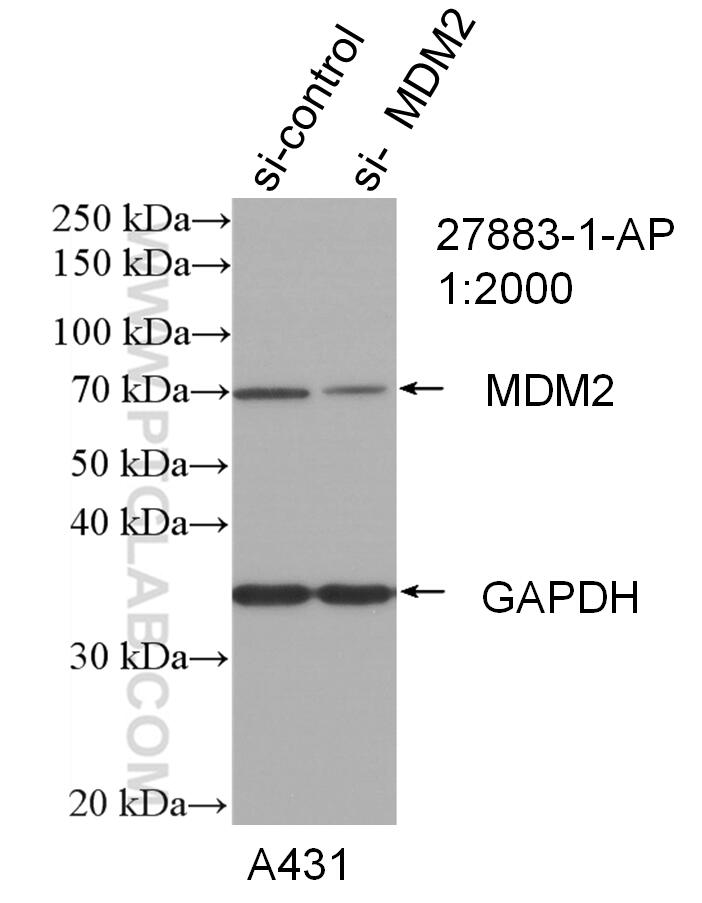
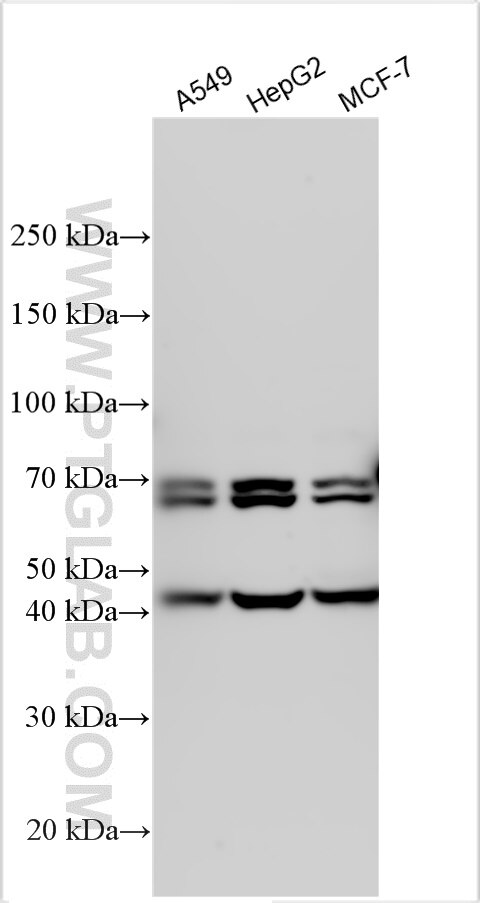
| Positive WB detected in | MCF-7 cells, A431 cells, A549 cells, HepG2 cells, T-47D cells |
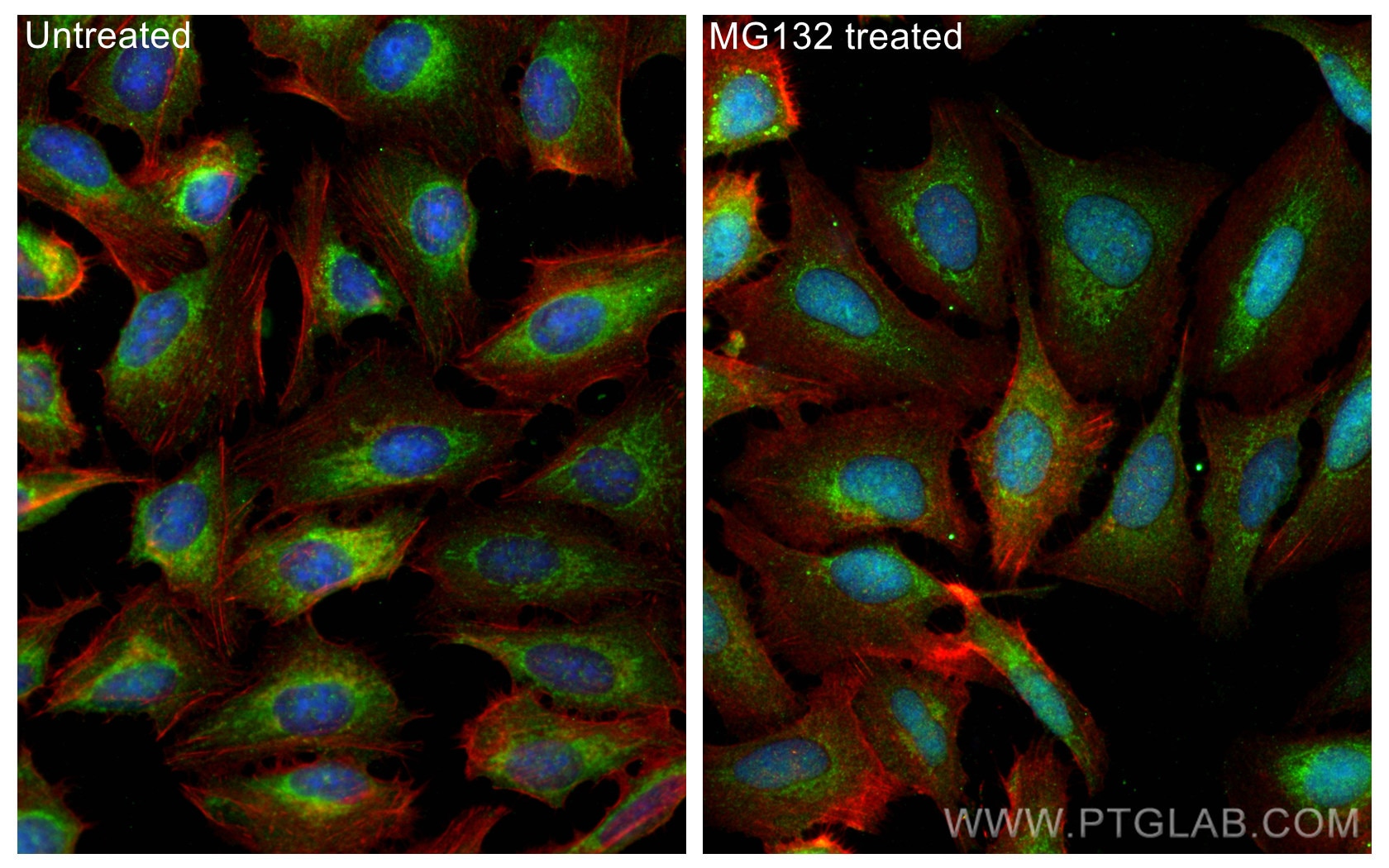
| Positive IF/ICC detected in | MG132 treated U2OS cells |
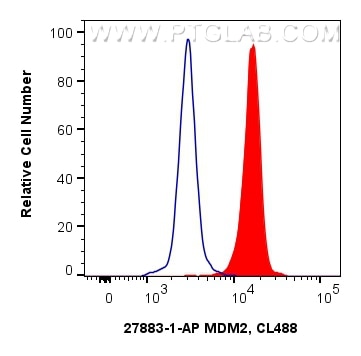
| Positive FC (Intra) detected in | HeLa cells |
Recommended dilution
| Application | Dilution |
|---|---|
| Western Blot (WB) | WB : 1:500-1:3000 |
| Immunofluorescence (IF)/ICC | IF/ICC : 1:200-1:800 |
| Flow Cytometry (FC) (INTRA) | FC (INTRA) : 0.40 ug per 10^6 cells in a 100 µl suspension |
| It is recommended that this reagent should be titrated in each testing system to obtain optimal results. | |
| Sample-dependent, Check data in validation data gallery. | |
Product Information
27883-1-AP targets MDM2/HDM2 in WB, IHC, IF/ICC, FC (Intra), IP, CoIP, ELISA applications and shows reactivity with human samples.
| Tested Reactivity | human |
| Cited Reactivity | human, mouse, rat |
| Host / Isotype | Rabbit / IgG |
| Class | Polyclonal |
| Type | Antibody |
| Immunogen |
CatNo: Ag27255 Product name: Recombinant human MDM2 protein Source: e coli.-derived, PGEX-4T Tag: GST Domain: 110-298 aa of NM_001145337.2 Sequence: MVNQQESSDSGTSVSENRCHLEGGSDQKDLVQELQEEKPSSSHLVSRPSTSSRRRAISETEENSDELSGERQRKRHKSDSISLSFDESLALCVIREICCERSSSSESTGTPSNPDLDAGVSEHSGDWLDQDSVSDQFSVEFEVESLDSEDYSLSEEGQELSDEDDEVYQVTVYQAGESDTDSFEEDPEIS Predict reactive species |
| Full Name | Mdm2 p53 binding protein homolog (mouse) |
| Calculated Molecular Weight | 55 kDa |
| Observed Molecular Weight | 75-85 kDa, 57-60 kDa, 40-55 kDa |
| GenBank Accession Number | NM_001145337.2 |
| Gene Symbol | MDM2 |
| Gene ID (NCBI) | 4193 |
| RRID | AB_2881003 |
| Conjugate | Unconjugated |
| Form | Liquid |
| Purification Method | Antigen affinity purification |
| UNIPROT ID | Q00987 |
| Storage Buffer | PBS with 0.02% sodium azide and 50% glycerol, pH 7.3. |
| Storage Conditions | Store at -20°C. Stable for one year after shipment. Aliquoting is unnecessary for -20oC storage. 20ul sizes contain 0.1% BSA. |
Background Information
What is the cellular localization of MDM2?
MDM2 is predominantly localized in the nucleoplasm.
What is the tissue specificity of MDM2?
MDM2 is non-specific, expressing ubiquitously in the brain, heart, kidney, skin, and other tissues. Certain
isoforms only express in cancerous cells and not normal tissue.
With what other molecules does MDM2 interact?
Most notably, the oncogene protein MDM2 regulates transcription factor p53 by binding its transcriptional
activation domain and by E3-ubiquitin ligase activity. Ribosome proteins rpL5, rpL11, and rpL23 also bind to
MDM2, inhibiting E3 ubiquitin ligase activity and promoting the p53 pathway.
What competes with MDM2 activity?
Nutilin-3 was designed to compete with MDM2 in binding with p53, inducing activation of the p53 pathway.
What is the role of ubiquitination in MDM2 activity?
While p53 is also affected by other post-translational modifications, its stability is determined by ubiquitination
mediation of MDM2, suppressing p53 transcriptional regulation and leading to the proteosomal degradation of
p53.
How is MDM2 associated with cancer?
MDM2 inhibits the activity of the tumor-suppressive protein p53, which serves as an important factor in
promoting DNA repair or activating apoptotic pathways. Loss of p53 is associated with tumor development
and growth.
What is the human ortholog of MDM2?
Human double-minute type 2 (HDM2)
In what cellular circumstances does the p53-MDM2 complex dissociate?
Cellular stress or DNA damage result in the phosphorylation and activation of p53. Phosphorylation also
prevents p53-MDM2 interaction.
Where is the gene located?
Hdm2 is located on human 12q15.
Mdm2 is located on murine 10 D2.
PMIDs: 24309898, 29584707, 9840926, 28714398
Protocols
| Product Specific Protocols | |
|---|---|
| IF protocol for MDM2/HDM2 antibody 27883-1-AP | Download protocol |
| WB protocol for MDM2/HDM2 antibody 27883-1-AP | Download protocol |
| Standard Protocols | |
|---|---|
| Click here to view our Standard Protocols |
Publications
What published studies show
The MDM2/HDM2 Polyclonal antibody (Cat# 27883-1-AP) has 56 citations published in journals including J Hematol Oncol, ACS Nano, J Clin Invest, Oncogene, PNAS, Cell Death & Disease, Theranostics, EBioMedicine, Adv Sci, Br J Cancer, J Med Chem, FASEB J, and iScience. Associated research fields primarily include cancer biology (especially the MDM2-p53 pathway), PROTAC and molecular glue degrader development, medicinal chemistry, neurodegeneration, and inflammatory disease.
| Species | Application | Title |
|---|---|---|
J Hematol Oncol Novel potent molecular glue degraders against broad range of hematological cancer cell lines via multiple neosubstrates degradation | ||
J Extracell Vesicles Extracellular Vesicle-Mediated Nucleolin Transfer in Glioblastoma: A Targetable Axis Driving Blood-Tumour Barrier Formation. | ||
ACS Nano Echinacoside-Zinc Nanomaterial Inhibits Skin Glycation by Suppressing the Transcriptional Activation of the Receptor for Advanced Glycation End-Products | ||
Theranostics Development of dual aptamers-functionalized c-MET PROTAC degraders for targeted therapy of osteosarcoma
| ||
J Clin Invest ZFP36L2 suppresses mTORc1 through a P53-dependent pathway to prevent peri-partum cardiomyopathy in mice. | ||
Adv Sci (Weinh) RPL6 Interacts with HMGCS1 to Stabilize HIF-1α by Promoting Cholesterol Production in Hepatocellular Carcinoma |






