

Tested Applications
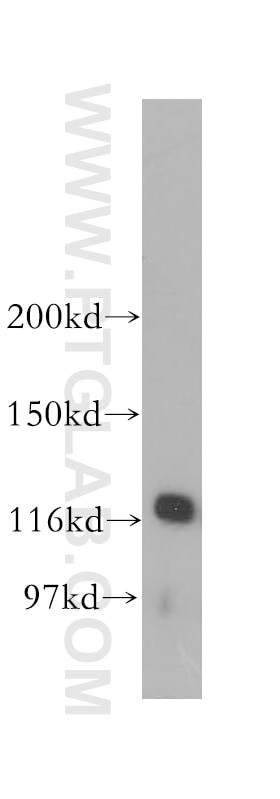
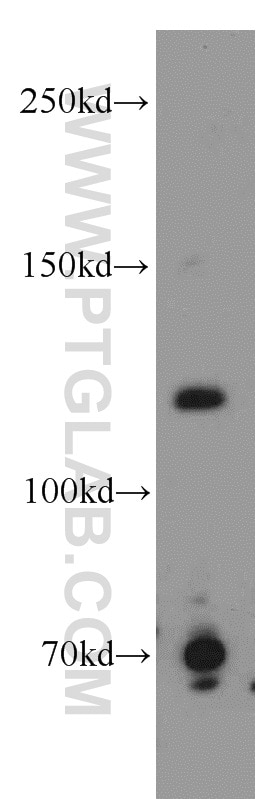
| Positive WB detected in | mouse testis tissue, COLO 320 cells |
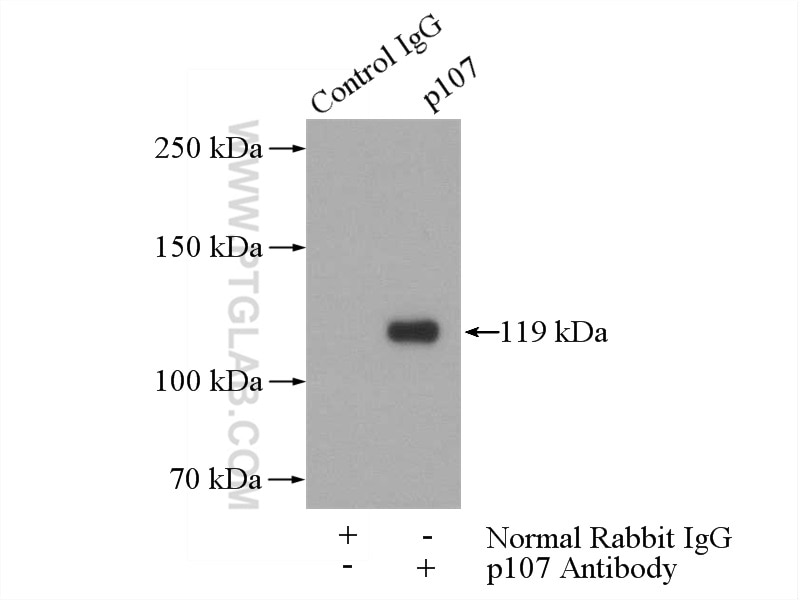
| Positive IP detected in | mouse testis tissue |
Recommended dilution
| Application | Dilution |
|---|---|
| Western Blot (WB) | WB : 1:500-1:2000 |
| Immunoprecipitation (IP) | IP : 0.5-4.0 ug for 1.0-3.0 mg of total protein lysate |
| It is recommended that this reagent should be titrated in each testing system to obtain optimal results. | |
| Sample-dependent, Check data in validation data gallery. | |
Product Information
13354-1-AP targets p107 in WB, IF, IP, ELISA applications and shows reactivity with human, mouse, rat samples.
| Tested Reactivity | human, mouse, rat |
| Cited Reactivity | human, mouse, non-human primate |
| Host / Isotype | Rabbit / IgG |
| Class | Polyclonal |
| Type | Antibody |
| Immunogen |
CatNo: Ag4146 Product name: Recombinant human RBL1 protein Source: e coli.-derived, PGEX-4T Tag: GST Domain: 1-351 aa of BC032247 Sequence: MFEDKPHAEGAAVVAAAGEALQALCQELNLDEGSAAEALDDFTAIRGNYSLEGEVTHWLACSLYVACRKSIIPTVGKGIMEGNCVSLTRILRSAKLSLIQFFSKMKKWMDMSNLPQEFRERIERLERNFEVSTVIFKKYEPIFLDIFQNPYEEPPKLPRSRKQRRIPCSVKDLFNFCWTLFVYTKGNFRMIGDDLVNSYHLLLCCLDLIFANAIMCPNRQDLLNPSFKGLPSDFHTADFTASEEPPCIIAVLCELHDGLLVEAKGIKEHYFKPYISKLFDRKILKGECLLDLSSFTDNSKAVNKEYEEYVLTVGDFDERIFLGADAEEEIGTPRKFTRDTPLGKLTAQANV Predict reactive species |
| Full Name | retinoblastoma-like 1 (p107) |
| Calculated Molecular Weight | 1068 aa, 119 kDa |
| Observed Molecular Weight | 119 kDa |
| GenBank Accession Number | BC032247 |
| Gene Symbol | p107 |
| Gene ID (NCBI) | 5933 |
| RRID | AB_2238024 |
| Conjugate | Unconjugated |
| Form | Liquid |
| Purification Method | Antigen affinity purification |
| UNIPROT ID | P28749 |
| Storage Buffer | PBS with 0.02% sodium azide and 50% glycerol, pH 7.3. |
| Storage Conditions | Store at -20°C. Stable for one year after shipment. Aliquoting is unnecessary for -20oC storage. 20ul sizes contain 0.1% BSA. |
Background Information
Retinoblastoma-like protein 1, also named RBL1, p107, is a member of E1A-binding proteins, which contains a A/B pocket, or pRb. Via this structure, RBL1 can bind to viral oncoproteins and other perteins containing LXCXE motif. It regulates cell proliferation via phosphorylation-sensitive interactions with E2F transcription factors and other proteins. Key regulator of entry into cell division. Directly involved in heterochromatin formation by maintaining overall chromatin structure and, in particular, that of constitutive heterochromatin by stabilizing histone methylation. Recruits and targets histone methyltransferases SUV420H1 and SUV420H2, leading to epigenetic transcriptional repression.(uniprot). It has been reported there are two transcirpts variants of RBL1, which encode a 119-kd protein and a 68-kd protein(PMID:7490090).
Protocols
| Product Specific Protocols | |
|---|---|
| IP protocol for p107 antibody 13354-1-AP | Download protocol |
| WB protocol for p107 antibody 13354-1-AP | Download protocol |
| Standard Protocols | |
|---|---|
| Click here to view our Standard Protocols |
Publications
What published studies show
The RBL1/p107 antibody (Cat# 13354-1-AP) has 18 total citations. Publications appear in Nature Communications, EMBO Journal, Cell Reports, Oncotarget, Biochemical Pharmacology, Journal of Virology, Cancers, PLoS ONE, Frontiers in Cell and Developmental Biology, and others. Research fields include cell cycle regulation, cancer biology, viral infection, pharmacology, glycolytic metabolism, muscle stem cell biology, and ciliogenesis. Applications are predominantly Western blotting, with some immunoprecipitation and immunofluorescence.
| Species | Application | Title |
|---|---|---|
Nat Commun p107 mediated mitochondrial function controls muscle stem cell proliferative fates. | ||
Nat Commun An actin filament branching surveillance system regulates cell cycle progression, cytokinesis and primary ciliogenesis
| ||
Cell Rep Mammalian Pum1 and Pum2 Control Body Size via Translational Regulation of the Cell Cycle Inhibitor Cdkn1b. | ||
J Ethnopharmacol Elucidating the pharmacological effects of Compound Kushen injection on MYC-P15-CCND1 signaling pathway in nasopharyngeal carcinoma - An in vitro study |




