CTAGE5 Rekombinanter Antikörper
CTAGE5 Rekombinant Antikörper für FC (Intra), ELISA
Wirt / Isotyp
Kaninchen / IgG
Getestete Reaktivität
human
Anwendung
FC (Intra), ELISA
Konjugation
Unkonjugiert
CloneNo.
230262E6
Kat-Nr. : 83017-1-RR
Synonyme
Filter:
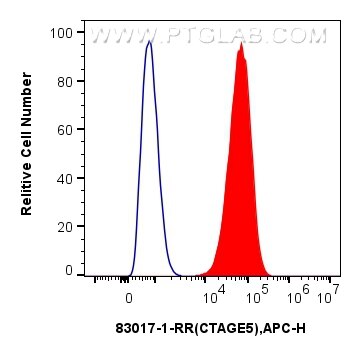
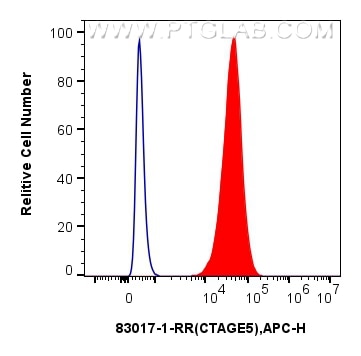
Geprüfte Anwendungen
| Erfolgreiche Detektion in FC (Intra) | HUVEC-Zellen, HepG2-Zellen |
Empfohlene Verdünnung
| Anwendung | Verdünnung |
|---|---|
| Durchflusszytometrie (FC) (INTRA) | FC (INTRA) : 0.25 ug per 10^6 cells in a 100 µl suspension |
| It is recommended that this reagent should be titrated in each testing system to obtain optimal results. | |
| Sample-dependent, check data in validation data gallery | |
Produktinformation
83017-1-RR bindet in FC (Intra), ELISA CTAGE5 und zeigt Reaktivität mit human
| Getestete Reaktivität | human |
| Wirt / Isotyp | Kaninchen / IgG |
| Klonalität | Rekombinant |
| Typ | Antikörper |
| Immunogen | Peptid |
| Vollständiger Name | CTAGE family, member 5 |
| Berechnetes Molekulargewicht | 92 kDa |
| GenBank-Zugangsnummer | NM_005930 |
| Gene symbol | CTAGE5 |
| Gene ID (NCBI) | 4253 |
| Konjugation | Unkonjugiert |
| Form | Liquid |
| Reinigungsmethode | Protein-A-Reinigung |
| Lagerungspuffer | PBS with 0.02% sodium azide and 50% glycerol |
| Lagerungsbedingungen | Bei -20°C lagern. Nach dem Versand ein Jahr lang stabil Aliquotieren ist bei -20oC Lagerung nicht notwendig. 20ul Größen enthalten 0,1% BSA. |
Hintergrundinformationen
Cutaneous T cell lymphoma-associated antigen 5 (CTAGE5) is a member of the cTAGE family. CTAGE5 is a tumor-associated antigen and is overexpressed in various cancer cell lines. CTAGE5 consists of a signal anchor motif, a single transmembrane domain, two coiled-coil motifs, and a proline-rich domain (PRD) from the N-terminus. CTAGE5 interacts with TANGO1 through its second coil region to form a cargo receptor complex (PMID: 21525241).
Protokolle
| PRODUKTSPEZIFISCHE PROTOKOLLE | |
|---|---|
| FC protocol for CTAGE5 antibody 83017-1-RR | Download protocol |
| STANDARD-PROTOKOLLE | |
|---|---|
| Klicken Sie hier, um unsere Standardprotokolle anzuzeigen |

