IL-29 Rekombinanter Antikörper
IL-29 Rekombinant Antikörper für FC (Intra)
Wirt / Isotyp
Kaninchen / IgG
Getestete Reaktivität
human
Anwendung
FC (Intra)
Konjugation
Unkonjugiert
CloneNo.
250226G7
Kat-Nr. : 98504-1-RR
Synonyme
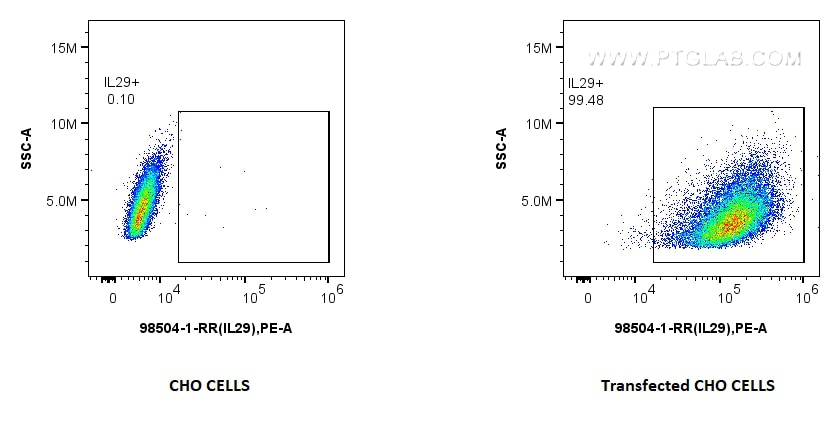
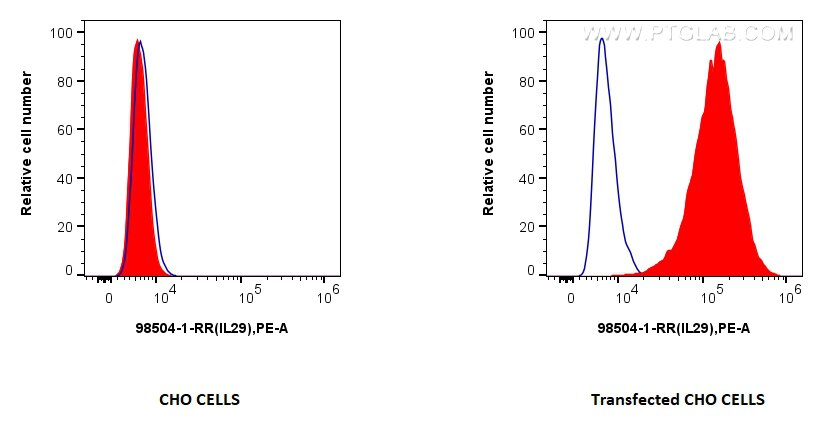
Geprüfte Anwendungen
| Erfolgreiche Detektion in FC (Intra) | Transfected CHO cells |
Empfohlene Verdünnung
| Anwendung | Verdünnung |
|---|---|
| This reagent has been tested for flow cytometric analysis. It is recommended that this reagent should be titrated in each testing system to obtain optimal results. | |
| Sample-dependent, check data in validation data gallery | |
Produktinformation
98504-1-RR bindet in FC (Intra) IL-29 und zeigt Reaktivität mit human
| Getestete Reaktivität | human |
| Wirt / Isotyp | Kaninchen / IgG |
| Klonalität | Rekombinant |
| Typ | Antikörper |
| Immunogen | IL-29 fusion protein Eg2843 |
| Vollständiger Name | interleukin 29 (interferon, lambda 1) |
| Berechnetes Molekulargewicht | 22 kDa |
| GenBank-Zugangsnummer | NM_172140.1 |
| Gene symbol | IL-29 |
| Gene ID (NCBI) | 282618 |
| Konjugation | Unkonjugiert |
| Form | Liquid |
| Reinigungsmethode | Protein-A-Reinigung |
| Lagerungspuffer | PBS with 0.09% sodium azide |
| Lagerungsbedingungen | Store at 2 - 8°C. Stable for one year after shipment. |
Hintergrundinformationen
Interleukin-29 (IL-29) is a cytokine belonging to the Type III interferon family, which has another two subfamilies IL-28A and IL-28B. They are also known as IFN-λ1, IFN-λ2 and IFN-λ3, respectively. IL-29 is produced predominantly by maturing dendritic cells and macrophages. IL-29 plays an important role in the immune response against pathogenes and especially against viruses by mechanisms similar to type I interferons. IL-29 receptor signals through JAK-STAT pathways leading to activated expression of interferon-stimulated genes and production of antiviral proteins.
Protokolle
| PRODUKTSPEZIFISCHE PROTOKOLLE | |
|---|---|
| FC protocol for IL-29 antibody 98504-1-RR | Download protocol |
| STANDARD-PROTOKOLLE | |
|---|---|
| Klicken Sie hier, um unsere Standardprotokolle anzuzeigen |

