
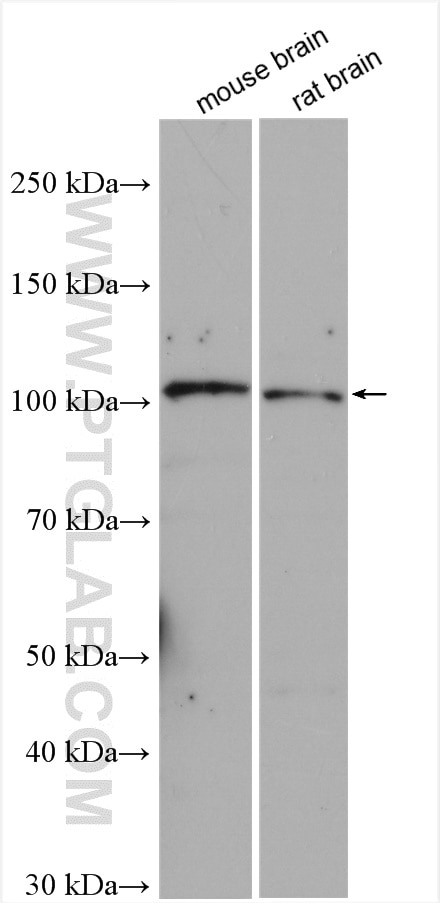
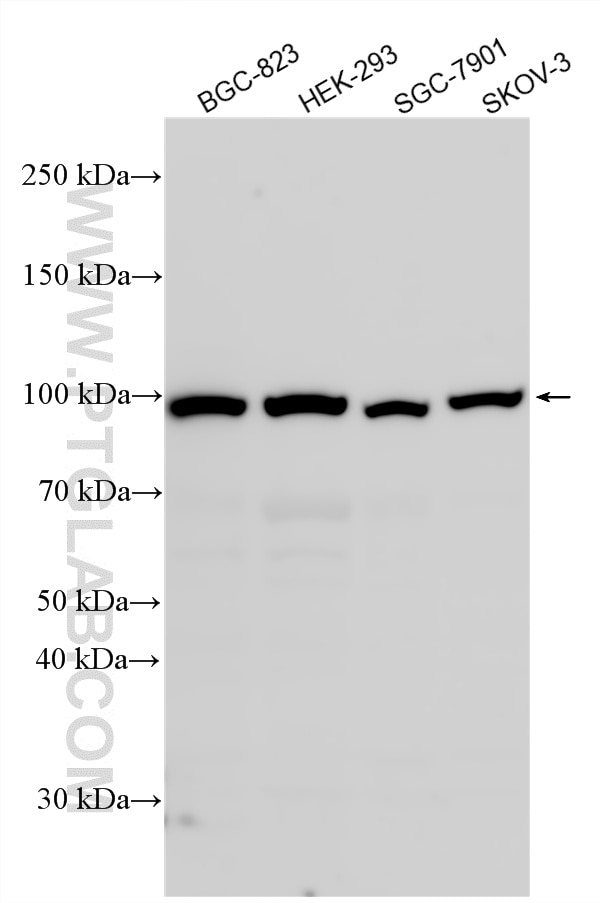

Tested Applications
| Positive WB detected in | BGC-823 cells, mouse brain tissue, HEK-293 cells, SGC-7901 cells, SKOV-3 cells, rat brain tissue |
Recommended dilution
| Application | Dilution |
|---|---|
| Western Blot (WB) | WB : 1:500-1:2000 |
| It is recommended that this reagent should be titrated in each testing system to obtain optimal results. | |
| Sample-dependent, Check data in validation data gallery. | |
Product Information
30007-1-AP targets LGR5 in WB, ELISA applications and shows reactivity with human, mouse, rat samples.
| Tested Reactivity | human, mouse, rat |
| Cited Reactivity | human, mouse, rat, chicken |
| Host / Isotype | Rabbit / IgG |
| Class | Polyclonal |
| Type | Antibody |
| Immunogen |
CatNo: Ag31625 Product name: Recombinant human LGR5 protein Source: e coli.-derived, PGEX-4T Tag: GST Domain: 824-907 aa of BC096324 Sequence: NPHFKEDLVSLRKQTYVWTRSKHPSLMSINSDDVEKQSCDSTQALVTFTSSSITYDLPPSSVPSPAYPVTESCHLSSVAFVPCL Predict reactive species |
| Full Name | leucine-rich repeat-containing G protein-coupled receptor 5 |
| Calculated Molecular Weight | 907 aa, 100 kDa |
| Observed Molecular Weight | 100 kDa |
| GenBank Accession Number | BC096324 |
| Gene Symbol | LGR5 |
| Gene ID (NCBI) | 8549 |
| RRID | AB_3086207 |
| Conjugate | Unconjugated |
| Form | Liquid |
| Purification Method | Antigen affinity purification |
| UNIPROT ID | O75473 |
| Storage Buffer | PBS with 0.02% sodium azide and 50% glycerol, pH 7.3. |
| Storage Conditions | Store at -20°C. Stable for one year after shipment. Aliquoting is unnecessary for -20oC storage. 20ul sizes contain 0.1% BSA. |
Background Information
Leucine-rich repeat-containing G-protein coupled receptor 5 (LGR5) also known as G-protein coupled receptor 49 (GPR49) or G-protein coupled receptor 67 (GPR67) is a protein that in humans is encoded by the LGR5 gene. It is a member of GPCR class A receptor proteins. R-spondin proteins are the biological ligands of LGR5. LGR5 is expressed across a diverse range of tissue such as in the muscle, placenta, spinal cord and brain and particularly as a biomarker of adult stem cells in certain tissues.LGR5 is crucial during embryogenesis as LGR null studies in mice incurred 100% neonatal mortality accompanied by several craniofacial distortions such as ankyloglossia and gastrointestinal dilation (PMID: 9642114, 16575208, 525477).
Protocols
| Product Specific Protocols | |
|---|---|
| WB protocol for LGR5 antibody 30007-1-AP | Download protocol |
| Standard Protocols | |
|---|---|
| Click here to view our Standard Protocols |
Publications
What published studies show
The LGR5 Polyclonal antibody (Cat# 30007-1-AP) has 26 citations across 24 journals, including Nature Communications, Microbiome, Biomaterials, Pharmacological Research, Cancer Letters, Genome Medicine, and iScience. Research fields span intestinal stem cell biology, colorectal and prostate cancer, inflammatory bowel disease/colitis, wound healing, hair follicle regeneration, immune regulation, tissue engineering, and microbiome-metabolite interactions.
| Species | Application | Title |
|---|---|---|
Nat Commun Small nucleolar RNA Snora61 drives self-renewal of intestinal stem cells via initiation of Lgr5 transcription.
| ||
Microbiome Improving fecal transplantation precision for enhanced maturation of intestinal function in germ-free mice through microencapsulation and probiotic intervention. | ||
Biomaterials Axolotl skin mechanics-biomimetic hydrogel promotes scarless wound healing associated with macrophage polarisation via Piezo1/YAP signalling. | ||
Pharmacol Res Targeted MSC therapy restores implantation by spatially reconstituting the RSPO1 niche via IL10-CXCL12 signaling. | ||
Cancer Lett Cancer Associated Fibroblasts-derived Lactate Induces Oxaliplatin Treatment Resistance by Promoting Cancer Stemness via ANTXR1 Lactylation in Colorectal Cancer |



