- Featured Product
- KD/KO Validated
PSMD9 Polyklonaler Antikörper
PSMD9 Polyklonal Antikörper für FC (Intra)
Wirt / Isotyp
Kaninchen / IgG
Getestete Reaktivität
human, Maus
Anwendung
FC (Intra)
Konjugation
CoraLite® Plus 488 Fluorescent Dye
Kat-Nr. : CL488-26922
Synonyme
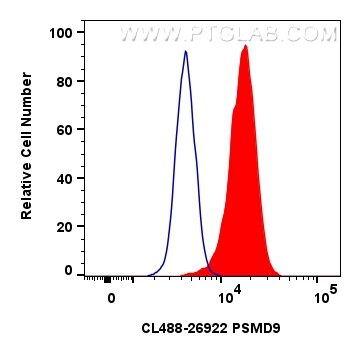
Geprüfte Anwendungen
| Erfolgreiche Detektion in FC (Intra) | HeLa-Zellen |
Empfohlene Verdünnung
| Anwendung | Verdünnung |
|---|---|
| Durchflusszytometrie (FC) (INTRA) | FC (INTRA) : 0.80 ug per 10^6 cells in a 100 µl suspension |
| It is recommended that this reagent should be titrated in each testing system to obtain optimal results. | |
| Sample-dependent, check data in validation data gallery | |
Produktinformation
CL488-26922 bindet in FC (Intra) PSMD9 und zeigt Reaktivität mit human, Maus
| Getestete Reaktivität | human, Maus |
| Wirt / Isotyp | Kaninchen / IgG |
| Klonalität | Polyklonal |
| Typ | Antikörper |
| Immunogen | PSMD9 fusion protein Ag25638 |
| Vollständiger Name | proteasome (prosome, macropain) 26S subunit, non-ATPase, 9 |
| Berechnetes Molekulargewicht | 27 kDa |
| Beobachtetes Molekulargewicht | 30 kDa |
| GenBank-Zugangsnummer | BC004213 |
| Gene symbol | PSMD9 |
| Gene ID (NCBI) | 5715 |
| Konjugation | CoraLite® Plus 488 Fluorescent Dye |
| Excitation/Emission maxima wavelengths | 493 nm / 522 nm |
| Form | Liquid |
| Reinigungsmethode | Antigen-Affinitätsreinigung |
| Lagerungspuffer | PBS with 50% glycerol, 0.05% Proclin300, 0.5% BSA |
| Lagerungsbedingungen | Bei -20°C lagern. Vor Licht schützen. Nach dem Versand ein Jahr stabil. Aliquotieren ist bei -20oC Lagerung nicht notwendig. 20ul Größen enthalten 0,1% BSA. |
Hintergrundinformationen
PSMD9 is a ubiquitous protein of eukaryotic cells and is a chaperon of the 26S proteasome complex, which degrades ubiquitinated proteins in eukaryotic cells and contributes to the degradation of intracellular proteins into antigenic peptides for antigen presentation by MHC class I cells. The 26S mammalian base sub-complex involves three distinct modules which have ATPase subunits distinctly associated to three chaperones, one of which is PSMD9 regulating the modules assembly. The PSMD9 ubiquitous regulatory role within the proteasome implies its potential pleiotropic effects within different physio-pathological systems. PSMD9 is known to form a stable subcomplex with PSMC3 and PSMC6, two of the AAA-ATPases, assisting in the assembly of the 20S and 19S particles to form the holo complex.
Protokolle
| PRODUKTSPEZIFISCHE PROTOKOLLE | |
|---|---|
| FC protocol for CL Plus 488 PSMD9 antibody CL488-26922 | Download protocol |
| STANDARD-PROTOKOLLE | |
|---|---|
| Klicken Sie hier, um unsere Standardprotokolle anzuzeigen |

