Anticorps Polyclonal de lapin anti-ADRB1
ADRB1 Polyclonal Antibody for WB, IHC, ELISA
Hôte / Isotype
Lapin / IgG
Réactivité testée
Humain, rat, souris
Applications
WB, IHC, ELISA
Conjugaison
Non conjugué
N° de cat : 28323-1-AP
Synonymes
Galerie de données de validation
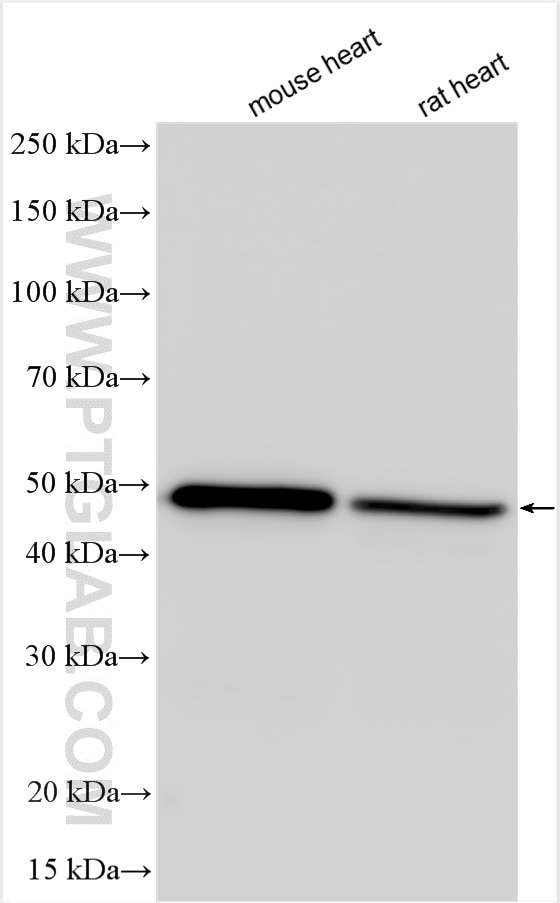
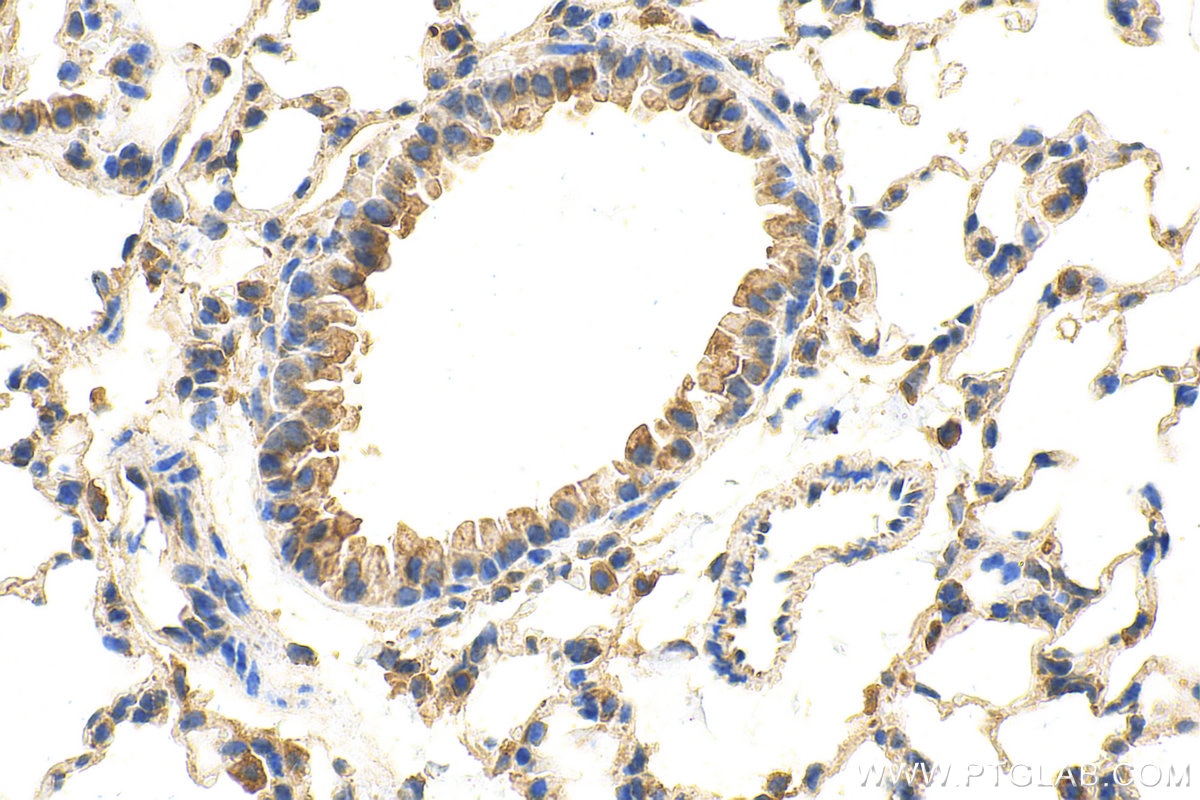
Applications testées
| Résultats positifs en WB | tissu cardiaque de souris, tissu cardiaque de rat |
| Résultats positifs en IHC | tissu pulmonaire de souris, il est suggéré de démasquer l'antigène avec un tampon de TE buffer pH 9.0; (*) À défaut, 'le démasquage de l'antigène peut être 'effectué avec un tampon citrate pH 6,0. |
Dilution recommandée
| Application | Dilution |
|---|---|
| Western Blot (WB) | WB : 1:1000-1:4000 |
| Immunohistochimie (IHC) | IHC : 1:50-1:500 |
| It is recommended that this reagent should be titrated in each testing system to obtain optimal results. | |
| Sample-dependent, check data in validation data gallery | |
Applications publiées
| WB | See 4 publications below |
| IHC | See 1 publications below |
Informations sur le produit
28323-1-AP cible ADRB1 dans les applications de WB, IHC, ELISA et montre une réactivité avec des échantillons Humain, rat, souris
| Réactivité | Humain, rat, souris |
| Réactivité citée | rat, Humain, souris |
| Hôte / Isotype | Lapin / IgG |
| Clonalité | Polyclonal |
| Type | Anticorps |
| Immunogène | ADRB1 Protéine recombinante Ag28223 |
| Nom complet | adrenergic, beta-1-, receptor |
| Masse moléculaire calculée | 51 kDa |
| Poids moléculaire observé | 49 kDa |
| Numéro d’acquisition GenBank | NM_000684 |
| Symbole du gène | ADRB1 |
| Identification du gène (NCBI) | 153 |
| Conjugaison | Non conjugué |
| Forme | Liquide |
| Méthode de purification | Purification par affinité contre l'antigène |
| Tampon de stockage | PBS with 0.02% sodium azide and 50% glycerol |
| Conditions de stockage | Stocker à -20°C. Stable pendant un an après l'expédition. L'aliquotage n'est pas nécessaire pour le stockage à -20oC Les 20ul contiennent 0,1% de BSA. |
Informations générales
ADRB1 (adrenergic receptor beta 1), a member of the G protein-coupled receptor (GPCR) superfamily, responds to catecholamine stimulation. ADRB1 is the predominant subtype expressed in the heart and mediates increases in inotropy and chronotropy when stimulated. ADRB1 mediates a wide range of cardiovascular physiological responses and has been of great interest to researchers as a therapeutic target for cardiovascular diseases. Moreover, three subtypes of ADRBs (ADRB1, ADRB2, and ADRB3) are encoded by three separate genes (PMID:16636683; 33372534; 33593484).
Protocole
| Product Specific Protocols | |
|---|---|
| WB protocol for ADRB1 antibody 28323-1-AP | Download protocol |
| IHC protocol for ADRB1 antibody 28323-1-AP | Download protocol |
| Standard Protocols | |
|---|---|
| Click here to view our Standard Protocols |
Publications
| Species | Application | Title |
|---|---|---|
iScience Region-specific sympatho-adrenergic regulation of specialized vasculature in bone homeostasis and regeneration | ||
Oncol Lett β‑adrenergic receptor activation promotes the proliferation of HepG2 cells via the ERK1/2/CREB pathways | ||
Brain Res The α1 adrenoceptor antagonist prazosin potentiates morphine induced conditioned place preference in rats | ||
Adv Sci (Weinh) Chronic Stress-Induced and Tumor Derived SP1+ Exosomes Polarizing IL-1β+ Neutrophils to Increase Lung Metastasis of Breast Cancer | ||
Adv Sci (Weinh) Targeting the E Prostanoid Receptor EP4 Mitigates Cardiac Fibrosis Induced by β-Adrenergic Activation |

