- Phare
- Validé par KD/KO
Anticorps Polyclonal de lapin anti-AFF4
AFF4 Polyclonal Antibody for WB, IP, ELISA
Hôte / Isotype
Lapin / IgG
Réactivité testée
Humain, rat, souris
Applications
WB, IHC, IP, CoIP, ELISA
Conjugaison
Non conjugué
N° de cat : 14662-1-AP
Synonymes
Galerie de données de validation
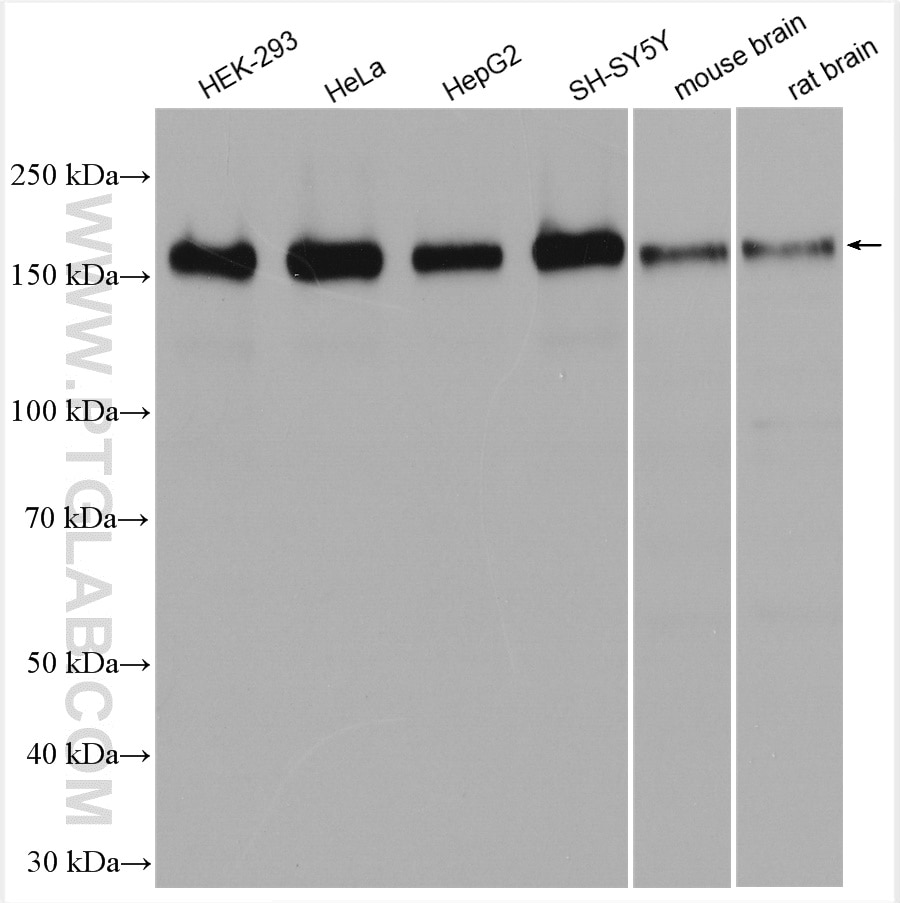
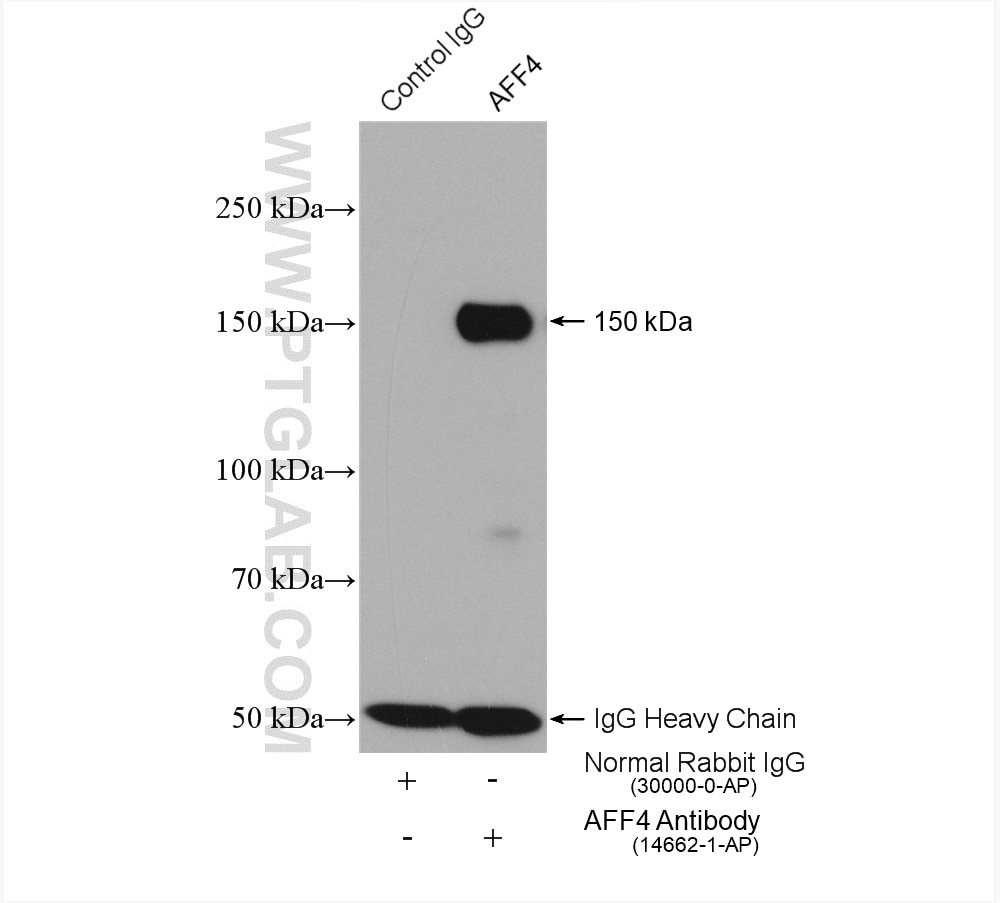
Applications testées
| Résultats positifs en WB | cellules HEK-293, cellules HeLa, cellules HepG2, tissu cérébral de rat, tissu cérébral de souris |
| Résultats positifs en IP | cellules HeLa, |
Dilution recommandée
| Application | Dilution |
|---|---|
| Western Blot (WB) | WB : 1:5000-1:50000 |
| Immunoprécipitation (IP) | IP : 0.5-4.0 ug for 1.0-3.0 mg of total protein lysate |
| It is recommended that this reagent should be titrated in each testing system to obtain optimal results. | |
| Sample-dependent, check data in validation data gallery | |
Applications publiées
| KD/KO | See 2 publications below |
| WB | See 17 publications below |
| IHC | See 1 publications below |
| IP | See 3 publications below |
| CoIP | See 1 publications below |
Informations sur le produit
14662-1-AP cible AFF4 dans les applications de WB, IHC, IP, CoIP, ELISA et montre une réactivité avec des échantillons Humain, rat, souris
| Réactivité | Humain, rat, souris |
| Réactivité citée | Humain, souris |
| Hôte / Isotype | Lapin / IgG |
| Clonalité | Polyclonal |
| Type | Anticorps |
| Immunogène | AFF4 Protéine recombinante Ag6336 |
| Nom complet | AF4/FMR2 family, member 4 |
| Masse moléculaire calculée | 127 kDa |
| Poids moléculaire observé | 140-150 kDa |
| Numéro d’acquisition GenBank | BC063007 |
| Symbole du gène | AFF4 |
| Identification du gène (NCBI) | 27125 |
| Conjugaison | Non conjugué |
| Forme | Liquide |
| Méthode de purification | Purification par affinité contre l'antigène |
| Tampon de stockage | PBS with 0.02% sodium azide and 50% glycerol |
| Conditions de stockage | Stocker à -20°C. Stable pendant un an après l'expédition. L'aliquotage n'est pas nécessaire pour le stockage à -20oC Les 20ul contiennent 0,1% de BSA. |
Informations générales
Transcriptional controled by RNA polymerase II (Pol II) is a multi-step process requiring the concerted action of multiple factors and contacts with the DNA template for the proper synthesis of nascent RNA [PMID:12676794]. ELL1 was demonstrated to be a Pol II elongation factor capable of enhancing the catalytic rate of transcription elongation by reducing transient pausing by the enzyme [PMID:8596958]. AFF4 was initially identified as a fusion partner of the MLL (mixed-lineage leukemia) gene participated in infant acute lymphoblastic leukemia, and a component of the ELL/p-TEFb elongation complex. AFF4 interacts with positive transcription elongation factor-b while also repressing Tat transactivation of HIV-1 [PMID:17389929].
Protocole
| Product Specific Protocols | |
|---|---|
| WB protocol for AFF4 antibody 14662-1-AP | Download protocol |
| IP protocol for AFF4 antibody 14662-1-AP | Download protocol |
| Standard Protocols | |
|---|---|
| Click here to view our Standard Protocols |
Publications
| Species | Application | Title |
|---|---|---|
Cell Targeting Processive Transcription Elongation via SEC Disruption for MYC-Induced Cancer Therapy. | ||
Nat Commun Transcriptional repression by a secondary DNA binding surface of DNA topoisomerase I safeguards against hypertranscription | ||
Mol Cell RNA Pol II preferentially regulates ribosomal protein expression by trapping disassociated subunits | ||
Genes Dev Acute perturbation strategies in interrogating RNA polymerase II elongation factor function in gene expression. | ||
Nucleic Acids Res Multiple P-TEFbs cooperatively regulate the release of promoter-proximally paused RNA polymerase II.
|

