Anticorps Recombinant de lapin anti-IL-23R
IL-23R Recombinant Antibody for FC
Hôte / Isotype
Lapin / IgG
Réactivité testée
Humain
Applications
FC
Conjugaison
CoraLite®594 Fluorescent Dye
CloneNo.
240905B5
N° de cat : CL594-98180
Synonymes
Galerie de données de validation
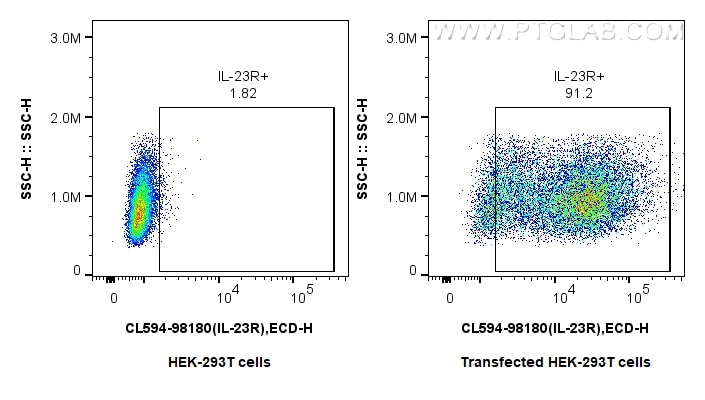
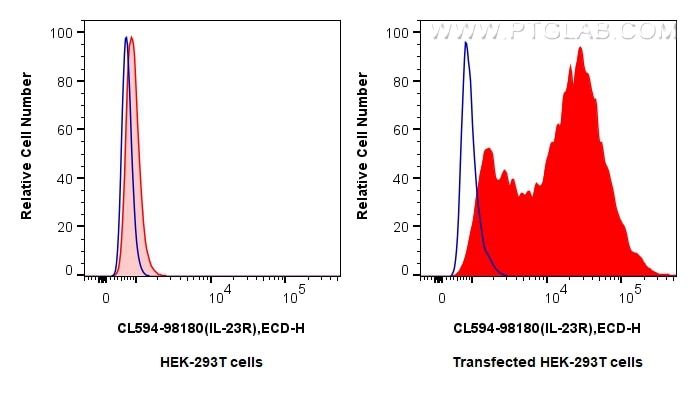
Applications testées
| Résultats positifs en cytométrie | Transfected HEK-293T cells, |
Dilution recommandée
| Application | Dilution |
|---|---|
| This reagent has been pre-titrated and tested for flow cytometric analysis. The suggested use of this reagent is 5 ul per 10^6 cells in a 100 µl suspension or 5 ul per 100 µl of whole blood. | |
| Sample-dependent, check data in validation data gallery | |
Informations sur le produit
CL594-98180 cible IL-23R dans les applications de FC et montre une réactivité avec des échantillons Humain
| Réactivité | Humain |
| Hôte / Isotype | Lapin / IgG |
| Clonalité | Recombinant |
| Type | Anticorps |
| Immunogène | Protéine recombinante |
| Nom complet | interleukin 23 receptor |
| Masse moléculaire calculée | 72 kDa |
| Numéro d’acquisition GenBank | NM_144701.3 |
| Symbole du gène | IL-23R |
| Identification du gène (NCBI) | 149233 |
| Conjugaison | CoraLite®594 Fluorescent Dye |
| Excitation/Emission maxima wavelengths | 588 nm / 604 nm |
| Forme | Liquide |
| Méthode de purification | Purification par protéine A |
| Tampon de stockage | PBS with 0.09% sodium azide and 0.5% BSA |
| Conditions de stockage | Store at 2-8°C. Avoid exposure to light. Stable for one year after shipment. |
Informations générales
Interleukin-23 receptor (IL-23R) is a type I cytokine receptor that plays a critical role in immune responses and inflammation. It forms a receptor complex with IL-12Rβ1 and is activated by the cytokine IL-23, which is primarily produced by dendritic cells and activated macrophages (PMID: 39796684). The genetic and epigenetic interactions in the IL-23R/IL-17 axis are associated with elevated expression of IL-17 and inflammatory bowel disease (IBD) pathogenesis (PMID: 21672939).
Protocole
| Product Specific Protocols | |
|---|---|
| FC protocol for CL594 IL-23R antibody CL594-98180 | Download protocol |
| Standard Protocols | |
|---|---|
| Click here to view our Standard Protocols |

