- Phare
- Validé par KD/KO
Anticorps Polyclonal de lapin anti-PSMD9
PSMD9 Polyclonal Antibody for FC (Intra)
Hôte / Isotype
Lapin / IgG
Réactivité testée
Humain, souris
Applications
FC (Intra)
Conjugaison
CoraLite® Plus 488 Fluorescent Dye
N° de cat : CL488-26922
Synonymes
Galerie de données de validation
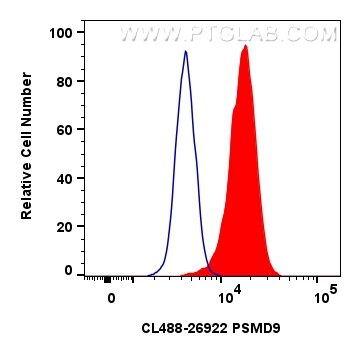
Applications testées
| Résultats positifs en FC (Intra) | cellules HeLa |
Dilution recommandée
| Application | Dilution |
|---|---|
| Flow Cytometry (FC) (INTRA) | FC (INTRA) : 0.80 ug per 10^6 cells in a 100 µl suspension |
| It is recommended that this reagent should be titrated in each testing system to obtain optimal results. | |
| Sample-dependent, check data in validation data gallery | |
Informations sur le produit
CL488-26922 cible PSMD9 dans les applications de FC (Intra) et montre une réactivité avec des échantillons Humain, souris
| Réactivité | Humain, souris |
| Hôte / Isotype | Lapin / IgG |
| Clonalité | Polyclonal |
| Type | Anticorps |
| Immunogène | PSMD9 Protéine recombinante Ag25638 |
| Nom complet | proteasome (prosome, macropain) 26S subunit, non-ATPase, 9 |
| Masse moléculaire calculée | 27 kDa |
| Poids moléculaire observé | 30 kDa |
| Numéro d’acquisition GenBank | BC004213 |
| Symbole du gène | PSMD9 |
| Identification du gène (NCBI) | 5715 |
| Conjugaison | CoraLite® Plus 488 Fluorescent Dye |
| Excitation/Emission maxima wavelengths | 493 nm / 522 nm |
| Forme | Liquide |
| Méthode de purification | Purification par affinité contre l'antigène |
| Tampon de stockage | PBS with 50% glycerol, 0.05% Proclin300, 0.5% BSA |
| Conditions de stockage | Stocker à -20 °C. Éviter toute exposition à la lumière. Stable pendant un an après l'expédition. L'aliquotage n'est pas nécessaire pour le stockage à -20oC Les 20ul contiennent 0,1% de BSA. |
Informations générales
PSMD9 is a ubiquitous protein of eukaryotic cells and is a chaperon of the 26S proteasome complex, which degrades ubiquitinated proteins in eukaryotic cells and contributes to the degradation of intracellular proteins into antigenic peptides for antigen presentation by MHC class I cells. The 26S mammalian base sub-complex involves three distinct modules which have ATPase subunits distinctly associated to three chaperones, one of which is PSMD9 regulating the modules assembly. The PSMD9 ubiquitous regulatory role within the proteasome implies its potential pleiotropic effects within different physio-pathological systems. PSMD9 is known to form a stable subcomplex with PSMC3 and PSMC6, two of the AAA-ATPases, assisting in the assembly of the 20S and 19S particles to form the holo complex.
Protocole
| Product Specific Protocols | |
|---|---|
| FC protocol for CL Plus 488 PSMD9 antibody CL488-26922 | Download protocol |
| Standard Protocols | |
|---|---|
| Click here to view our Standard Protocols |

