Anticorps Polyclonal de lapin anti-Phospho-PKC Alpha (Thr638)
Phospho-PKC Alpha (Thr638) Polyclonal Antibody for WB, IF/ICC, ELISA
Hôte / Isotype
Lapin / IgG
Réactivité testée
Humain, souris
Applications
WB, IF/ICC, ELISA
Conjugaison
Non conjugué
N° de cat : 29123-1-AP
Synonymes
Galerie de données de validation
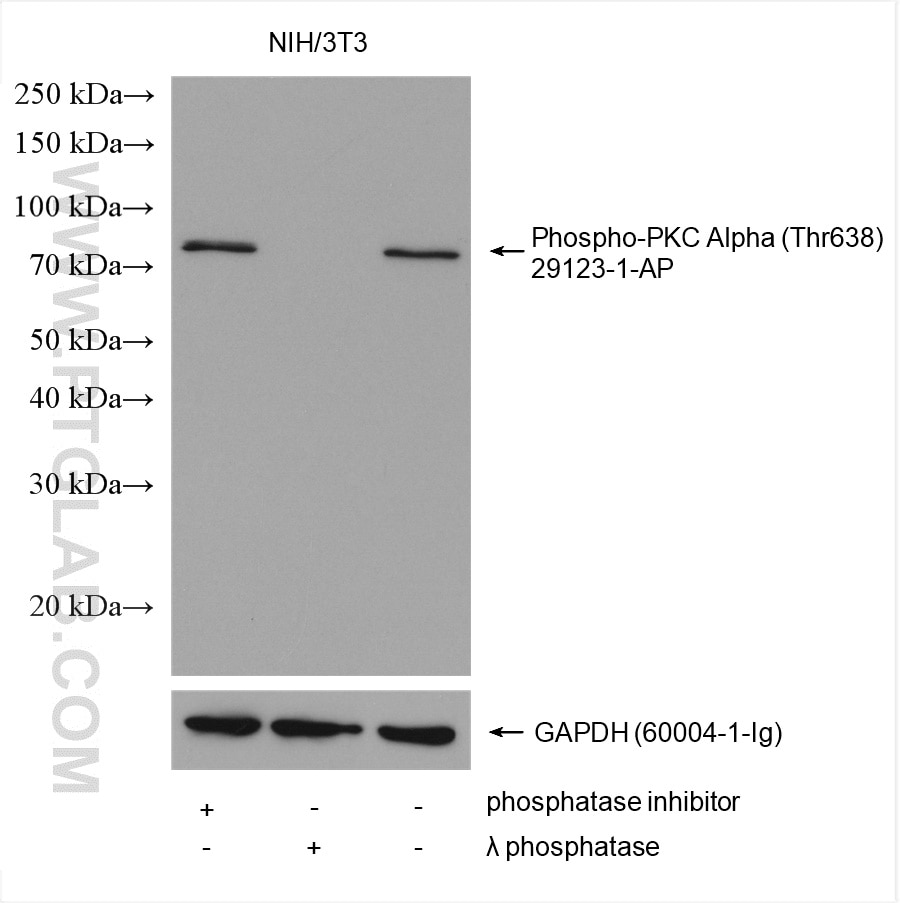
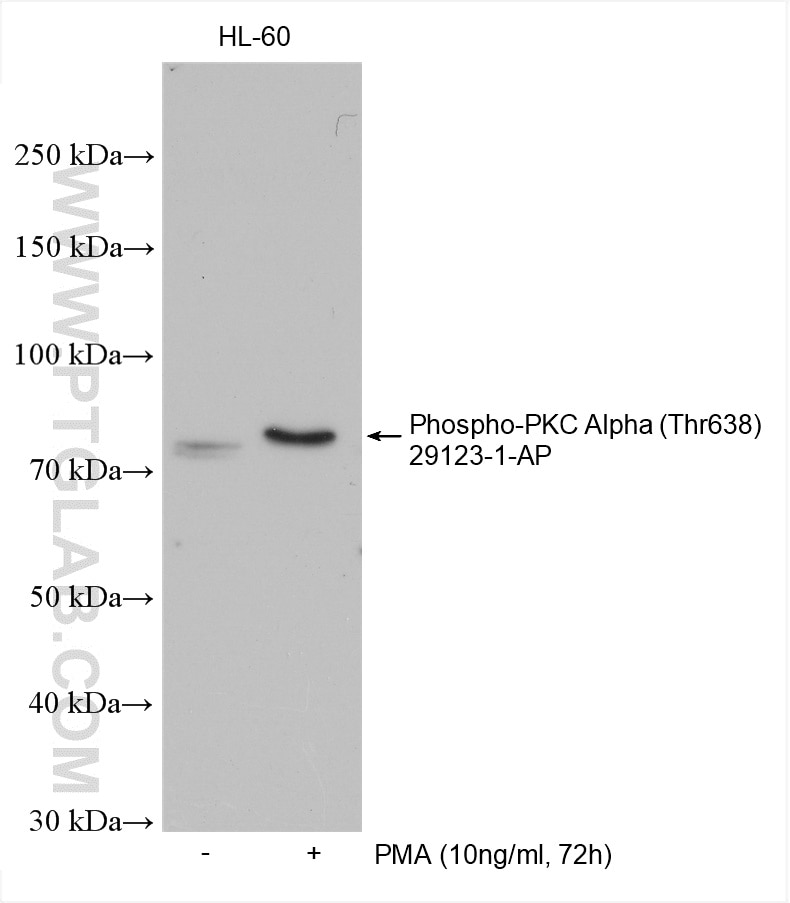
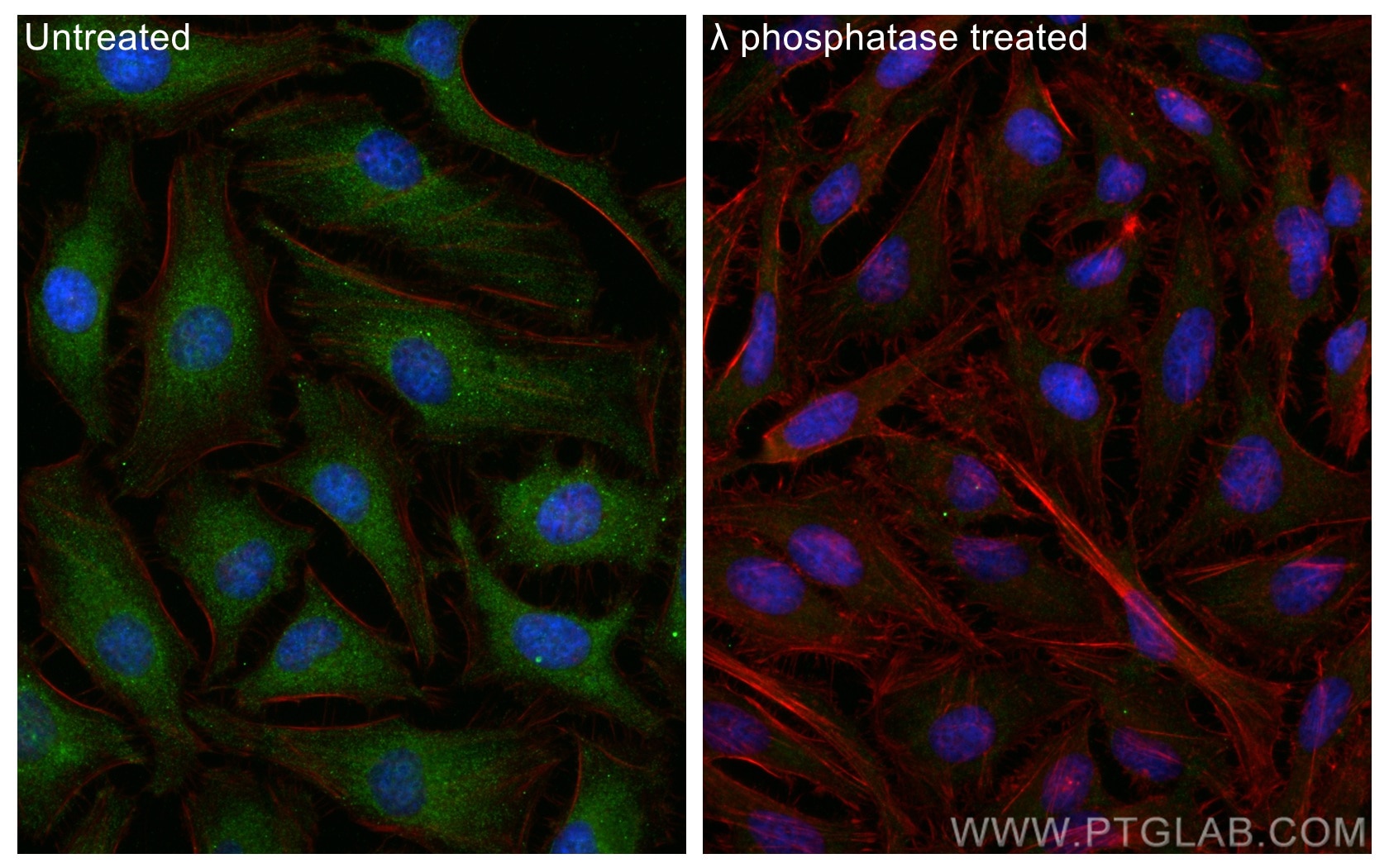
Applications testées
| Résultats positifs en WB | cellules NIH/3T3 traitées à la λ phosphatase, PMA treated HL-60 cells |
| Résultats positifs en IF/ICC | cellules HeLa traitées à la λ phosphatase, |
Dilution recommandée
| Application | Dilution |
|---|---|
| Western Blot (WB) | WB : 1:2000-1:10000 |
| Immunofluorescence (IF)/ICC | IF/ICC : 1:200-1:800 |
| It is recommended that this reagent should be titrated in each testing system to obtain optimal results. | |
| Sample-dependent, check data in validation data gallery | |
Applications publiées
| WB | See 6 publications below |
Informations sur le produit
29123-1-AP cible Phospho-PKC Alpha (Thr638) dans les applications de WB, IF/ICC, ELISA et montre une réactivité avec des échantillons Humain, souris
| Réactivité | Humain, souris |
| Réactivité citée | Humain, souris |
| Hôte / Isotype | Lapin / IgG |
| Clonalité | Polyclonal |
| Type | Anticorps |
| Immunogène | Peptide |
| Nom complet | protein kinase C, alpha |
| Masse moléculaire calculée | 77 kDa |
| Poids moléculaire observé | 77 kDa |
| Numéro d’acquisition GenBank | AK055431 |
| Symbole du gène | PKC Alpha |
| Identification du gène (NCBI) | 5578 |
| Conjugaison | Non conjugué |
| Forme | Liquide |
| Méthode de purification | Purification par affinité contre l'antigène |
| Tampon de stockage | PBS with 0.02% sodium azide and 50% glycerol |
| Conditions de stockage | Stocker à -20°C. Stable pendant un an après l'expédition. L'aliquotage n'est pas nécessaire pour le stockage à -20oC Les 20ul contiennent 0,1% de BSA. |
Informations générales
PKCs are a family of serine/threonine kinases involved in various processes in cells including proliferation, differentiation, cell survival, and apoptosis. PKC family is composed of three different subgroups: conventional (cPKC), the novel (nPKC) and atypical (aPKC). PKCα, β1, β2, and γ belong to cPKC, PKCδ, ε, η and θ are nPKC, whereas aPKC comprises of PKCζ and λ/ι. All PKCs consist of the N-terminal regulatory region and C-terminal catalytic region (kinase domain). PKCs are physiologically activated by various extracellular signals transduced by hormones, growth factors, cytokines or antigens. The presence of activated PKCs on internal membranes leads to the phosphorylation of various interacting proteins. (PMID: 32466765, PMID: 12417016)
Protocole
| Product Specific Protocols | |
|---|---|
| WB protocol for Phospho-PKC Alpha (Thr638) antibody 29123-1-AP | Download protocol |
| IF protocol for Phospho-PKC Alpha (Thr638) antibody 29123-1-AP | Download protocol |
| Standard Protocols | |
|---|---|
| Click here to view our Standard Protocols |
Publications
| Species | Application | Title |
|---|---|---|
Chem Biol Interact Lead-induced cardiomyocytes apoptosis by inhibiting gap junction intercellular communication via modulating the PKCα/Cx43 signaling pathway | ||
Cancer Med MAPK4 predicts poor prognosis and facilitates the proliferation and migration of glioma through the AKT/mTOR pathway | ||
J Leukoc Biol Transient receptor potential vanilloid 4 (TRPV4) in neutrophils enhances myocardial ischemia/reperfusion injury | ||
Int J Mol Sci Oryza sativa L. Indica Seed Coat Ameliorated Concanavalin A-Induced Acute Hepatitis in Mice via MDM2/p53 and PKCα/MAPK1 Signaling Pathways | ||
Cell Rep Med Cholinergic signaling via muscarinic M1 receptor confers resistance to docetaxel in prostate cancer | ||
Cytotechnology β-sitosterol in Yijing Hugui decoction prevents cyclophosphamide-induced premature ovarian insufficiency via the AKT1/Nrf2 pathway |

