

Tested Applications
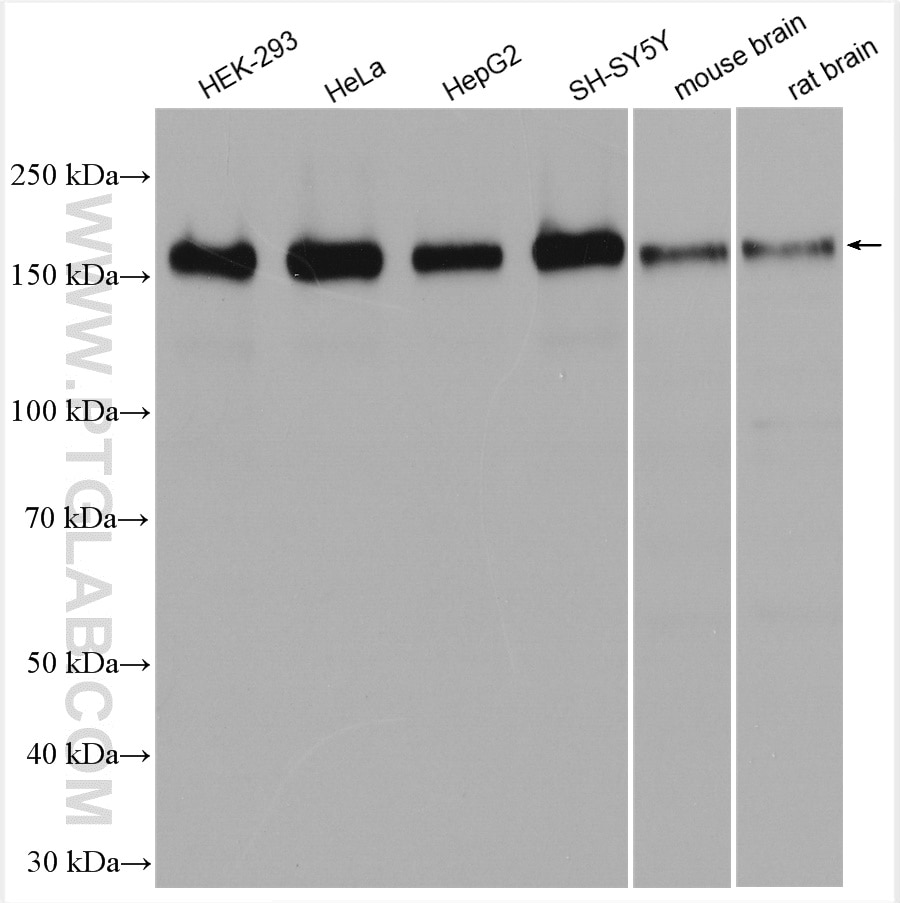
| Positive WB detected in | HEK-293 cells, HeLa cells, HepG2 cells, mouse brain tissue, rat brain tissue |
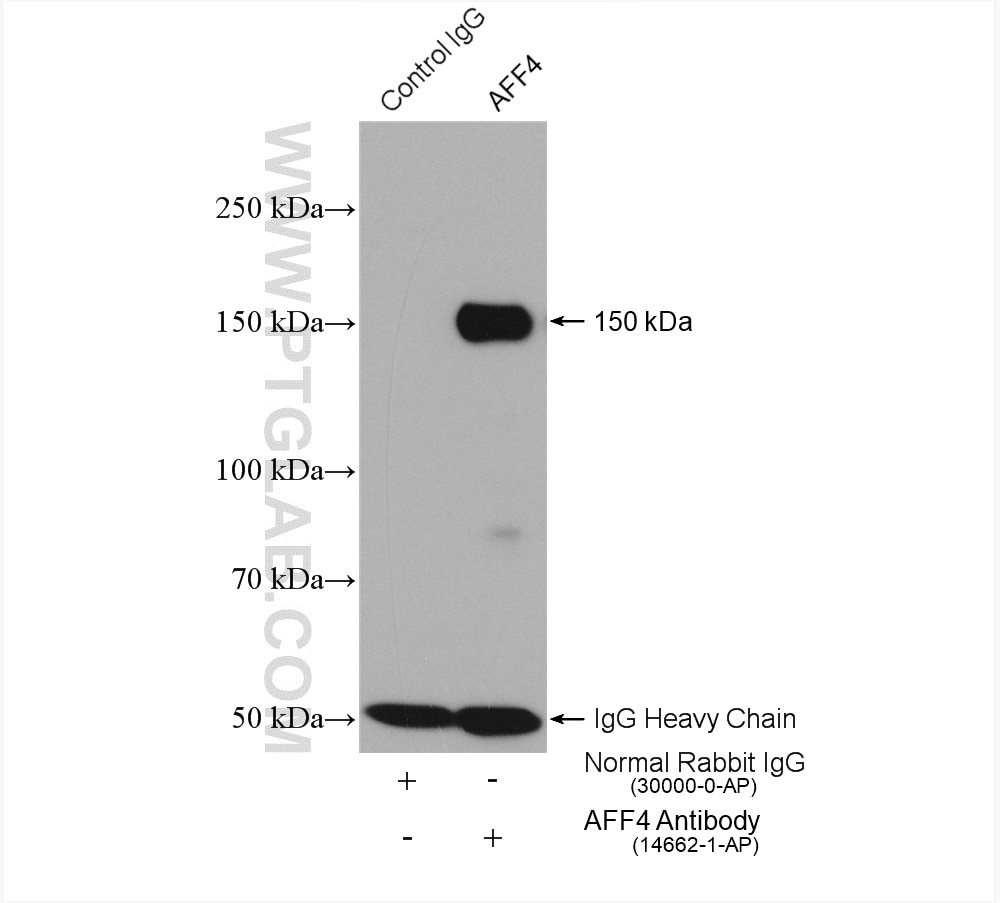
| Positive IP detected in | HeLa cells |
Recommended dilution
| Application | Dilution |
|---|---|
| Western Blot (WB) | WB : 1:5000-1:50000 |
| Immunoprecipitation (IP) | IP : 0.5-4.0 ug for 1.0-3.0 mg of total protein lysate |
| It is recommended that this reagent should be titrated in each testing system to obtain optimal results. | |
| Sample-dependent, Check data in validation data gallery. | |
Product Information
14662-1-AP targets AFF4 in WB, IHC, IP, CoIP, ELISA applications and shows reactivity with human, mouse, rat samples.
| Tested Reactivity | human, mouse, rat |
| Cited Reactivity | human, mouse |
| Host / Isotype | Rabbit / IgG |
| Class | Polyclonal |
| Type | Antibody |
| Immunogen |
CatNo: Ag6336 Product name: Recombinant human AFF4 protein Source: e coli.-derived, PGEX-4T Tag: GST Domain: 1-338 aa of BC063007 Sequence: MNREDRNVLRMKERERRNQEIQQGEDAFPPSSPLFAEPYKVTSKEDKLSSRIQSMLGNYDEMKDFIGDRSIPKLVAIPKPTVPPSADEKSNPNFFEQRHGGSHQSSKWTPVGPAPSTSQSQKRSSGLQSGHSSQRTSAGSSSGTNSSGQRHDRESYNNSGSSSRKKGQHGSEHSKSRSSSPGKPQAVSSLNSSHSRSHGNDHHSKEHQRSKSPRDPDANWDSPSRVPFSSGQHSTQSFPPSLMSKSNSMLQKPTAYVRPMDGQESMEPKLSSEHYSSQSHGNSMTELKPSSKAHLTKLKIPSQPLDASASGDVSCVDEILKEMTHSWPPPLTAIHTPC Predict reactive species |
| Full Name | AF4/FMR2 family, member 4 |
| Calculated Molecular Weight | 127 kDa |
| Observed Molecular Weight | 140-150 kDa |
| GenBank Accession Number | BC063007 |
| Gene Symbol | AFF4 |
| Gene ID (NCBI) | 27125 |
| RRID | AB_2242609 |
| Conjugate | Unconjugated |
| Form | Liquid |
| Purification Method | Antigen affinity purification |
| UNIPROT ID | Q9UHB7 |
| Storage Buffer | PBS with 0.02% sodium azide and 50% glycerol, pH 7.3. |
| Storage Conditions | Store at -20°C. Stable for one year after shipment. Aliquoting is unnecessary for -20oC storage. 20ul sizes contain 0.1% BSA. |
Background Information
Transcriptional controled by RNA polymerase II (Pol II) is a multi-step process requiring the concerted action of multiple factors and contacts with the DNA template for the proper synthesis of nascent RNA [PMID:12676794]. ELL1 was demonstrated to be a Pol II elongation factor capable of enhancing the catalytic rate of transcription elongation by reducing transient pausing by the enzyme [PMID:8596958]. AFF4 was initially identified as a fusion partner of the MLL (mixed-lineage leukemia) gene participated in infant acute lymphoblastic leukemia, and a component of the ELL/p-TEFb elongation complex. AFF4 interacts with positive transcription elongation factor-b while also repressing Tat transactivation of HIV-1 [PMID:17389929].
Protocols
| Product Specific Protocols | |
|---|---|
| IP protocol for AFF4 antibody 14662-1-AP | Download protocol |
| WB protocol for AFF4 antibody 14662-1-AP | Download protocol |
| Standard Protocols | |
|---|---|
| Click here to view our Standard Protocols |
Publications
What published studies show
The anti-AFF4 antibody (Cat# 14662-1-AP) has 19 total citations across journals including Cell, Cancer Discovery, Nature Communications, Molecular Cell, Genes & Development, Science Advances, Nucleic Acids Research, and others. Research fields span transcription elongation, cancer therapy (MYC-driven, glioblastoma, pancreatic cancer), HIV-1 proviral transcription and latency reversal, RNA Pol II regulation, m6A epigenetic modification, pulmonary fibrosis, and osteogenesis. Applications are predominantly WB and IP.
| Species | Application | Title |
|---|---|---|
Cell Targeting Processive Transcription Elongation via SEC Disruption for MYC-Induced Cancer Therapy. | ||
Cancer Discov Transcription Elongation Machinery Is a Druggable Dependency and Potentiates Immunotherapy in Glioblastoma Stem Cells | ||
Nat Commun Transcriptional repression by a secondary DNA binding surface of DNA topoisomerase I safeguards against hypertranscription | ||
Nat Commun CSTF2 mediated mRNA N6-methyladenosine modification drives pancreatic ductal adenocarcinoma m6A subtypes | ||
Cell Discov Structural and functional insight into the effect of AFF4 dimerization on activation of HIV-1 proviral transcription. |



