
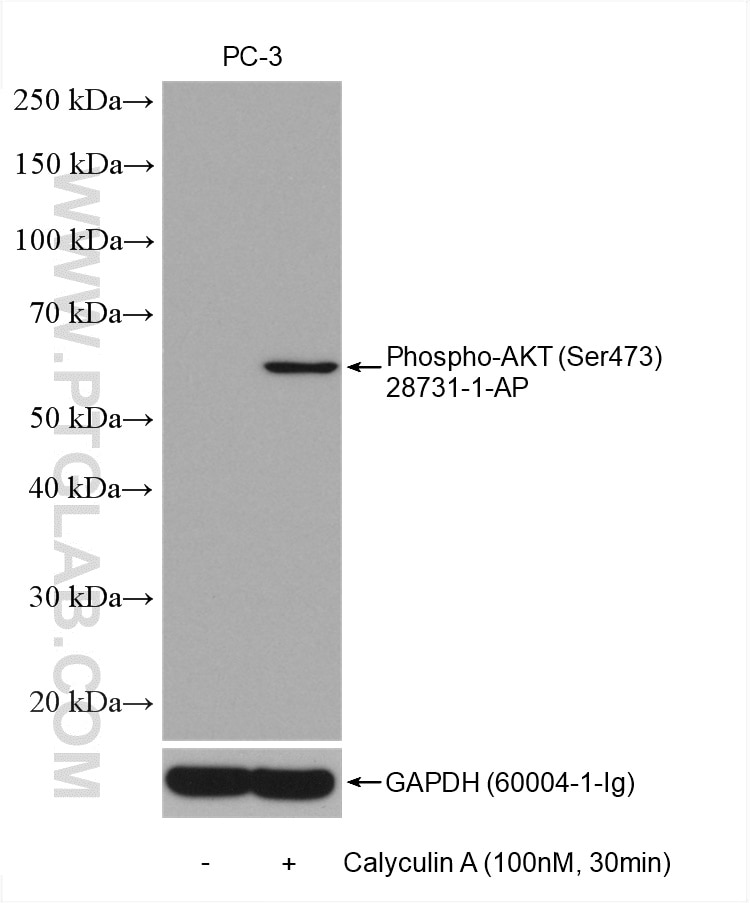
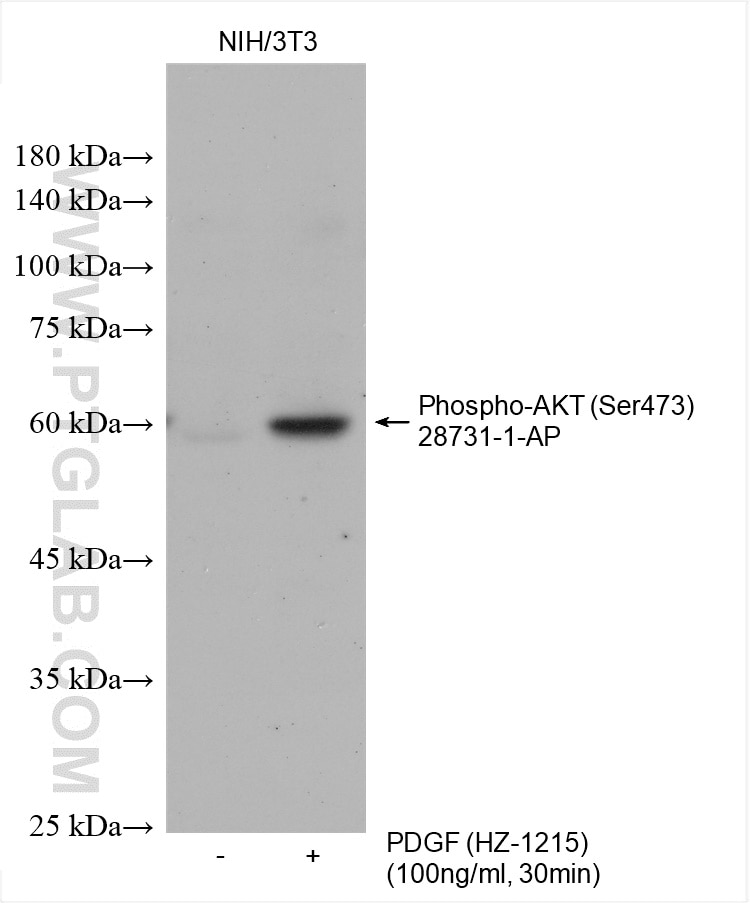
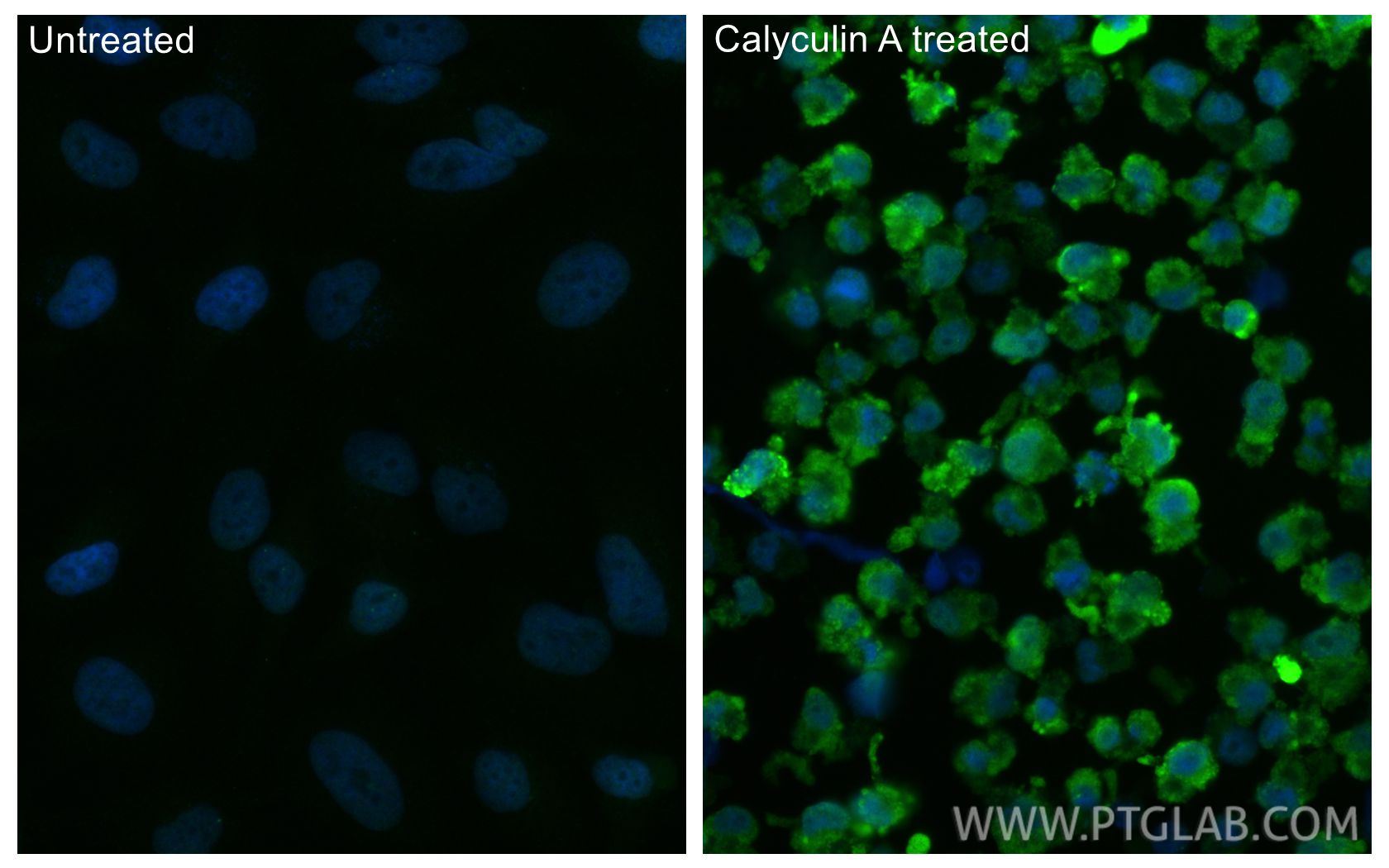

Tested Applications
| Positive WB detected in | Calyculin A treated PC-3 cells, PDGF treated NIH/3T3 cells |
| Positive IF/ICC detected in | Calyculin A treated HeLa cells |
Recommended dilution
| Application | Dilution |
|---|---|
| Western Blot (WB) | WB : 1:1000-1:5000 |
| Immunofluorescence (IF)/ICC | IF/ICC : 1:50-1:500 |
| It is recommended that this reagent should be titrated in each testing system to obtain optimal results. | |
| Sample-dependent, Check data in validation data gallery. | |
Product Information
28731-1-AP targets Phospho-AKT (Ser473) in WB, IHC, IF/ICC, ELISA applications and shows reactivity with human, mouse samples.
| Tested Reactivity | human, mouse |
| Cited Reactivity | human, mouse, rat, pig, rabbit, monkey, chicken, zebrafish, sheep |
| Host / Isotype | Rabbit / IgG |
| Class | Polyclonal |
| Type | Antibody |
| Immunogen |
Peptide Predict reactive species |
| Full Name | v-akt murine thymoma viral oncogene homolog 1 |
| Observed Molecular Weight | 58 kDa |
| GenBank Accession Number | NM_005163 |
| Gene Symbol | AKT1 |
| Gene ID (NCBI) | 207 |
| RRID | AB_2881201 |
| Conjugate | Unconjugated |
| Form | Liquid |
| Purification Method | Antigen affinity purification |
| UNIPROT ID | P31749 |
| Storage Buffer | PBS with 0.02% sodium azide and 50% glycerol, pH 7.3. |
| Storage Conditions | Store at -20°C. Stable for one year after shipment. Aliquoting is unnecessary for -20oC storage. 20ul sizes contain 0.1% BSA. |
Background Information
Phosphorylation on Thr-308, Ser-473 and Tyr-474 is required for full activity. Activated TNK2 phosphorylates it on Tyr-176 resulting in its binding to the anionic plasma membrane phospholipid PA (PubMed:20333297). This phosphorylated form localizes to the cell membrane, where it is targeted by PDPK1 and PDPK2 for further phosphorylations on Thr-308 and Ser-473 leading to its activation (PubMed:9512493). Ser-473 phosphorylation by mTORC2 favors Thr-308 phosphorylation by PDPK1 (PubMed:21464307, PubMed:8978681). AKT1 Thr-308 and Ser-473 is Phosphorylated by IKBKE and TBK1 (PubMed:15718470, PubMed:18456494, PubMed:20481595, PubMed:8978681). Ser-473 phosphorylation is enhanced by interaction with AGAP2 isoform 2 (PIKE-A) (PubMed:14761976). Ser-473 phosphorylation is enhanced in focal cortical dysplasias with Taylor-type balloon cells (PubMed:17013611). Ser-473 phosphorylation is enhanced by signaling through activated FLT3 (By similarity). Ser-473 is dephosphorylated by PHLPP (PubMed:28147277) and Ser-473 by PP2A phosphatase (PubMed:21329884).
Protocols
| Product Specific Protocols | |
|---|---|
| IF protocol for Phospho-AKT (Ser473) antibody 28731-1-AP | Download protocol |
| WB protocol for Phospho-AKT (Ser473) antibody 28731-1-AP | Download protocol |
| Standard Protocols | |
|---|---|
| Click here to view our Standard Protocols |
Publications
What published studies show
The Phospho-AKT (Ser473) Polyclonal antibody (28731-1-AP) has 344 total citations. It is widely cited in high-impact journals including Advanced Materials, Metabolism, Theranostics, Advanced Science, Cell Death & Disease, Journal of Neuroinflammation, Journal of Translational Medicine, and others covering oncology, cardiology, and neuroscience. Applications are mainly Western blotting, with IHC and IF. Research fields span cancer biology (multiple tumor types), cardiovascular disease, diabetic/metabolic disorders, neuroinflammation and brain injury, wound healing, and natural-product/ethnopharmacology studies, reflecting the antibody's broad utility in PI3K/AKT signaling research across species.
| Species | Application | Title |
|---|---|---|
Adv Mater In Situ Triggered Self-Contraction Bioactive Microgel Assembly Accelerates Diabetic Skin Wound Healing by Activating Mechanotransduction and Biochemical Pathway | ||
Metabolism Anti-sarcopenic effects of active vitamin D through modulation of anabolic and catabolic signaling pathways in human skeletal muscle: A randomized controlled trial | ||
J Nanobiotechnology A novel delivery nanobiotechnology: engineered miR-181b exosomes improved osteointegration by regulating macrophage polarization | ||
Theranostics An anti-FAP-scFv-functionalized exosome-carrying hydrogel delivers SKI mRNA to fibrotic nucleus pulposus cells to alleviate intervertebral disc degeneration by regulating FOXO3 | ||
Adv Sci (Weinh) Platelet-Derived Growth Factor C Facilitates Malignant Behavior of Pancreatic Ductal Adenocarcinoma by Regulating SREBP1 Mediated Lipid Metabolism | ||
Adv Sci (Weinh) A Lipid-Sensitive Spider Peptide Toxin Exhibits Selective Anti-Leukemia Efficacy through Multimodal Mechanisms |
Reviews
What customers say
Able is busy answering your previous question. Please try again later.
The reviews below have been submitted by verified Proteintech customers who received an incentive for providing their feedback.
Kamal (Verified Customer) (02-25-2026) | Antibody was diluted 1:200 in 1X PBS and incubated overnight.
|
Julia (Verified Customer) (07-24-2025) | Consistent results
|
Itziar (Verified Customer) (06-27-2022) | This antibody works very well with even little protein quantities
|




