
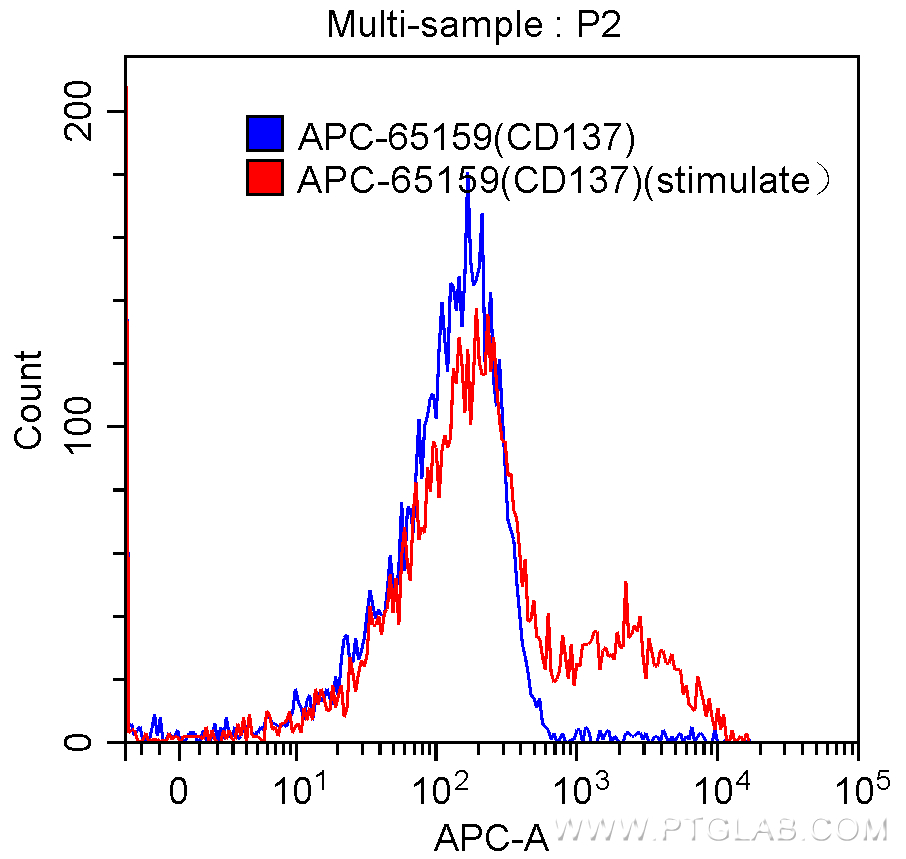
Tested Applications
| Positive FC detected in | human peripheral blood mononuclear cells |
Recommended dilution
| Application | Dilution |
|---|---|
| Flow Cytometry (FC) | FC : 10 ul per 10^6 cells in 100 μl suspension |
| This reagent has been pre-titrated and tested for flow cytometric analysis. The suggested use of this reagent is 10 µl per 10^6 cells in a 100 µl suspension or 10 µl per 100 µl of whole blood. | |
| Sample-dependent, Check data in validation data gallery. | |
Product Information
APC-65159 targets CD137 in FC applications and shows reactivity with Human,Non-human primates samples.
| Tested Reactivity | Human,Non-human primates |
| Host / Isotype | Mouse / IgG1, kappa |
| Class | Monoclonal |
| Type | Antibody |
| Immunogen |
Recombinant human CD137 ectodomain Predict reactive species |
| Full Name | tumor necrosis factor receptor superfamily, member 9 |
| Calculated Molecular Weight | 28 kDa |
| GenBank Accession Number | BC006196 |
| Gene Symbol | TNFRSF9/CD137 |
| Gene ID (NCBI) | 3604 |
| RRID | AB_2883033 |
| Conjugate | APC Fluorescent Dye |
| Excitation/Emission Maxima Wavelengths | 650 nm / 660 nm |
| Excitation Laser | Red Laser (633 nm) |
| Form | Liquid |
| Purification Method | The purified antibody is conjugated with allophycocyanin (APC) under optimum conditions. The conjugate is purified by size-exclusion chromatography. |
| UNIPROT ID | Q07011 |
| Storage Buffer | PBS with 0.09% sodium azide, pH 7.3. |
| Storage Conditions | Store at 2-8°C. Avoid exposure to light. Stable for one year after shipment. |
Background Information
CD137, also known as TNFRSF9 or 4-1BB, is an inducible T cell surface receptor that belongs to the tumor necrosis factor receptor superfamily. CD137 is a transmembrane protein expressed on the surface of activated T-cells. In addition, activation-dependent expression of CD137 has also been found in B lymphocytes, monocytes, and diverse nonlymphoid cell types. CD137 provides a co-stimulatory signal that enhances the survival, and differentiation of cells, and has a crucial role in the development of CD8 cytotoxic T cells and anti-tumor immunity. (PMID: 9826581; 23696891)


