







Tested Applications
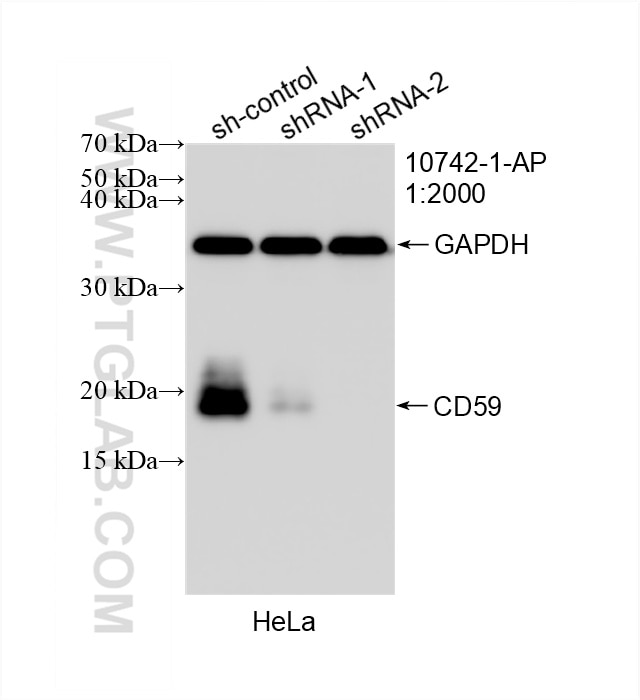
| Positive WB detected in | BxPC-3 cells, HeLa cells, human brain tissue, HUVEC cells |
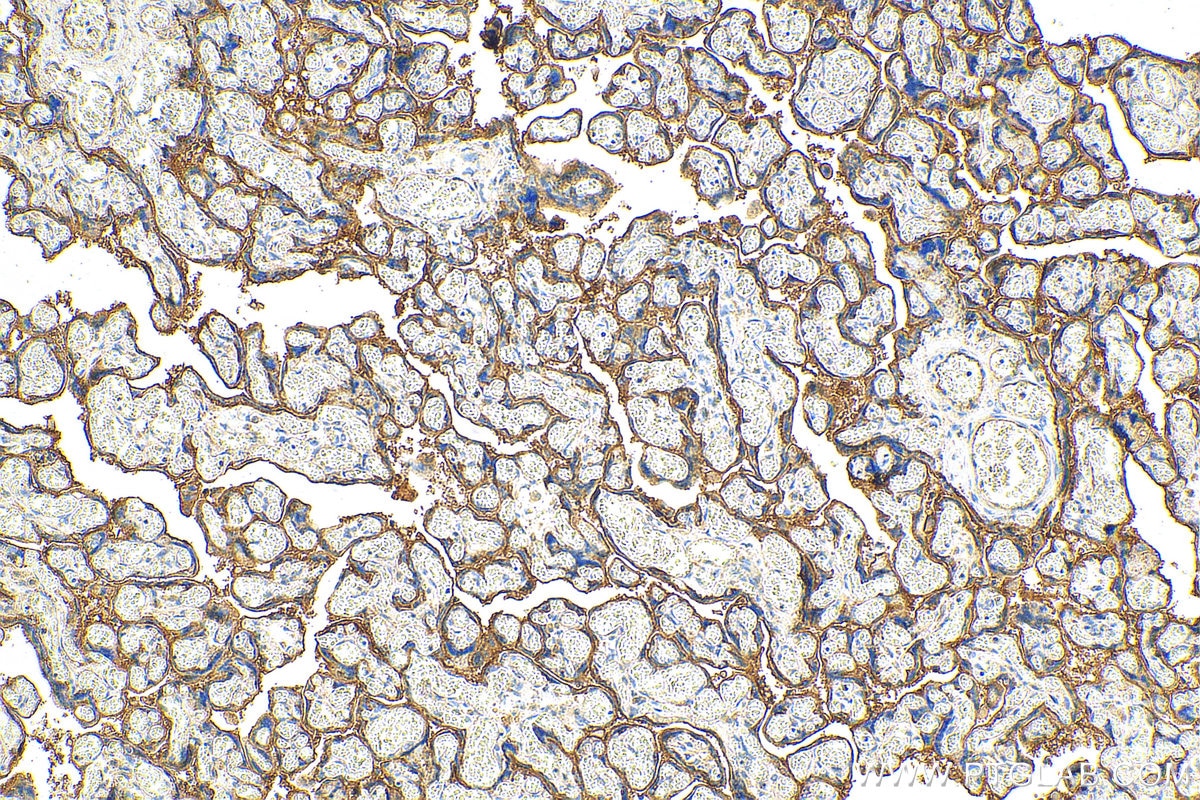
| Positive IHC detected in | human placenta tissue, human tonsillitis tissue Note: suggested antigen retrieval with TE buffer pH 9.0; (*) Alternatively, antigen retrieval may be performed with citrate buffer pH 6.0 |
| Positive IF/ICC detected in | BxPC-3 cells |
Recommended dilution
| Application | Dilution |
|---|---|
| Western Blot (WB) | WB : 1:500-1:2000 |
| Immunohistochemistry (IHC) | IHC : 1:50-1:500 |
| Immunofluorescence (IF)/ICC | IF/ICC : 1:50-1:500 |
| It is recommended that this reagent should be titrated in each testing system to obtain optimal results. | |
| Sample-dependent, Check data in validation data gallery. | |
Product Information
10742-1-AP targets CD59 in WB, IHC, IF/ICC, ELISA applications and shows reactivity with human samples.
| Tested Reactivity | human |
| Cited Reactivity | human, pig |
| Host / Isotype | Rabbit / IgG |
| Class | Polyclonal |
| Type | Antibody |
| Immunogen |
CatNo: Ag1173 Product name: Recombinant human CD59 protein Source: e coli.-derived, PGEX-4T Tag: GST Domain: 1-128 aa of BC001506 Sequence: MGIQGGSVLFGLLLVLAVFCHSGHSLQCYNCPNPTADCKTAVNCSSDFDACLITKAGLQVYNKCWKFEHCNFNDVTTRLRENELTYYCCKKDLCNFNEQLENGGTSLSEKTVLLLVTPFLAAAWSLHP Predict reactive species |
| Full Name | CD59 molecule, complement regulatory protein |
| Calculated Molecular Weight | 19 kDa |
| Observed Molecular Weight | 18-20 kDa |
| GenBank Accession Number | BC001506 |
| Gene Symbol | CD59 |
| Gene ID (NCBI) | 966 |
| RRID | AB_2076228 |
| Conjugate | Unconjugated |
| Form | Liquid |
| Purification Method | Antigen affinity purification |
| UNIPROT ID | P13987 |
| Storage Buffer | PBS with 0.02% sodium azide and 50% glycerol, pH 7.3. |
| Storage Conditions | Store at -20°C. Stable for one year after shipment. Aliquoting is unnecessary for -20oC storage. 20ul sizes contain 0.1% BSA. |
Background Information
CD59, also named as MIC11, MIN1, MIN2, MIN3, MSK21, MIRL, MACIF, HRF20 and 1F5 antigen, is a cell surface molecule glycoprotein with MW 18-25 kDa. It acts as a determinant of proximal-distal cell identity. CD59 acts by binding to the C8 and/or C9 complements of the assembling membrane attack complex (MAC), thereby preventing incorporation of the multiple copies of C9 required for complete formation of the osmolytic pore. It is involved in signal transduction for T-cell activation complexed to a protein tyrosine kinase.
Protocols
| Product Specific Protocols | |
|---|---|
| IF protocol for CD59 antibody 10742-1-AP | Download protocol |
| IHC protocol for CD59 antibody 10742-1-AP | Download protocol |
| WB protocol for CD59 antibody 10742-1-AP | Download protocol |
| Standard Protocols | |
|---|---|
| Click here to view our Standard Protocols |
Publications
What published studies show
The CD59 Polyclonal antibody (Cat# 10742-1-AP) has 17 citations across journals including Molecular Cancer, Journal of Nanobiotechnology, Advanced Science, International Journal of Oncology, Marine Drugs, International Journal of Molecular Sciences, Molecular Neurobiology, and PLoS One. Research fields span cancer (ovarian, breast, gastric), ferroptosis, drug resistance, complement-mediated immunity, age-related macular degeneration, neurology (neuromyelitis optica), and reproductive biology. Most applications were Western blot, with some IHC and IF.
| Species | Application | Title |
|---|---|---|
Mol Cancer Cell surface CD55 traffics to the nucleus leading to cisplatin resistance and stemness by inducing PRC2 and H3K27 trimethylation on chromatin in ovarian cancer | ||
J Nanobiotechnology Targeting cancer stem-like cells via cholesterol modulation and ferroptosis induction using a multifunctional nanoplatform to overcome drug resistance. | ||
Adv Sci (Weinh) Cupric Doping Hollow Prussian Blue Nanoplatform for Enhanced Cholesterol Depletion: a Promising Strategy for Breast Cancer Therapy and Metastasis Inhibition | ||
Int J Oncol The membrane complement regulatory protein CD59 promotes tumor growth and predicts poor prognosis in breast cancer. | ||
Mar Drugs Influence of a Very High-Molecular Weight Fucoidan from Laminaria hyperborea on Age-Related Macular Degeneration-Relevant Pathomechanisms in Ocular Cell Models | ||
Mar Drugs Fucoidan from Fucus vesiculosus Protects Retinal Pigment Epithelium from Lipid-Induced Damage Related to AMD. |
Reviews
What customers say
The single review for this antibody reports a positive experience with Western Blot. The user applied a 1:1000 dilution and observed a clear band, rating the product 5 out of 5 stars. Overall, the feedback indicates the antibody performed well for its intended application, delivering a distinct and reliable signal.
The reviews below have been submitted by verified Proteintech customers who received an incentive for providing their feedback.
Macarena Lucia (Verified Customer) (10-17-2022) | clear band
|








