

Tested Applications
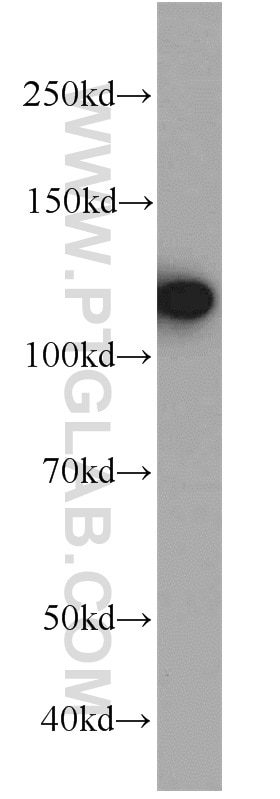
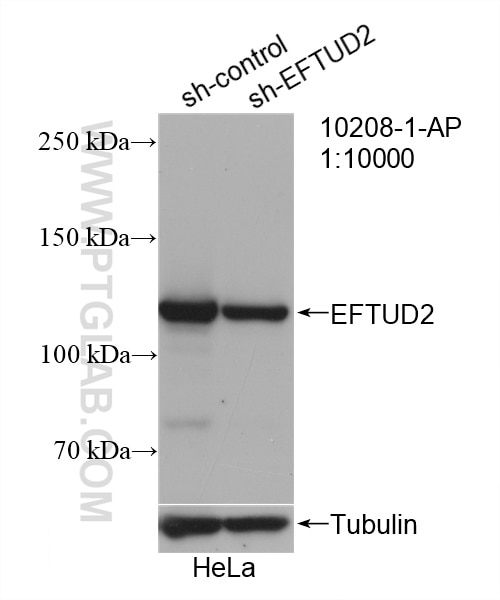
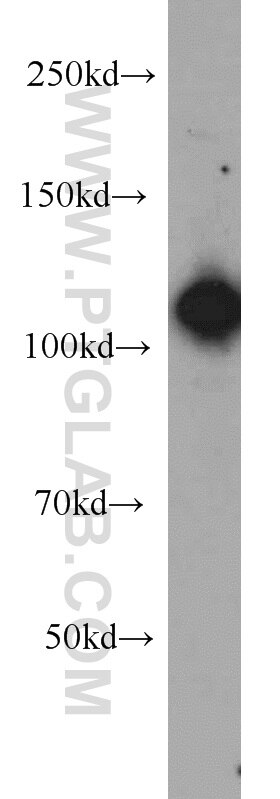
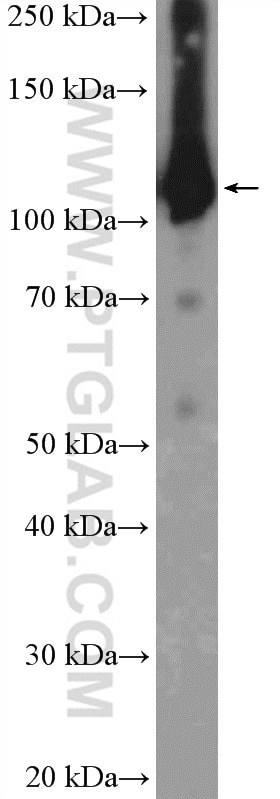
| Positive WB detected in | HeLa cells |
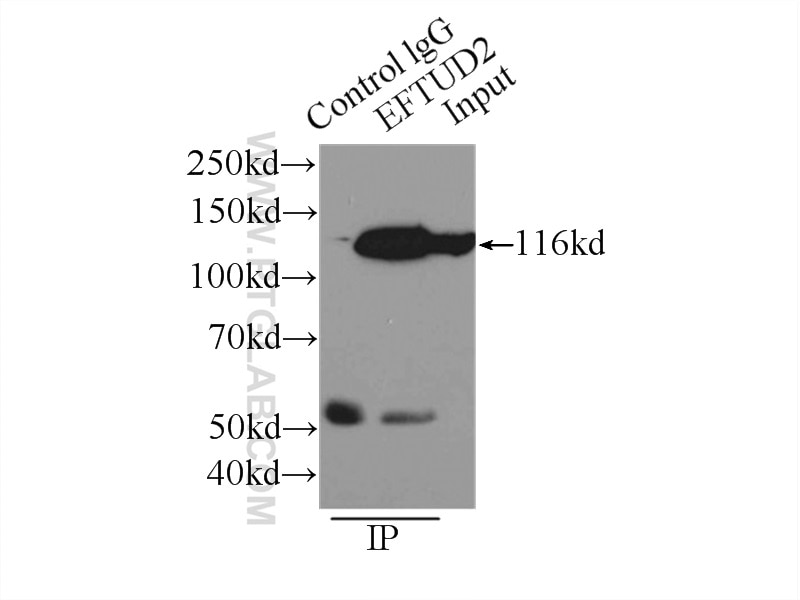
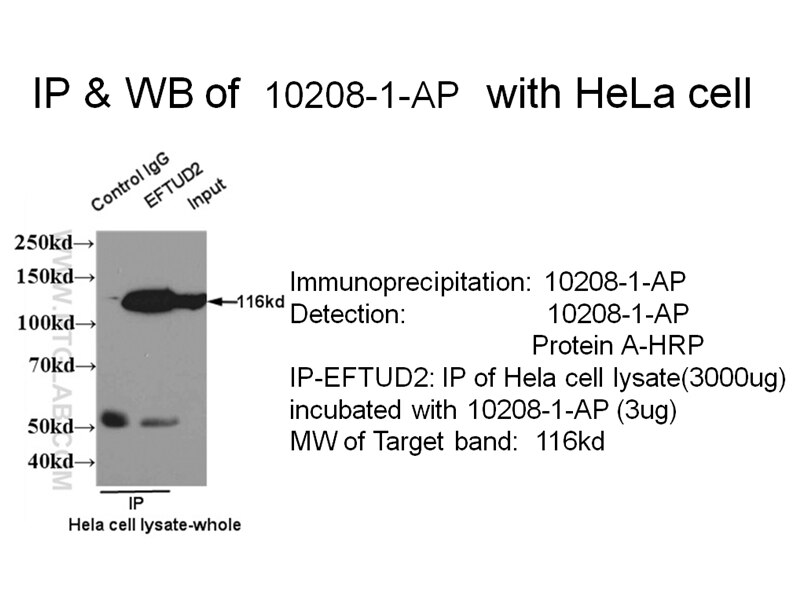
| Positive IP detected in | HeLa cells |
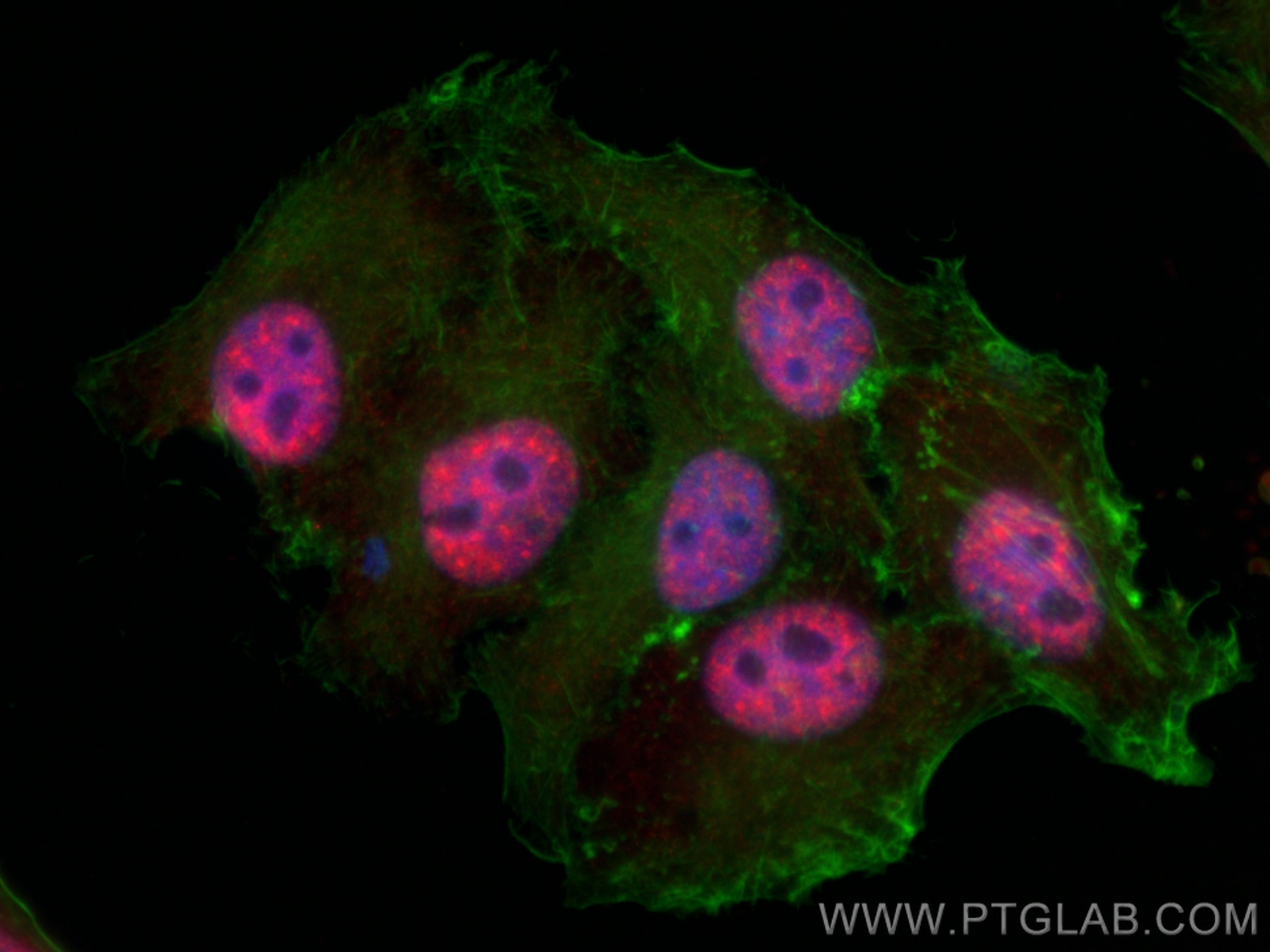
| Positive IF/ICC detected in | HepG2 cells |
Recommended dilution
| Application | Dilution |
|---|---|
| Western Blot (WB) | WB : 1:500-1:2000 |
| Immunoprecipitation (IP) | IP : 0.5-4.0 ug for 1.0-3.0 mg of total protein lysate |
| Immunofluorescence (IF)/ICC | IF/ICC : 1:400-1:1600 |
| It is recommended that this reagent should be titrated in each testing system to obtain optimal results. | |
| Sample-dependent, Check data in validation data gallery. | |
Product Information
10208-1-AP targets EFTUD2 in WB, IHC, IF/ICC, IP, CoIP, RIP, ELISA, PLA applications and shows reactivity with human samples.
| Tested Reactivity | human |
| Cited Reactivity | human, mouse |
| Host / Isotype | Rabbit / IgG |
| Class | Polyclonal |
| Type | Antibody |
| Immunogen |
CatNo: Ag0279 Product name: Recombinant human EFTUD2 protein Source: e coli.-derived, PGEX-4T Tag: GST Domain: 13-217 aa of BC002360 Sequence: IGPELDSDEDDDELGRETKDLDEMDDDDDDDDVGDHDDDHPGMEVVLHEDKKYYPTAEEVYGPEVETIVQEEDTQPLTEPIIKPVKTKKFTLMEQTLPVTVYEMDFLADLMDNSELIRNVTLCGHLHHGKTCFVDCLIEQTHPEIRKRYDQDLCYTDILFTEQERGVGIKSTPVTVVLPDTKGKSYLFNIMDTPGHVNFSDEVTA Predict reactive species |
| Full Name | elongation factor Tu GTP binding domain containing 2 |
| Calculated Molecular Weight | 116 kDa |
| Observed Molecular Weight | 116 kDa |
| GenBank Accession Number | BC002360 |
| Gene Symbol | EFTUD2 |
| Gene ID (NCBI) | 9343 |
| RRID | AB_2095834 |
| Conjugate | Unconjugated |
| Form | Liquid |
| Purification Method | Antigen affinity purification |
| UNIPROT ID | Q15029 |
| Storage Buffer | PBS with 0.02% sodium azide and 50% glycerol, pH 7.3. |
| Storage Conditions | Store at -20°C. Stable for one year after shipment. Aliquoting is unnecessary for -20oC storage. 20ul sizes contain 0.1% BSA. |
Background Information
EFTUD2 encodes the 116 kDa U5 small nuclear ribonecleoprotein (snRNP) component, also named SNU114, it has GTP binding activity and is required for pre-mRNA splicing. Evolutionarily conserved human snRNP protein (U5-116kDa) is homologous to the ribosomal elongation factor EF-2 (ribosomal translocase). Defects in EFTUD2 are the cause of mandibulofacial dysostosis with microcephaly (MFDM). So far, acetylation and phosphorylation sites of EFTUD2 have been identified. Catolog#10208-1-AP is a rabbit polyclonal antibody raised against the N-terminal of human EFTUD2.
Protocols
| Product Specific Protocols | |
|---|---|
| IF protocol for EFTUD2 antibody 10208-1-AP | Download protocol |
| IP protocol for EFTUD2 antibody 10208-1-AP | Download protocol |
| WB protocol for EFTUD2 antibody 10208-1-AP | Download protocol |
| Standard Protocols | |
|---|---|
| Click here to view our Standard Protocols |
Publications
What published studies show
The EFTUD2 Polyclonal antibody (cat. no. 10208-1-AP) has 22 citations. They appear in journals including Nature Immunology, Neuron, Nucleic Acids Research, Journal of Experimental & Clinical Cancer Research, Science Advances, Cell Reports, iScience, FASEB Journal, RNA, Journal of Biological Chemistry, Proteomics, Journal of Molecular Biology, Journal of Neurochemistry, Poultry Science, Heliyon, and Cancer Research and Treatment. Research fields span spliceosome/RNA splicing, ferroptosis and neurodegeneration, cancer biology, proteomics, and muscle differentiation.
| Species | Application | Title |
|---|---|---|
Nat Immunol Syndromic immune disorder caused by a viable hypomorphic allele of spliceosome component Snrnp40. | ||
Neuron Spliceosomal GTPase Eftud2 deficiency-triggered ferroptosis leads to Purkinje cell degeneration | ||
Nucleic Acids Res XAB2 depletion induces intron retention in POLR2A to impair global transcription and promote cellular senescence. | ||
Nucleic Acids Res Neurochondrin promotes U5 snRNP maturation by regulating AAR2 release from PRPF8. | ||
J Exp Clin Cancer Res The feedback loop of EFTUD2/c-MYC impedes chemotherapeutic efficacy by enhancing EFTUD2 transcription and stabilizing c-MYC protein in colorectal cancer | ||
Sci Adv Immunopeptidomics-guided discovery and characterization of neoantigens for personalized cancer immunotherapy. |








