
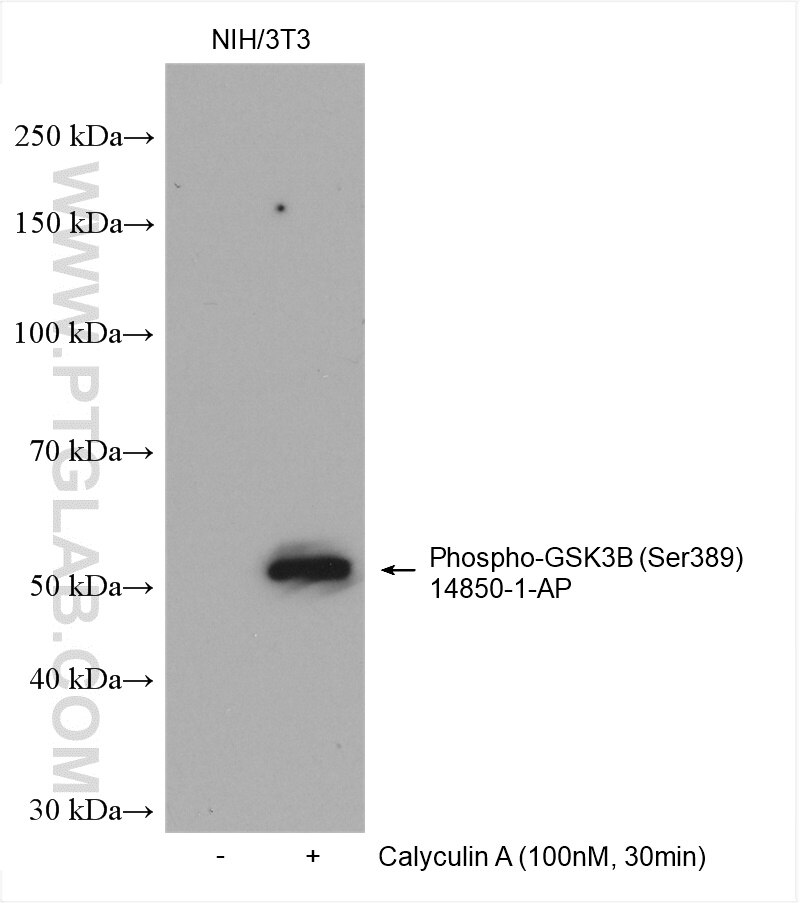

Tested Applications
| Positive WB detected in | Calyculin A treated NIH/3T3 cells |
Recommended dilution
| Application | Dilution |
|---|---|
| Western Blot (WB) | WB : 1:1000-1:4000 |
| It is recommended that this reagent should be titrated in each testing system to obtain optimal results. | |
| Sample-dependent, Check data in validation data gallery. | |
Product Information
14850-1-AP targets Phospho-GSK3B (Ser389) in WB, IHC, IF, ELISA applications and shows reactivity with mouse, rat samples.
| Tested Reactivity | mouse, rat |
| Cited Reactivity | human, mouse, rat, pig |
| Host / Isotype | Rabbit / IgG |
| Class | Polyclonal |
| Type | Antibody |
| Immunogen |
Peptide Predict reactive species |
| Full Name | glycogen synthase kinase 3 beta |
| Calculated Molecular Weight | 48 kDa |
| Observed Molecular Weight | 46-50 kDa |
| GenBank Accession Number | BC060743 |
| Gene Symbol | Gsk3b |
| Gene ID (NCBI) | 56637 |
| RRID | AB_2878085 |
| Conjugate | Unconjugated |
| Form | Liquid |
| Purification Method | Antigen affinity purification |
| UNIPROT ID | Q9WV60 |
| Storage Buffer | PBS with 0.02% sodium azide and 50% glycerol, pH 7.3. |
| Storage Conditions | Store at -20°C. Stable for one year after shipment. Aliquoting is unnecessary for -20oC storage. 20ul sizes contain 0.1% BSA. |
Background Information
Glycogen synthase kinase 3s are serine/threonine kinases that were originally identified as key regulatory enzymes in glucose metabolism. There are two isoforms, GSK3α and GSK3β, encoded by separate genes, which are overall 85% homologous to each other, with 95% identity in the kinase domains. To date, phosphorylation at Ser9 by Akt is the best-characterized mechanism for the inhibition of GSK3β activity. GSK3β is phosphorylated at S389 in vivo by p38 MAPK and that this alternative regulatory mechanism of GSK3β is tissue-specific(PMID:18451303).
Protocols
| Product Specific Protocols | |
|---|---|
| WB protocol for Phospho-GSK3B (Ser389) antibody 14850-1-AP | Download protocol |
| Standard Protocols | |
|---|---|
| Click here to view our Standard Protocols |
Publications
What published studies show
The Phospho-GSK3B (Ser389) Polyclonal antibody (Catalog No. 14850-1-AP) has a total of 85 citations. These citations appear in prominent journals including Molecular Cancer, Cancer Research, Nature Communications, ACS Nano, Redox Biology, Advanced Science, Pharmacological Research, Molecular Psychiatry, and Journal of Neuroinflammation, among many others.
The research spans diverse fields including oncology (lung, gastric, colorectal, osteosarcoma, breast, renal, ovarian, bladder, and CNS cancers), neurodegenerative disease (Alzheimer's disease, tauopathy), metabolic disorders (type 2 diabetes, glucose/lipid metabolism), cardiovascular diseases (hypertrophy, myocardial injury, aortic aneurysm), bone metabolism (osteoporosis, osteogenesis), liver injury and fibrosis, and neuroscience.
| Species | Application | Title |
|---|---|---|
Mol Cancer Hsa_circ_0125356 promotes gemcitabine resistance by modulating WNT canonical and non-canonical pathways via miR-582-5p/FGF9 axis in non-small cell lung cancer | ||
Cancer Res p38 Stabilizes Snail by Suppressing DYRK2-Mediated Phosphorylation that is Required for GSK3β-βTrCP-Induced Snail Degradation. | ||
Nat Commun Mechanical loading and hyperosmolarity as a daily resetting cue for skeletal circadian clocks | ||
ACS Nano Flowerbed-Inspired Mg-Loaded Scaffold Accelerates Critical-Sized Bone-Defect Repair by Reprogramming the Microenvironment. | ||
Redox Biol Distinct dual roles of p-Tyr42 RhoA GTPase in tau phosphorylation and ATP citrate lyase activation upon different Aβ concentrations. | ||
Adv Sci (Weinh) Aloe Emodin Alleviates Radiation-Induced Heart Disease via Blocking P4HB Lactylation and Mitigating Kynurenine Metabolic Disruption |


