

Tested Applications
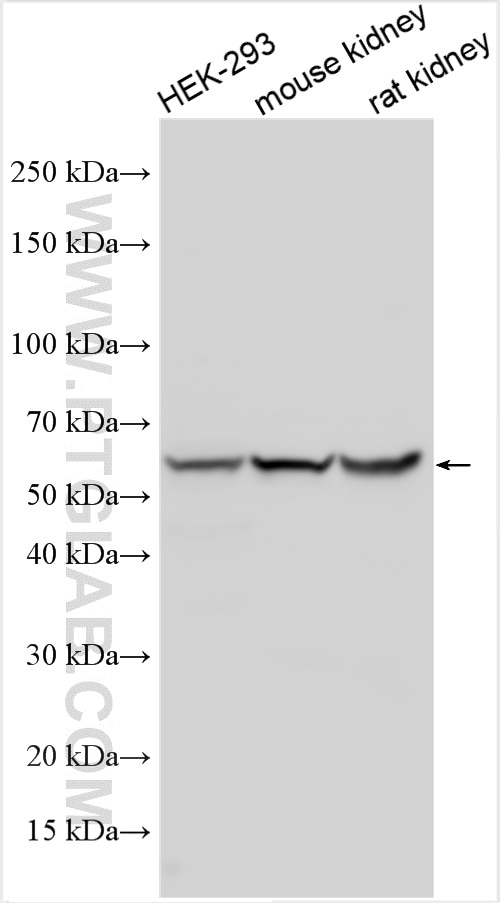
| Positive WB detected in | HEK-293 cells, mouse kidney tissue, rat kidney tissue |
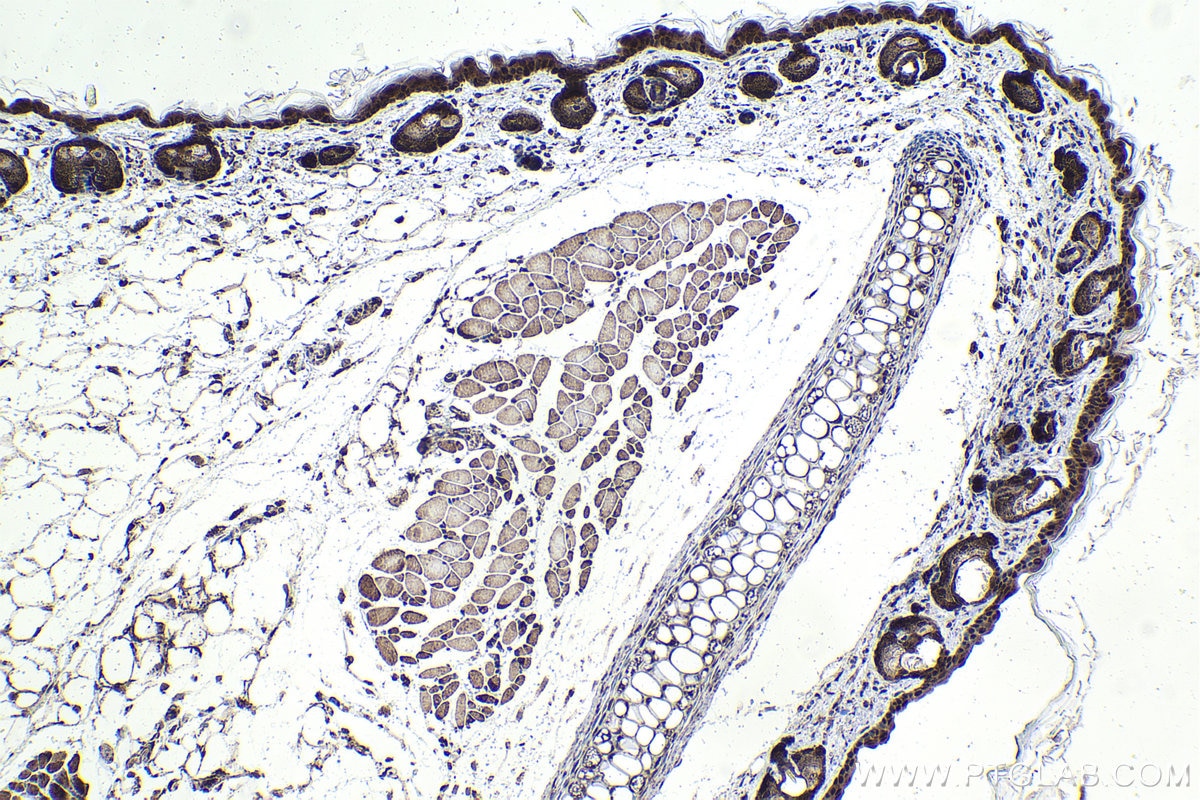
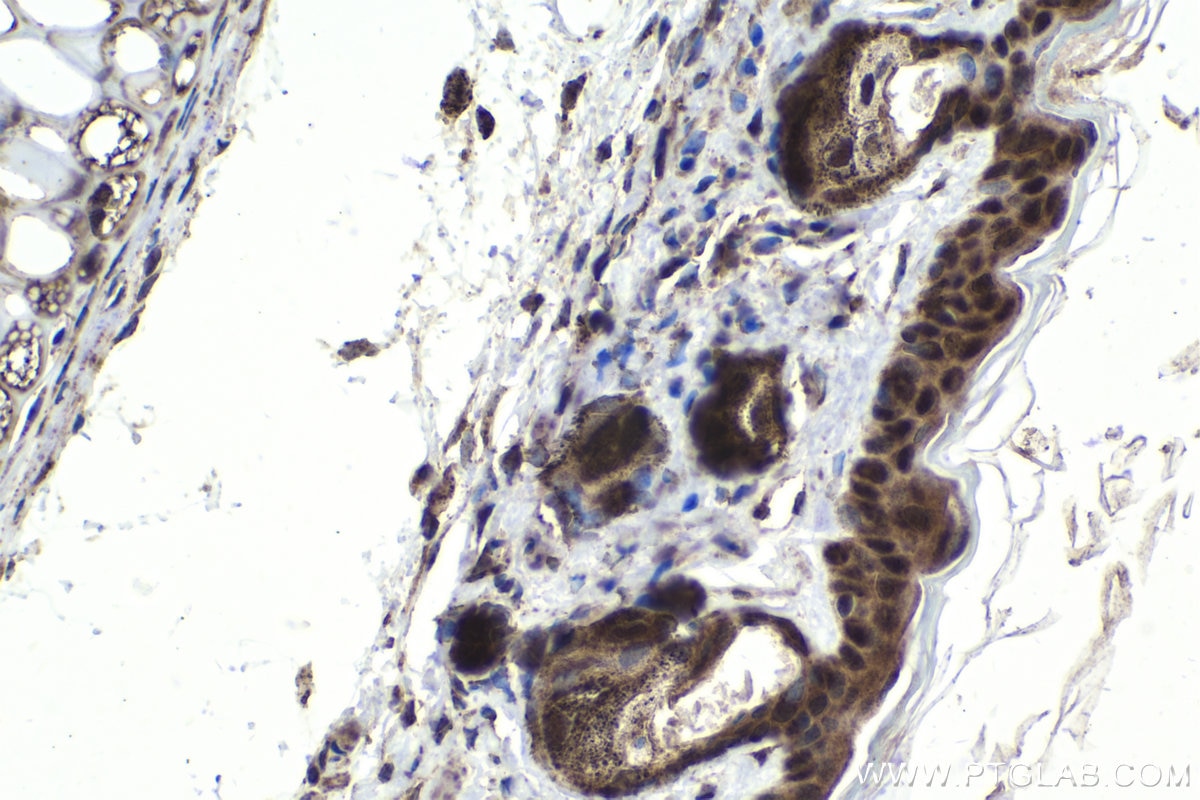
| Positive IHC detected in | mouse skin tissue Note: suggested antigen retrieval with TE buffer pH 9.0; (*) Alternatively, antigen retrieval may be performed with citrate buffer pH 6.0 |
Recommended dilution
| Application | Dilution |
|---|---|
| Western Blot (WB) | WB : 1:2000-1:16000 |
| Immunohistochemistry (IHC) | IHC : 1:250-1:1000 |
| It is recommended that this reagent should be titrated in each testing system to obtain optimal results. | |
| Sample-dependent, Check data in validation data gallery. | |
Product Information
22392-1-AP targets IRF7 in WB, IHC, IF, ELISA applications and shows reactivity with human, mouse samples.
| Tested Reactivity | human, mouse |
| Cited Reactivity | human, mouse, pig, duck, paralichthys olivaceus |
| Host / Isotype | Rabbit / IgG |
| Class | Polyclonal |
| Type | Antibody |
| Immunogen |
CatNo: Ag18059 Product name: Recombinant human IRF7 protein Source: e coli.-derived, PGEX-4T Tag: GST Domain: 168-516 aa of BC136555 Sequence: PGPFLAHTHAGLQAPGPLPAPAGDKGDLLLQAVQQSCLADHLLTASWGADPVPTKAPGEGQEGLPLTGACAGGPGLPAGELYGWAVETTPSPGPQPAALTTGEAAAPESPHQAEPYLSPSPSACTAVQEPSPGALDVTIMYKGRTVLQKVVGHPSCTFLYGPPDPAVRATDPQQVAFPSPAELPDQKQLRYTEELLRHVAPGLHLELRGPQLWARRMGKCKVYWEVGGPPGSASPSTPACLLPRNCDTPIFDFRVFFQELVEFRARQRRGSPRYTIYLGFGQDLSAGRPKEKSLVLVKLEPWLCRVHLEGTQREGVSSLDSSSLSLCLSSANSLYDDIECFLMELEQPA Predict reactive species |
| Full Name | IRF 7 |
| Calculated Molecular Weight | 516 aa, 56 kDa |
| Observed Molecular Weight | 55 kDa |
| GenBank Accession Number | BC136555 |
| Gene Symbol | IRF7 |
| Gene ID (NCBI) | 3665 |
| RRID | AB_2879097 |
| Conjugate | Unconjugated |
| Form | Liquid |
| Purification Method | Antigen affinity purification |
| UNIPROT ID | Q92985 |
| Storage Buffer | PBS with 0.02% sodium azide and 50% glycerol, pH 7.3. |
| Storage Conditions | Store at -20°C. Stable for one year after shipment. Aliquoting is unnecessary for -20oC storage. 20ul sizes contain 0.1% BSA. |
Background Information
IRF-7 (IFN regulatory factor 7) is a member of the IFN regulatory transcription factor (IRF) family. IRF-7 has been shown to play a role in the transcriptional activation of virus-inducible cellular proteins, including IFN beta chain proteins. Inducible expression of IRF-7 is largely restricted to lymphoid tissue. Four transcript variants encoding distinct isoforms (A,B,C and D) have been identified for this (PMID:9786932).The active IRF7A exists as a dimer form ~80 kDa(PMID:11073981). The MW 67-70 kDa has been reported in some papers (PMID:9786932; 22951831).Various posttranslational modifications of IRF7 including phosphorylation, ubiquitination, sumoylation and acetylation are identified (PMID:22951831).This antibody is a rabbit polyclonal antibody raised against the C-terminal 349 amino acid residues of human IRF7 D. The molecular weight of Nonphosphorylated IRF7 cofractionated with the 44-kDa marker, approximating its predicted size. In contrast, phosphorylated IRF7, which migrate more slowly on SDS-PAGE. This phosphorylated IRF7 was consistent with a size of 80 to 90 kDa. (PMID: 11073981 )
Protocols
| Product Specific Protocols | |
|---|---|
| IHC protocol for IRF7 antibody 22392-1-AP | Download protocol |
| WB protocol for IRF7 antibody 22392-1-AP | Download protocol |
| Standard Protocols | |
|---|---|
| Click here to view our Standard Protocols |
Publications
What published studies show
The IRF7 Polyclonal antibody (Cat# 22392-1-AP) has accumulated 41 citations published in journals such as Advanced Science, Cancer Letters, Cell Reports, Frontiers in Immunology, Journal of Immunology, Cell Chemical Biology, Brain Behavior and Immunity, and Arthritis Research & Therapy. Associated research fields include innate immunity and type I interferon signaling, oncology (glioma, colorectal cancer, AML, melanoma), inflammatory diseases (intestinal colitis, rheumatoid arthritis, psoriasis), antiviral immunity, macrophage polarization, and neuroinflammation.
| Species | Application | Title |
|---|---|---|
MedComm (2020) Single-cell transcriptomics reveals IRF7 regulation of the tumor microenvironment in isocitrate dehydrogenase wild-type glioma | ||
Adv Sci (Weinh) Mechanisms of Baicalin Alleviates Intestinal Inflammation: Role of M1 Macrophage Polarization and Lactobacillus amylovorus | ||
Cancer Lett NR4A1 depletion inhibits colorectal cancer progression by promoting necroptosis via the RIG-I-like receptor pathway | ||
Phytomedicine Si-Ni-San ameliorates chronic colitis by modulating type I interferons-mediated inflammation. | ||
Cell Chem Biol Identifying enhancers of innate immune signaling as broad-spectrum antivirals active against emerging viruses. | ||
Int J Biol Macromol Structure elucidation and molecular mechanism of an immunomodulatory polysaccharide from Nostoc commune |
Reviews
What customers say
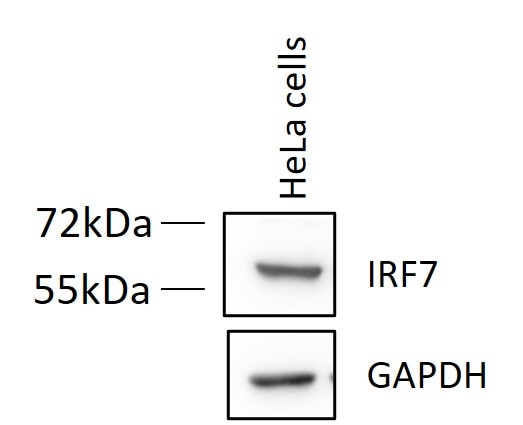
One reviewer used this antibody for Western Blot to detect IRF7 in HeLa cells and gave it a 5-star rating. They reported excellent performance at a 1/2000 dilution, noting that it could be further diluted without loss of signal. Overall, the feedback is positive, highlighting reliable detection and flexibility in working dilution.
The reviews below have been submitted by verified Proteintech customers who received an incentive for providing their feedback.
Margaux (Verified Customer) (10-25-2025) | I used this antibody to detect IRF7 in HeLa cells by western-blot. It worked very well at the dilution 1/2000 and it could easily be diluted more.
 |




