
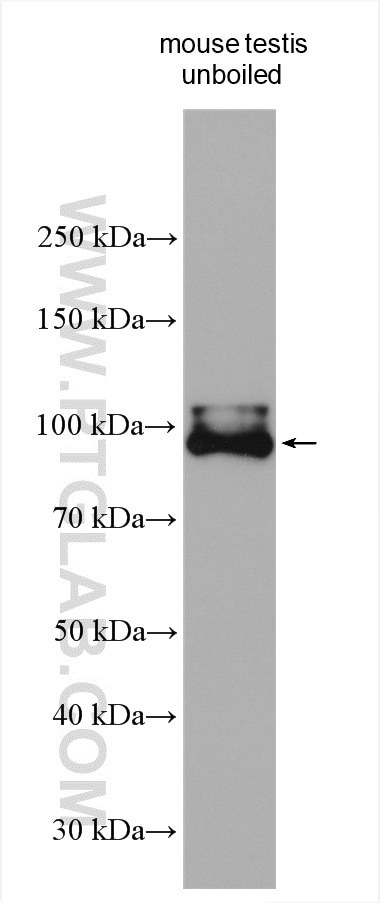
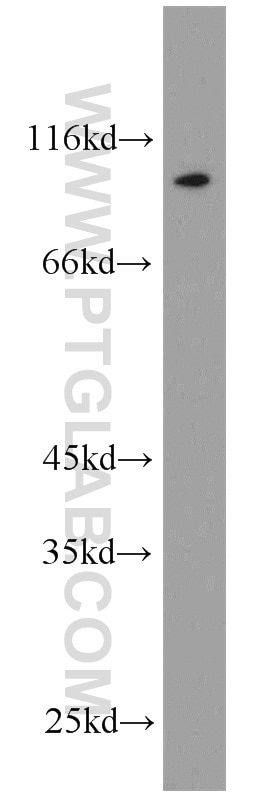
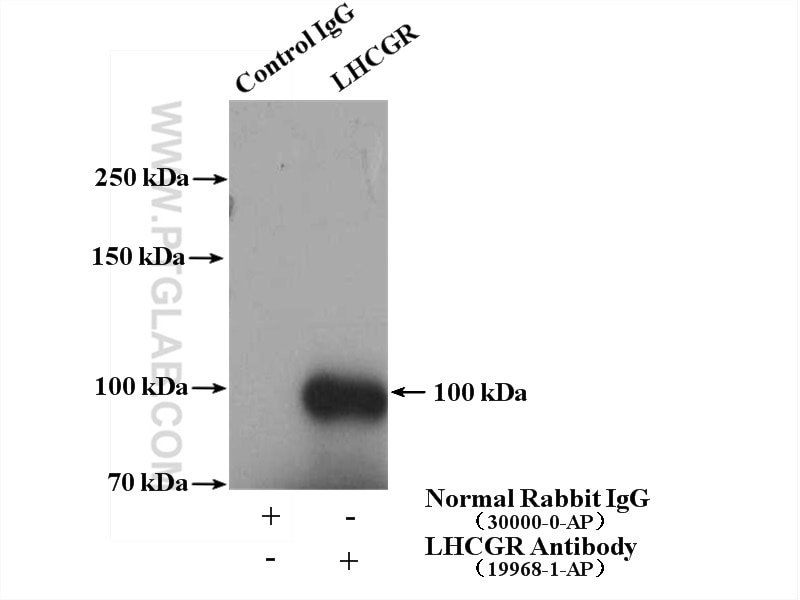
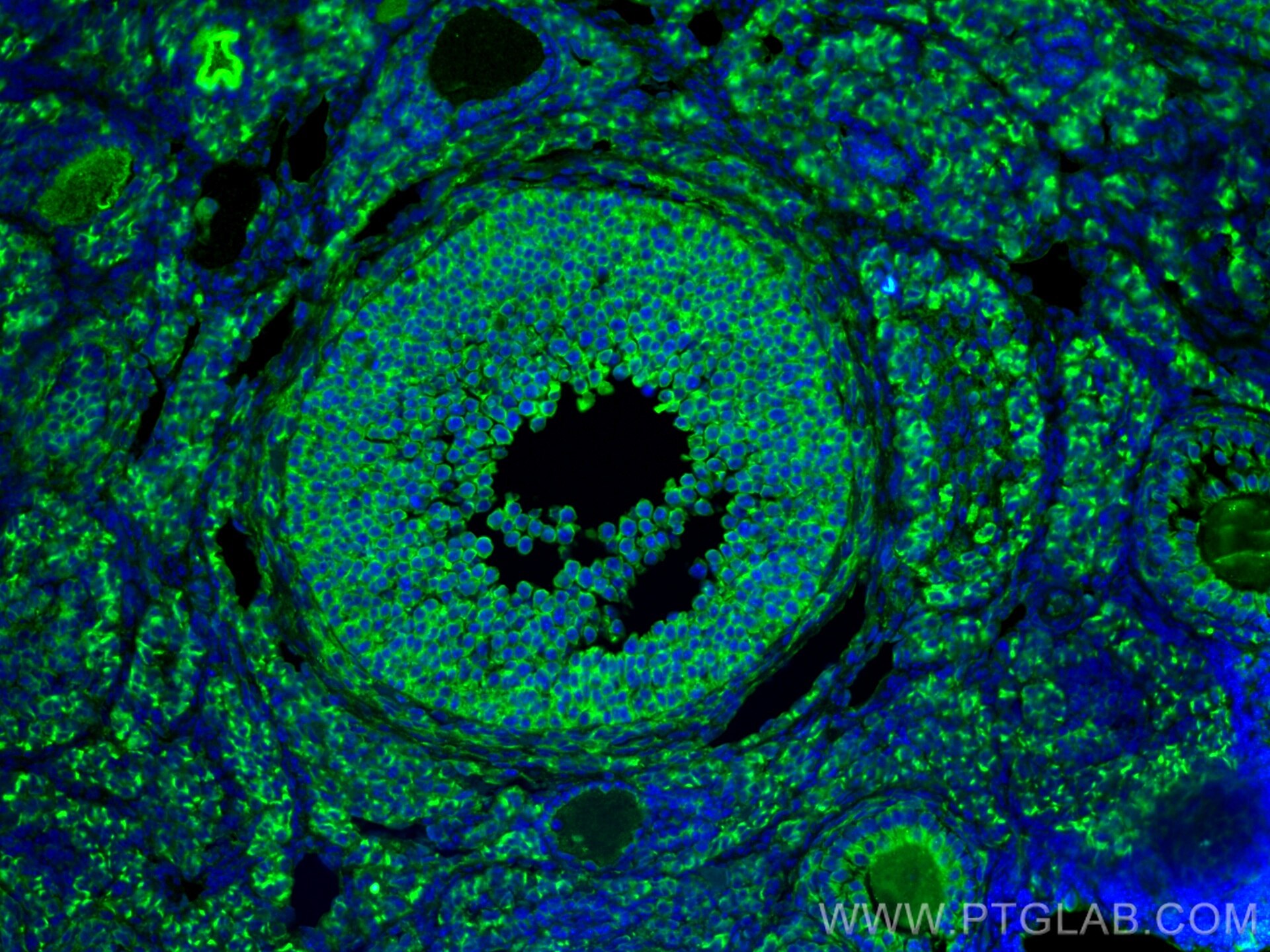

Tested Applications
| Positive WB detected in | unboiled mouse testis tissue, mouse ovary tissue |
| Positive IP detected in | mouse testis tissue |
| Positive IF-P detected in | mouse ovary tissue |
Recommended dilution
| Application | Dilution |
|---|---|
| Western Blot (WB) | WB : 1:500-1:3000 |
| Immunoprecipitation (IP) | IP : 0.5-4.0 ug for 1.0-3.0 mg of total protein lysate |
| Immunofluorescence (IF)-P | IF-P : 1:50-1:500 |
| It is recommended that this reagent should be titrated in each testing system to obtain optimal results. | |
| Sample-dependent, Check data in validation data gallery. | |
Product Information
19968-1-AP targets LHCGR in WB, IHC, IF-P, IP, ELISA applications and shows reactivity with human, mouse, rat samples.
| Tested Reactivity | human, mouse, rat |
| Cited Reactivity | human, mouse, rat, pig, sheep |
| Host / Isotype | Rabbit / IgG |
| Class | Polyclonal |
| Type | Antibody |
| Immunogen |
Peptide Predict reactive species |
| Full Name | LHCGR |
| Calculated Molecular Weight | 79 kDa |
| Observed Molecular Weight | 90-100 kDa |
| GenBank Accession Number | NM_000233 |
| Gene Symbol | LHCGR |
| Gene ID (NCBI) | 3973 |
| RRID | AB_10697685 |
| Conjugate | Unconjugated |
| Form | Liquid |
| Purification Method | Antigen affinity purification |
| UNIPROT ID | P22888 |
| Storage Buffer | PBS with 0.02% sodium azide and 50% glycerol, pH 7.3. |
| Storage Conditions | Store at -20°C. Stable for one year after shipment. Aliquoting is unnecessary for -20oC storage. 20ul sizes contain 0.1% BSA. |
Background Information
Lutropin-choriogonadotropic hormone receptor (LHCGR, also known as LHR or LSHR) belongs to the rhodopsin-like family of G protein-coupled receptors (GPCRs). It plays a crucial role in the regulation of gonadal functions by stimulating steroidogenesis in response to luteinizing hormone (LH) or hCG (PMID: 15866423). Mutations in the LHCGR gene result in familial male-limited precocious puberty, Leydig cell hypoplasia, and empty follicle syndrome (PMID: 30711030). LHCGR protein consists of 699 amino acids with a calculated molecular weight of 79 kDa. Due to massive glycosylation, the molecular mass of the mature LHCGR is higher (85-100 kDa) than the predicted molecular protein mass of 79 kDa (PMID: 23686864; 15866423; 29075189; 15969756).
Protocols
| Product Specific Protocols | |
|---|---|
| IF protocol for LHCGR antibody 19968-1-AP | Download protocol |
| IP protocol for LHCGR antibody 19968-1-AP | Download protocol |
| WB protocol for LHCGR antibody 19968-1-AP | Download protocol |
| Standard Protocols | |
|---|---|
| Click here to view our Standard Protocols |
Publications
What published studies show
Anti-LHCGR (Luteinizing Hormone/Choriogonadotropin Receptor) antibody, catalog number 19968-1-AP, has 40 total citations. Citations appear in journals including Cell Stem Cell, iScience, Int J Mol Sci, Fertil Steril, Hum Reprod, Biol Reprod, J Hazard Mater, Reprod Biol Endocrinol, and Sci Rep. Associated research fields encompass reproductive endocrinology, steroidogenesis, Leydig and granulosa cell biology, PCOS, endometriosis, environmental reproductive toxicology, circadian rhythm in reproduction, and placental biology.
| Species | Application | Title |
|---|---|---|
Cell Death Dis MeCP2 duplication causes hyperandrogenism by upregulating LHCGR and downregulating RORα. | ||
Part Fibre Toxicol Chronic exposure to polystyrene microplastics induced male reproductive toxicity and decreased testosterone levels via the LH-mediated LHR/cAMP/PKA/StAR pathway. | ||
J Hazard Mater GRP78/IRE1 and cGAS/STING pathway crosstalk through CHOP facilitates iodoacetic acid-mediated testosterone decline | ||
Int J Nanomedicine La2O3 Nanoparticles Induce Reproductive Toxicity Mediated by the Nrf-2/ARE Signaling Pathway in Kunming Mice. | ||
Fertil Steril Optimizing In Vitro Maturation Outcomes of Oocytes Following Gonadotropin Priming in Premenarcheal Girls Undergoing Ovarian Tissue Cryopreservation |





