

Tested Applications
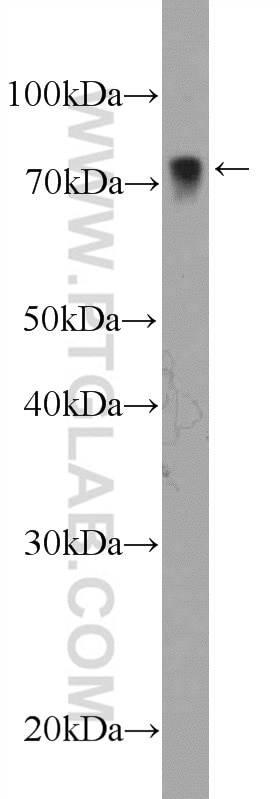
| Positive WB detected in | NIH/3T3 cells |
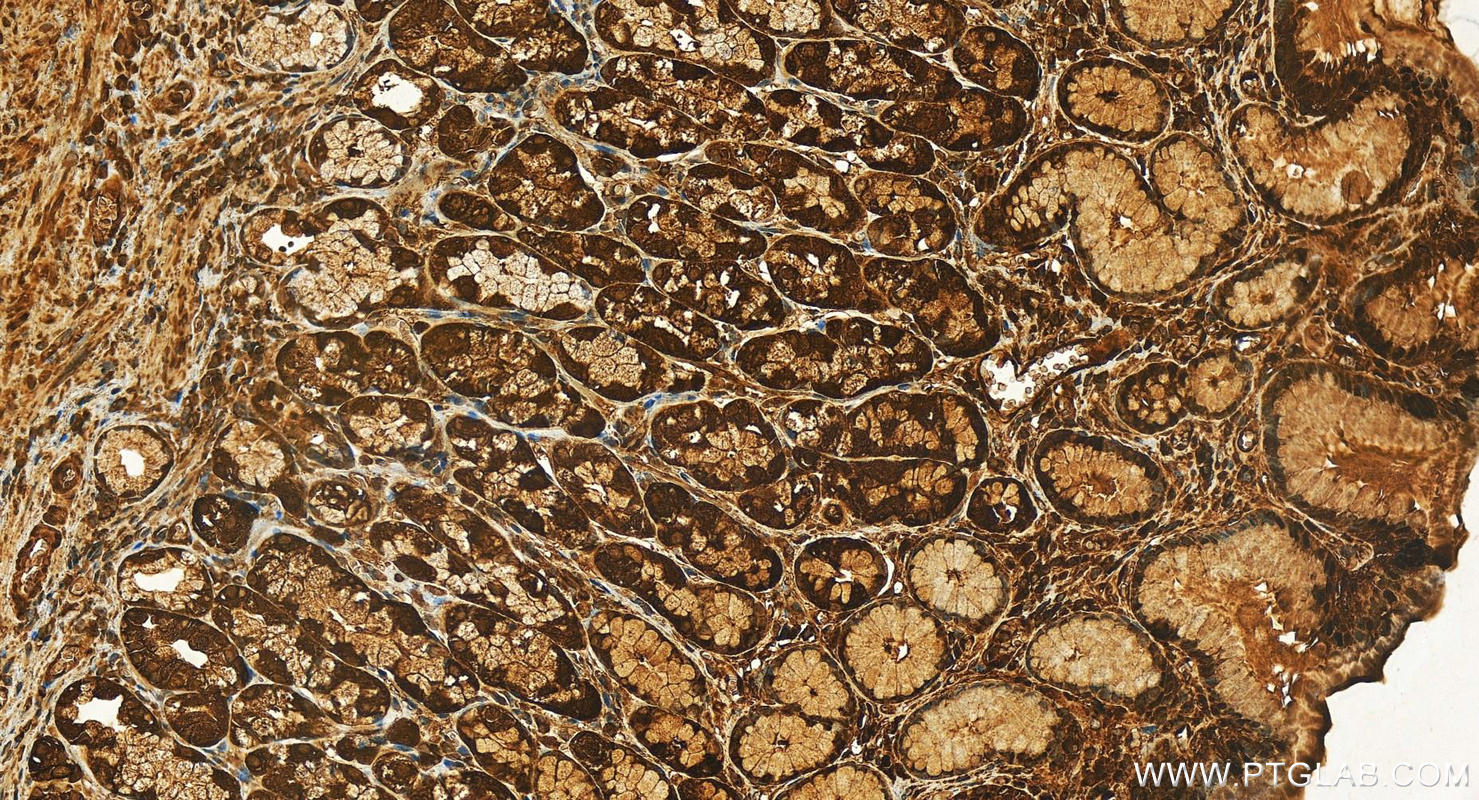
| Positive IHC detected in | human stomach tissue Note: suggested antigen retrieval with TE buffer pH 9.0; (*) Alternatively, antigen retrieval may be performed with citrate buffer pH 6.0 |
Recommended dilution
| Application | Dilution |
|---|---|
| Western Blot (WB) | WB : 1:500-1:1000 |
| Immunohistochemistry (IHC) | IHC : 1:50-1:500 |
| It is recommended that this reagent should be titrated in each testing system to obtain optimal results. | |
| Sample-dependent, Check data in validation data gallery. | |
Product Information
12350-1-AP targets LIMK2 in WB, IHC, IF, ELISA applications and shows reactivity with human, mouse, rat samples.
| Tested Reactivity | human, mouse, rat |
| Cited Reactivity | human, mouse, rat |
| Host / Isotype | Rabbit / IgG |
| Class | Polyclonal |
| Type | Antibody |
| Immunogen |
CatNo: Ag3011 Product name: Recombinant human LIMK2 protein Source: e coli.-derived, T-HIS Tag: 6*His Domain: 379-686 aa of BC013051 Sequence: KLNLLTEYIEGGTLKDFLRSMDPFPWQQKVRFAKGIASGMAYLHSMCIIHRDLNSHNCLIKLDKTVVVADFGLSRLIVEERKRAPMEKATTKKRTLRKNDRKKRYTVVGNPYWMAPEMLNGKSYDETVDIFSFGIVLCEIIGQVYADPDCLPRTLDFGLNVKLFWEKFVPTDCPPAFFPLAAICCRLEPESRAPPGAAGEGPGCADDEGPVRRQGKVTIKYDPKELRKHLNLEEWILEQLTRLYDCQEEEISELEIDVDELLDMESDDAWASRVKELLVDCYKPTEAFISGLLDKIRAMQKLSTPQKK Predict reactive species |
| Full Name | LIM domain kinase 2 |
| Calculated Molecular Weight | 686 aa, 78 kDa |
| Observed Molecular Weight | 70-80 kDa |
| GenBank Accession Number | BC013051 |
| Gene Symbol | LIMK2 |
| Gene ID (NCBI) | 3985 |
| RRID | AB_2137094 |
| Conjugate | Unconjugated |
| Form | Liquid |
| Purification Method | Antigen affinity purification |
| UNIPROT ID | P53671 |
| Storage Buffer | PBS with 0.02% sodium azide and 50% glycerol, pH 7.3. |
| Storage Conditions | Store at -20°C. Stable for one year after shipment. Aliquoting is unnecessary for -20oC storage. 20ul sizes contain 0.1% BSA. |
Background Information
The family of LIM kinase (LIMK) includes two similar proteins, LIMK1 and LIMK2, that share overall identity of 53% with 75%, 55%, and 42% amino acid identity in the LIM, kinase, and PDZ domains, respectively. LIMK2 regulates actin cytoskeletal reorganization through phosphorylating and inactivating cofilin, an actin-depolymerizing factor of actin filaments. It also may associate with gamma-tubulin and play a role in mitotic spindle assembly. High levels of LIMK2 are evident in uterus, thymus, and spleen whereas lower levels are observed in brain, heart, liver, stomach, skeletal muscle, and testes according to the results of western blotting(PMID:16399995). It has 3 isoforms produced by alternative splicing of the molecular weight of 70-78 kDa. It can be detected a band of 47 kDa or 50-55 kDa in the testes because the antibody is recognizing the testis-specific variant of LIMK2 and the this difference could be due to species variation(PMID:17928627).
Protocols
| Product Specific Protocols | |
|---|---|
| IHC protocol for LIMK2 antibody 12350-1-AP | Download protocol |
| WB protocol for LIMK2 antibody 12350-1-AP | Download protocol |
| Standard Protocols | |
|---|---|
| Click here to view our Standard Protocols |
Publications
What published studies show
The anti-LIMK2 antibody (Cat# 12350-1-AP) has 11 total citations across journals including Theranostics, Cell Death & Disease, Advanced Healthcare Materials, Journal of Cachexia, Sarcopenia and Muscle, European Journal of Pharmacology, Molecular Biotechnology, PLoS One, BMC Medical Genomics, Brazilian Journal of Medical and Biological Research, and bioRxiv. Research fields span oncology (bladder, colorectal, cervical, lung, and osteosarcoma cancer), bone regeneration, neural/vascular repair post-cerebral infarction, muscular dystrophy, pulmonary hypertension, and cytoskeletal remodeling/EMT.
| Species | Application | Title |
|---|---|---|
Theranostics NUDT21 inhibits bladder cancer progression through ANXA2 and LIMK2 by alternative polyadenylation. | ||
Cell Death Dis Imbalanced LIMK1 and LIMK2 expression leads to human colorectal cancer progression and metastasis via promoting β-catenin nuclear translocation. | ||
Adv Healthc Mater Therapeutic Targeting of the IRF9/RTN4/RHOA/ROCK Pathway via RVG29-Modified PLGA Nanoparticles and rTMS for Neural and Vascular Regeneration Post-Cerebral Infarction. | ||
Adv Healthc Mater Modification of PLGA Scaffold by MSC-Derived Extracellular Matrix Combats Macrophage Inflammation to Initiate Bone Regeneration via TGF-β-Induced Protein. | ||
J Cachexia Sarcopenia Muscle RhoA/ROCK2 signalling is enhanced by PDGF-AA in fibro-adipogenic progenitor cells: implications for Duchenne muscular dystrophy. | ||
Eur J Pharmacol Pinocembrin attenuates susceptibility to atrial fibrillation in rats with pulmonary arterial hypertension |



