

Tested Applications
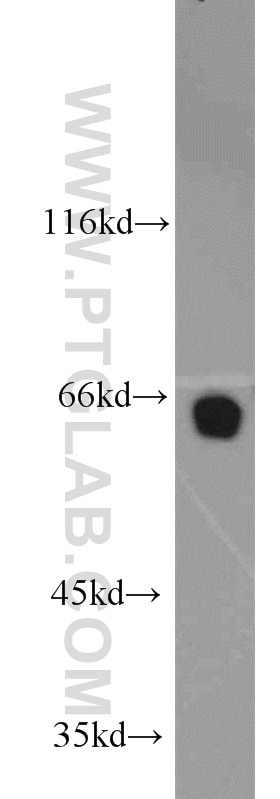
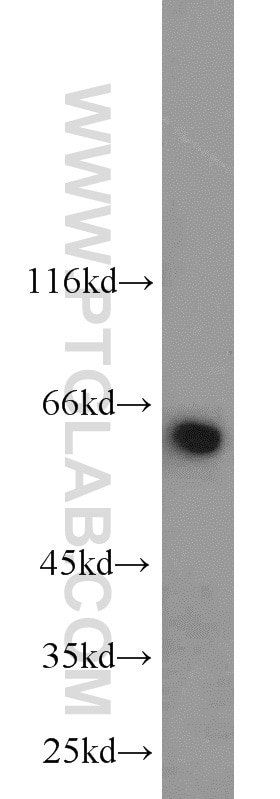
| Positive WB detected in | PC-3 cells, NIH/3T3 cells |
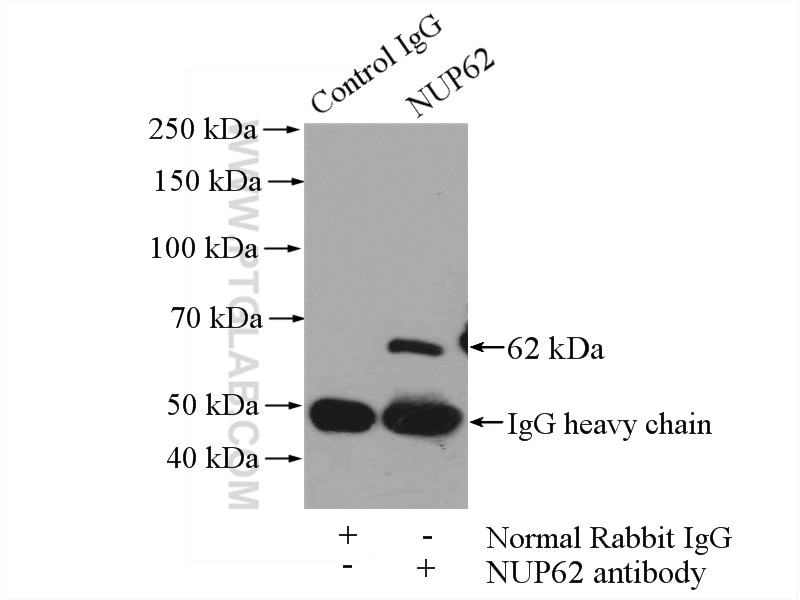
| Positive IP detected in | NIH/3T3 cells |
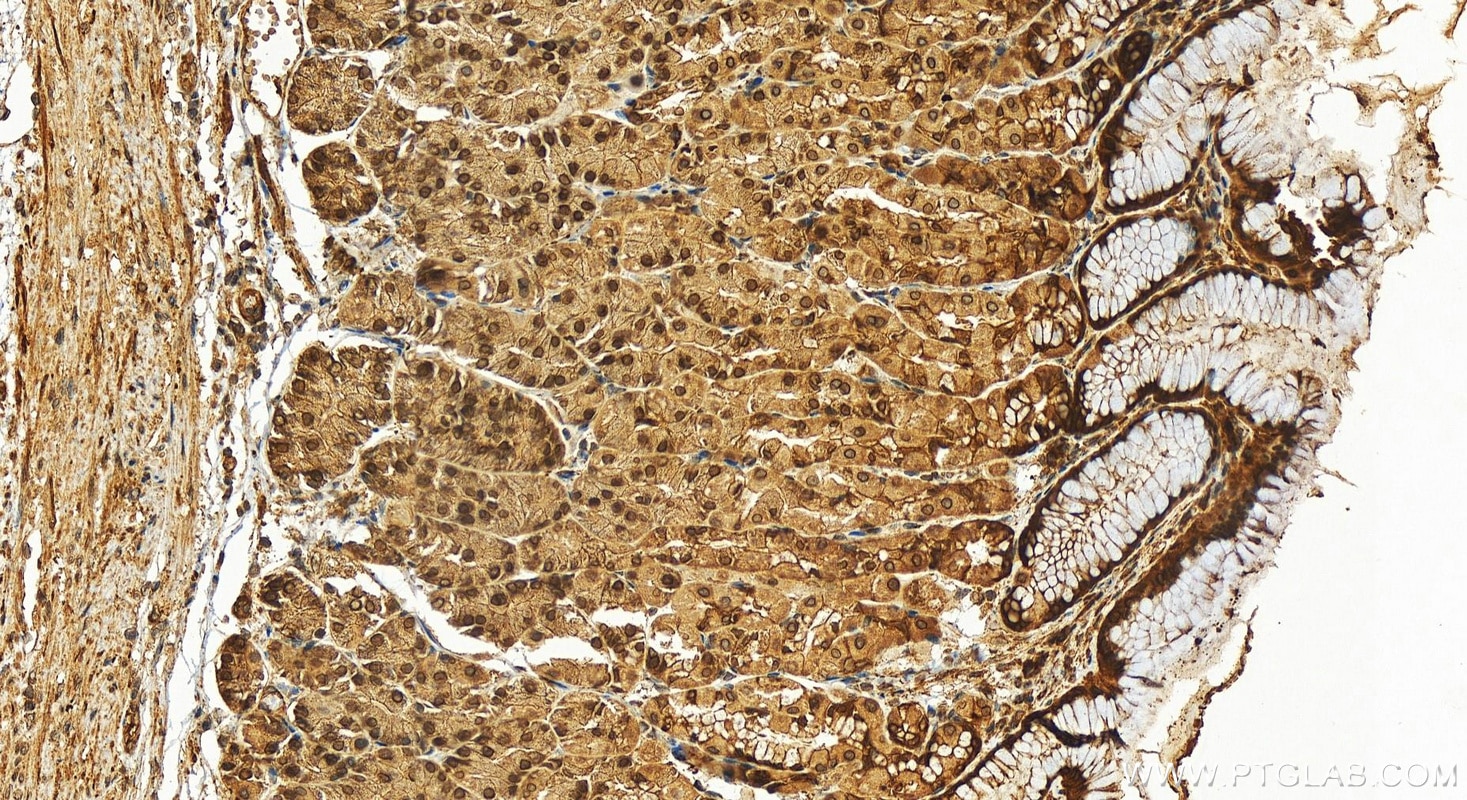
| Positive IHC detected in | human stomach tissue Note: suggested antigen retrieval with TE buffer pH 9.0; (*) Alternatively, antigen retrieval may be performed with citrate buffer pH 6.0 |
Recommended dilution
| Application | Dilution |
|---|---|
| Western Blot (WB) | WB : 1:500-1:3000 |
| Immunoprecipitation (IP) | IP : 0.5-4.0 ug for 1.0-3.0 mg of total protein lysate |
| Immunohistochemistry (IHC) | IHC : 1:50-1:500 |
| It is recommended that this reagent should be titrated in each testing system to obtain optimal results. | |
| Sample-dependent, Check data in validation data gallery. | |
Product Information
13916-1-AP targets NUP62 in WB, IHC, IF, IP, ELISA applications and shows reactivity with human, mouse, rat samples.
| Tested Reactivity | human, mouse, rat |
| Cited Reactivity | human, mouse, rat, pig, monkey, chicken |
| Host / Isotype | Rabbit / IgG |
| Class | Polyclonal |
| Type | Antibody |
| Immunogen |
CatNo: Ag4912 Product name: Recombinant human NUP62 protein Source: e coli.-derived, PGEX-4T Tag: GST Domain: 173-522 aa of BC014842 Sequence: IGSAGNSAQPTAPATLPFTPATPAATTAGATQPAAPTPTATITSTGPSLFASIATAPTSSATTGLSLCTPVTTAGAPTAGTQGFSLKAPGAASGTSTTTSTAATATATTTSSSSTTGFALNLKPLAPAGIPSNTAAAVTAPPGPGAAAGAAASSAMTYAQLESLINKWSLELEDQERHFLQQATQVNAWDRTLIENGEKITSLHREVEKVKLDQKRLDQELDFILSQQKELEDLLSPLEELVKEQSGTIYLQHADEEREKTYKLAENIDAQLKRMAQDLKDIIEHLNTSGAPADTSDPLQQICKILNAHMDSLQWIDQNSALLQRKVEEVTKVCEGRRKEQERSFRITFD Predict reactive species |
| Full Name | nucleoporin 62kDa |
| Calculated Molecular Weight | 522 aa, 53 kDa |
| Observed Molecular Weight | 62 kDa |
| GenBank Accession Number | BC014842 |
| Gene Symbol | NUP62 |
| Gene ID (NCBI) | 23636 |
| RRID | AB_2267660 |
| Conjugate | Unconjugated |
| Form | Liquid |
| Purification Method | Antigen affinity purification |
| UNIPROT ID | P37198 |
| Storage Buffer | PBS with 0.02% sodium azide and 50% glycerol, pH 7.3. |
| Storage Conditions | Store at -20°C. Stable for one year after shipment. Aliquoting is unnecessary for -20oC storage. 20ul sizes contain 0.1% BSA. |
Background Information
NUP62 belongs to the nucleoporin NSP1/NUP62 family. It is essential component of the nuclear pore complex. The N-terminal is probably involved in nucleocytoplasmic transport. The C-terminal is probably involved in protein-protein interaction via coiled-coil formation and may function in anchorage of p62 to the pore complex. Defects in NUP62 are the cause of infantile striatonigral degeneration (SNDI). NUP62 consists of a single promoter with a CpG island and three transcribed exons. It is ubiquitously expressed, an observation compatible with its essential role in transporting cargo across the nuclear envelope. (PMID:16029492)
Protocols
| Product Specific Protocols | |
|---|---|
| IHC protocol for NUP62 antibody 13916-1-AP | Download protocol |
| IP protocol for NUP62 antibody 13916-1-AP | Download protocol |
| WB protocol for NUP62 antibody 13916-1-AP | Download protocol |
| Standard Protocols | |
|---|---|
| Click here to view our Standard Protocols |
Publications
What published studies show
Anti-Nup62 (Cat# 13916-1-AP) has 23 citations published in 21 journals including Science, Nature Microbiology, Nature Physics, Molecular Cell, Journal of Clinical Investigation, Cell Reports, PLoS Pathogens, and Nature Communications. Research fields span nuclear pore complex biology, nucleocytoplasmic trafficking, phase separation, cancer, neurology, virology/immunology, lipid metabolism, autophagy, and RNA biology.
| Species | Application | Title |
|---|---|---|
Nat Microbiol Nuclear pore blockade reveals that HIV-1 completes reverse transcription and uncoating in the nucleus. | ||
Nat Phys Structural anisotropy results in mechano-directional transport of proteins across nuclear pores
| ||
Mol Cell RAPIDASH: Tag-free enrichment of ribosome-associated proteins reveals composition dynamics in embryonic tissue, cancer cells, and macrophages | ||
J Clin Invest Sec13 promotes oligodendrocyte differentiation and myelin repair through autocrine pleiotrophin signaling. | ||
Cell Death Discov Exon junction complex and nuclear pore complex components preferentially govern the nuclear export of spliced lncRNAs. |





