

Tested Applications
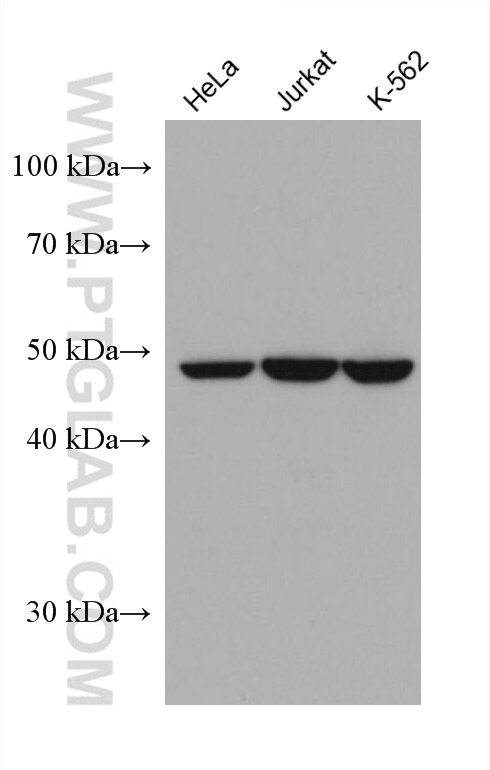
| Positive WB detected in | HeLa cells, A549 cells, pig adipose tissue, Jurkat cells, K-562 cells |
Recommended dilution
| Application | Dilution |
|---|---|
| Western Blot (WB) | WB : 1:1000-1:6000 |
| It is recommended that this reagent should be titrated in each testing system to obtain optimal results. | |
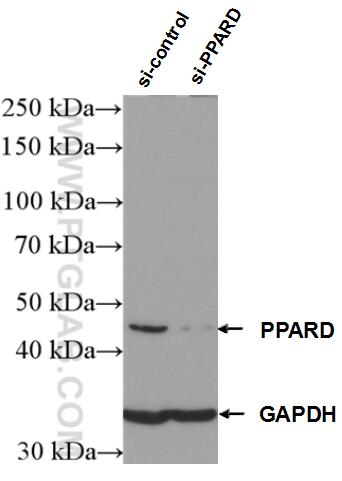
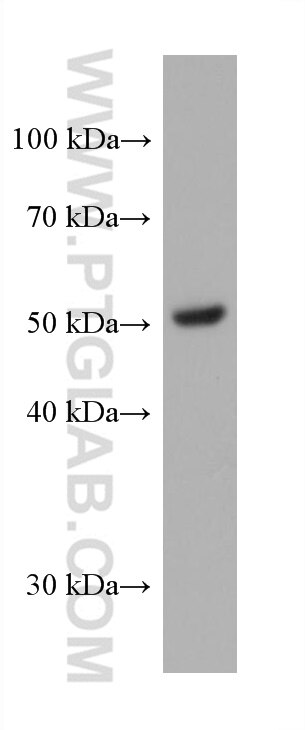
| Sample-dependent, Check data in validation data gallery. | |
Product Information
60193-1-Ig targets PPARD in WB, IHC, ChIP, ELISA applications and shows reactivity with human, pig samples.
| Tested Reactivity | human, pig |
| Cited Reactivity | human, mouse, rat, pig, zebrafish |
| Host / Isotype | Mouse / IgG2a |
| Class | Monoclonal |
| Type | Antibody |
| Immunogen |
CatNo: Ag16770 Product name: Recombinant human PPARD protein Source: e coli.-derived, PET28a Tag: 6*His Domain: 102-361 aa of BC002715 Sequence: IRMKLEYEKCERSCKIQKKNRNKCQYCRFQKCLALGMSHNAIRFGRMPEAEKRKLVAGLTANEGSQYNPQVADLKAFSKHIYNAYLKNFNMTKKKARSILTGKASHTAPFVIHDIETLWQAEKGLVWKQLVNGLPPYKEISVHVFYRCQCTTVETVRELTEFAKSIPSFSSLFLNDQVTLLKYGVHEAIFAMLASIVNKDGLLVANGSGFVTREFLRSLRKPFSDIIEPKFEFAVKFNALELDDSDLALFIAAIILCGGE Predict reactive species |
| Full Name | peroxisome proliferator-activated receptor delta |
| Calculated Molecular Weight | 50 kDa |
| Observed Molecular Weight | 54 kDa |
| GenBank Accession Number | BC002715 |
| Gene Symbol | PPARD |
| Gene ID (NCBI) | 5467 |
| RRID | AB_10896827 |
| Conjugate | Unconjugated |
| Form | Liquid |
| Purification Method | Protein A purification |
| UNIPROT ID | Q03181 |
| Storage Buffer | PBS with 0.02% sodium azide and 50% glycerol, pH 7.3. |
| Storage Conditions | Store at -20°C. Stable for one year after shipment. Aliquoting is unnecessary for -20oC storage. 20ul sizes contain 0.1% BSA. |
Background Information
Peroxisome proliferator-activator receptor delta(PPARD), a ligand-activated transcription factor, belongs to the PPARs family, which get its name for their chemicals that induce proliferation of peroxisomes, organelles that contributes to the oxidation of fatty acids. PPARD is a receptor for peroxisome proliferator and once activated by a ligand, it binds to and activates the promoter elements of target genes, such as acylCoA oxidase gene. But it act as a repressor for the NPC1L1 gene.
Protocols
| Product Specific Protocols | |
|---|---|
| WB protocol for PPARD antibody 60193-1-Ig | Download protocol |
| Standard Protocols | |
|---|---|
| Click here to view our Standard Protocols |
Publications
What published studies show
The PPARD Monoclonal antibody (Cat# 60193-1-Ig) has 29 citations spanning journals including Nature Communications, Cell Reports, Advanced Science, Cell Death & Disease, Clinical and Translational Medicine, PLoS Pathogens, Journal of Biological Chemistry, and iScience. Research fields cover lipid metabolism, hepatocellular carcinoma, fibrosis, cardiovascular disease, diabetes, neurodegeneration, inflammation, circadian biology, and metabolic reprogramming across human, mouse, rat, zebrafish, and pig models.
| Species | Application | Title |
|---|---|---|
Nat Commun Axin formation inhibitor 1 aggravates hepatic ischemia‒reperfusion injury by promoting the ubiquitination and degradation of PPARβ | ||
Genes Dis 8-Chloroadenosine suppresses hepatocellular carcinoma progression via ADAR1/PPARγ axis-mediated lipid metabolism. | ||
Adv Sci (Weinh) The Loss of an Orphan Nuclear Receptor NR2E3 Augments Wnt/β-catenin Signaling via Epigenetic Dysregulation that Enhances Sp1-β catenin-p300 Interactions in Hepatocellular Carcinoma | ||
Cell Death Dis CILP1 interacting with YBX1 promotes hypertrophic scar formation by suppressing PPARs transcription | ||
Clin Transl Med Cullin-associated and neddylation-dissociated 1 regulate reprogramming of lipid metabolism through SKP1-Cullin-1-F-boxFBXO11 -mediated heterogeneous nuclear ribonucleoprotein A2/B1 ubiquitination and promote hepatocellular carcinoma |




