
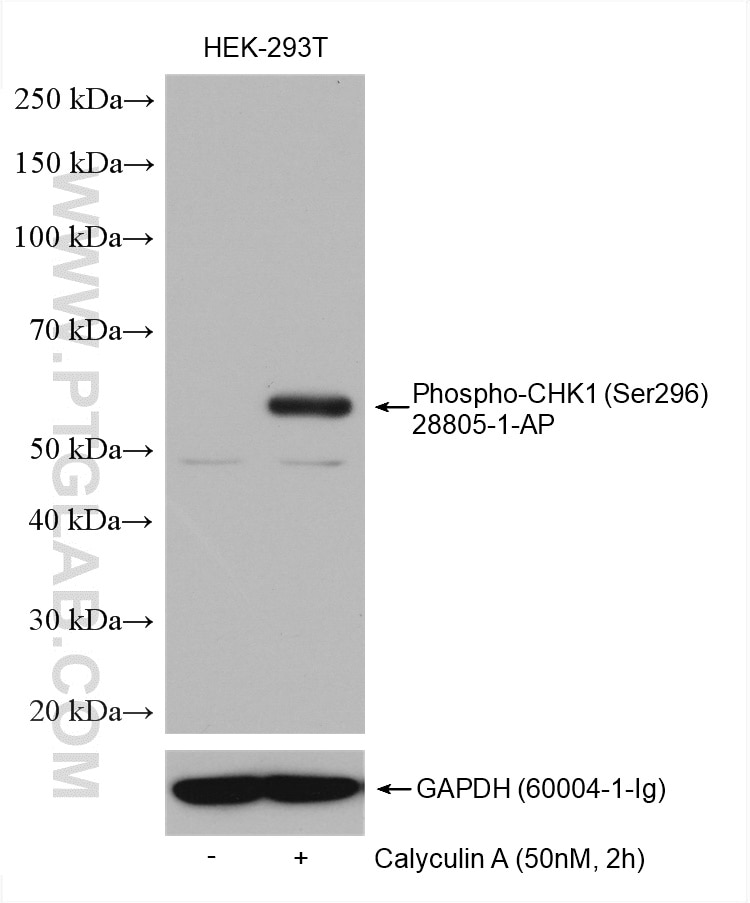

Tested Applications
| Positive WB detected in | Calyculin A treated HEK-293T cells |
Recommended dilution
| Application | Dilution |
|---|---|
| Western Blot (WB) | WB : 1:1000-1:8000 |
| It is recommended that this reagent should be titrated in each testing system to obtain optimal results. | |
| Sample-dependent, Check data in validation data gallery. | |
Product Information
28805-1-AP targets Phospho-Chk1 (Ser296) in WB, ELISA applications and shows reactivity with human, mouse, rat samples.
| Tested Reactivity | human, mouse, rat |
| Cited Reactivity | human, mouse |
| Host / Isotype | Rabbit / IgG |
| Class | Polyclonal |
| Type | Antibody |
| Immunogen |
Peptide Predict reactive species |
| Full Name | CHK1 checkpoint homolog (S. pombe) |
| Calculated Molecular Weight | 54 kDa |
| Observed Molecular Weight | 55 kDa |
| GenBank Accession Number | BC004202 |
| Gene Symbol | Chk1 |
| Gene ID (NCBI) | 1111 |
| RRID | AB_2881215 |
| Conjugate | Unconjugated |
| Form | Liquid |
| Purification Method | Antigen affinity purification |
| UNIPROT ID | O14757 |
| Storage Buffer | PBS with 0.02% sodium azide and 50% glycerol, pH 7.3. |
| Storage Conditions | Store at -20°C. Stable for one year after shipment. Aliquoting is unnecessary for -20oC storage. 20ul sizes contain 0.1% BSA. |
Background Information
In response to DNA damage, mammalian cells prevent cell cycle progression through the control of critical cell cycle regulators. CHK1 (synonym: CHEK1), a homolog of the Schizosaccharomyces pombe Chk1 protein kinase, is required for the DNA damage checkpoint. Human Chk1 protein is modified in response to DNA damage. In vitro Chk1 binds to and phosphorylate the dual-specificity protein phosphatases Cdc25A, Cdc25B, and Cdc25C, which control cell cycle transitions by dephosphorylating cyclin-dependent kinases. CHK1 can be autophosphorylated (PMID:22941630) and ubiquitinated (PMID:19276361). Activation of Chk1 involves phosphorylation at Ser317 and Ser345 by ATM/ATR, followed by autophosphorylation of Ser296. Activation occurs in response to blocked DNA replication and certain forms of genotoxic stress.
Protocols
| Product Specific Protocols | |
|---|---|
| WB protocol for Phospho-Chk1 (Ser296) antibody 28805-1-AP | Download protocol |
| Standard Protocols | |
|---|---|
| Click here to view our Standard Protocols |
Publications
What published studies show
The anti-CHK1 antibody (Cat# 28805-1-AP) has 12 citations across 11 journals, including Advanced Science, Cell Reports, Cell Death & Discovery, Journal of Experimental & Clinical Cancer Research, and Archives of Toxicology. Research fields span DNA damage response, cancer biology (glioma, ovarian, colorectal, colon), cardiotoxicity, cardiac regeneration, COPD, and osteoarthritis. All cited applications are Western blot, primarily in human and mouse samples.
| Species | Application | Title |
|---|---|---|
J Exp Clin Cancer Res TRAF7 knockdown induces cellular senescence and synergizes with lomustine to inhibit glioma progression and recurrence | ||
Adv Sci (Weinh) Elevated TRIM25 Impairs Poly (ADP-ribose) Metabolism via PARG Degradation and Mediates Compression-Induced Intervertebral Disc Degeneration. | ||
Research (Wash D C) Nanoengineered Gallium Ion Incorporated Formulation for Safe and Efficient Reversal of PARP Inhibition and Platinum Resistance in Ovarian Cancer | ||
Arch Toxicol SIRT3-dependent mitochondrial redox homeostasis mitigates CHK1 inhibition combined with gemcitabine treatment induced cardiotoxicity in hiPSC-CMs and mice | ||
Cell Death Discov Tert promotes cardiac regenerative repair after MI through alleviating ROS-induced DNA damage response in cardiomyocyte |


