
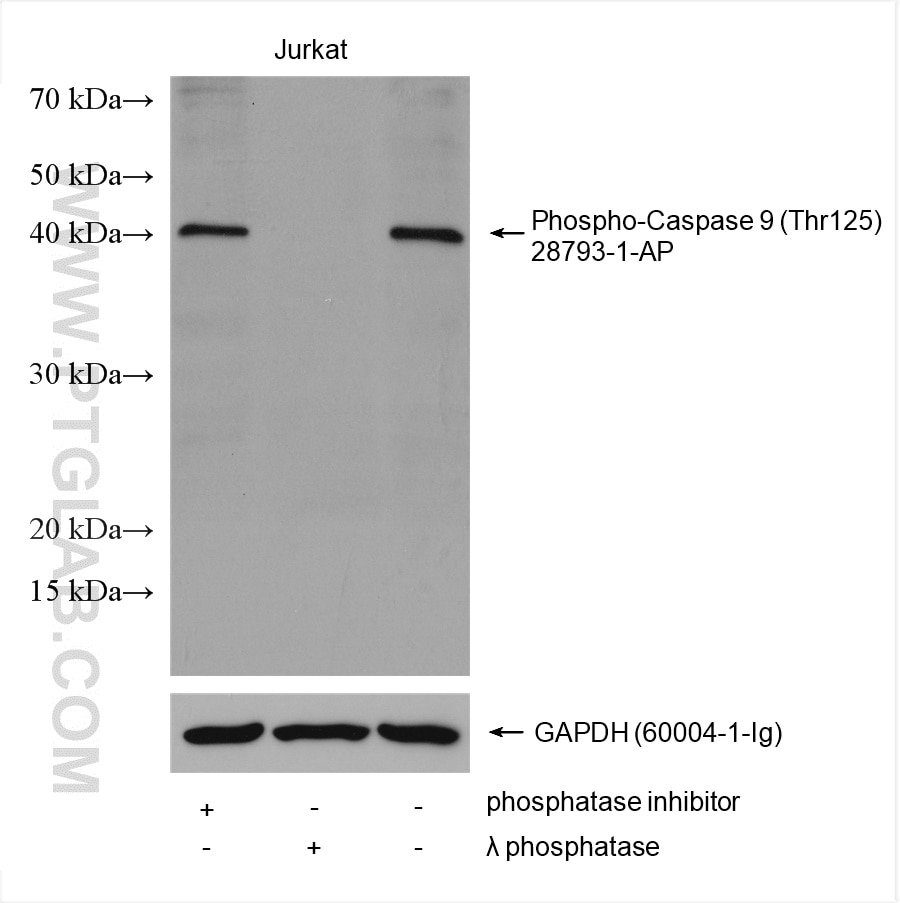

Tested Applications
| Positive WB detected in | Jurkat cells |
Recommended dilution
| Application | Dilution |
|---|---|
| Western Blot (WB) | WB : 1:1000-1:8000 |
| It is recommended that this reagent should be titrated in each testing system to obtain optimal results. | |
| Sample-dependent, Check data in validation data gallery. | |
Product Information
28793-1-AP targets Phospho-Caspase 9 (Thr125) in WB, ELISA applications and shows reactivity with human samples.
| Tested Reactivity | human |
| Host / Isotype | Rabbit / IgG |
| Class | Polyclonal |
| Type | Antibody |
| Immunogen |
Peptide Predict reactive species |
| Full Name | caspase 9, apoptosis-related cysteine peptidase |
| Calculated Molecular Weight | 46 kDa |
| Observed Molecular Weight | 40 kDa |
| GenBank Accession Number | BC002452 |
| Gene Symbol | Caspase 9 |
| Gene ID (NCBI) | 842 |
| RRID | AB_2918204 |
| Conjugate | Unconjugated |
| Form | Liquid |
| Purification Method | Antigen affinity purification |
| UNIPROT ID | P55211 |
| Storage Buffer | PBS with 0.02% sodium azide and 50% glycerol, pH 7.3. |
| Storage Conditions | Store at -20°C. Stable for one year after shipment. Aliquoting is unnecessary for -20oC storage. 20ul sizes contain 0.1% BSA. |
Background Information
Caspase 9 also name as MCH6, APAF3, APAF-3, ICE-LAP6 and CASPASE-9c, is a member of the cysteine-aspartic acid protease (caspase) family. It's synthesized as a 46 kDa precursor protein which can be cleaved into a 35 kDa subunit and a 11 kDa subunit. Control of all caspases is tightly regulated by a series of phosphorylation events enacted by several different kinases. Caspase-9 is the most heavily phosphorylated of all caspases, with phosphorylation of at least 11 distinct residues in all three caspase-9 domains by nine kinases. It plays a central role in the mitochondrial or intrinsic apoptotic pathway that is engaged in response to many apoptotic stimuli. Once activated, caspase-9 cleaves and activates the effector caspases 3 and 7 to bring about apoptosis. It's reported that there is an increase in caspase 9 expression and activity in the hypoxic brain. Inhibition of Caspase 9 activity would render opportunity to treat neurological diseases such as stroke, neurodegenerative diseases or brain injury caused by hypoxia. (PMID: 19788417, PMID: 10529400, PMID: 9812896, PMID: 18840507, PMID: 29066624)
Protocols
| Product Specific Protocols | |
|---|---|
| WB protocol for Phospho-Caspase 9 (Thr125) antibody 28793-1-AP | Download protocol |
| Standard Protocols | |
|---|---|
| Click here to view our Standard Protocols |
Reviews
What customers say
One reviewer (Christoffer N.) gave 5 stars for using this antibody in immunofluorescence at a 1:200 dilution on mouse postnatal (P7) retina and adult mouse retina. The antibody worked well on both paraffin-embedded adult tissue and cryo-embedded postnatal tissue. Overall, the review is positive with no reported issues.
The reviews below have been submitted by verified Proteintech customers who received an incentive for providing their feedback.
Christoffer (Verified Customer) (03-03-2025) | Used on adult mouse retina embedded in paraffin as well as cryo embedded postnatal (p7) mouse tissue and work well.
|


