

Tested Applications
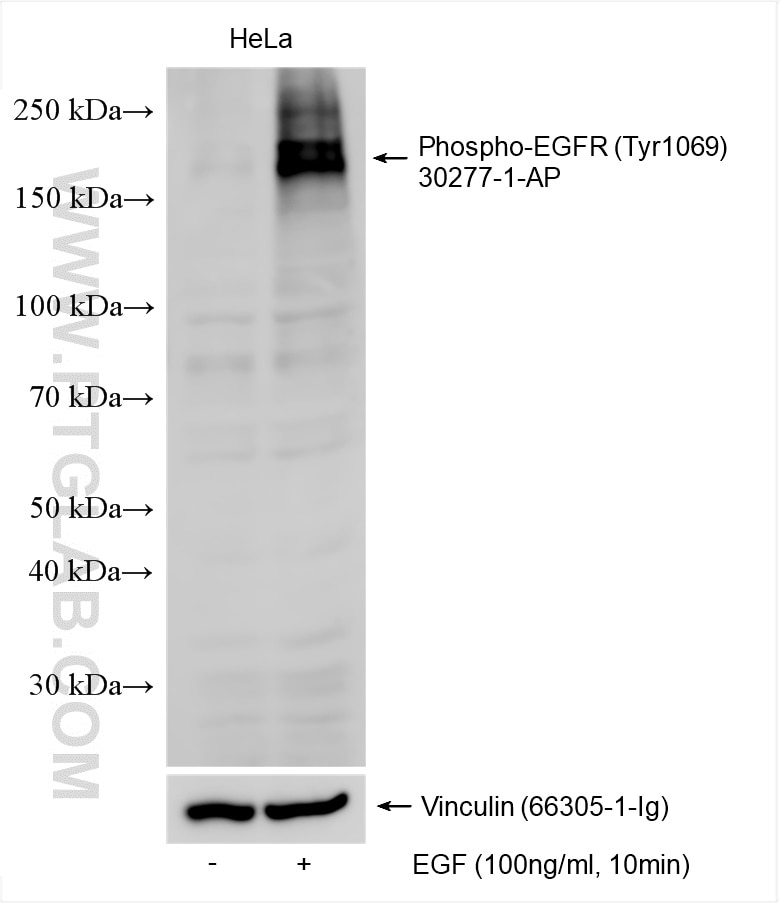
| Positive WB detected in | EGF treated HeLa cells |
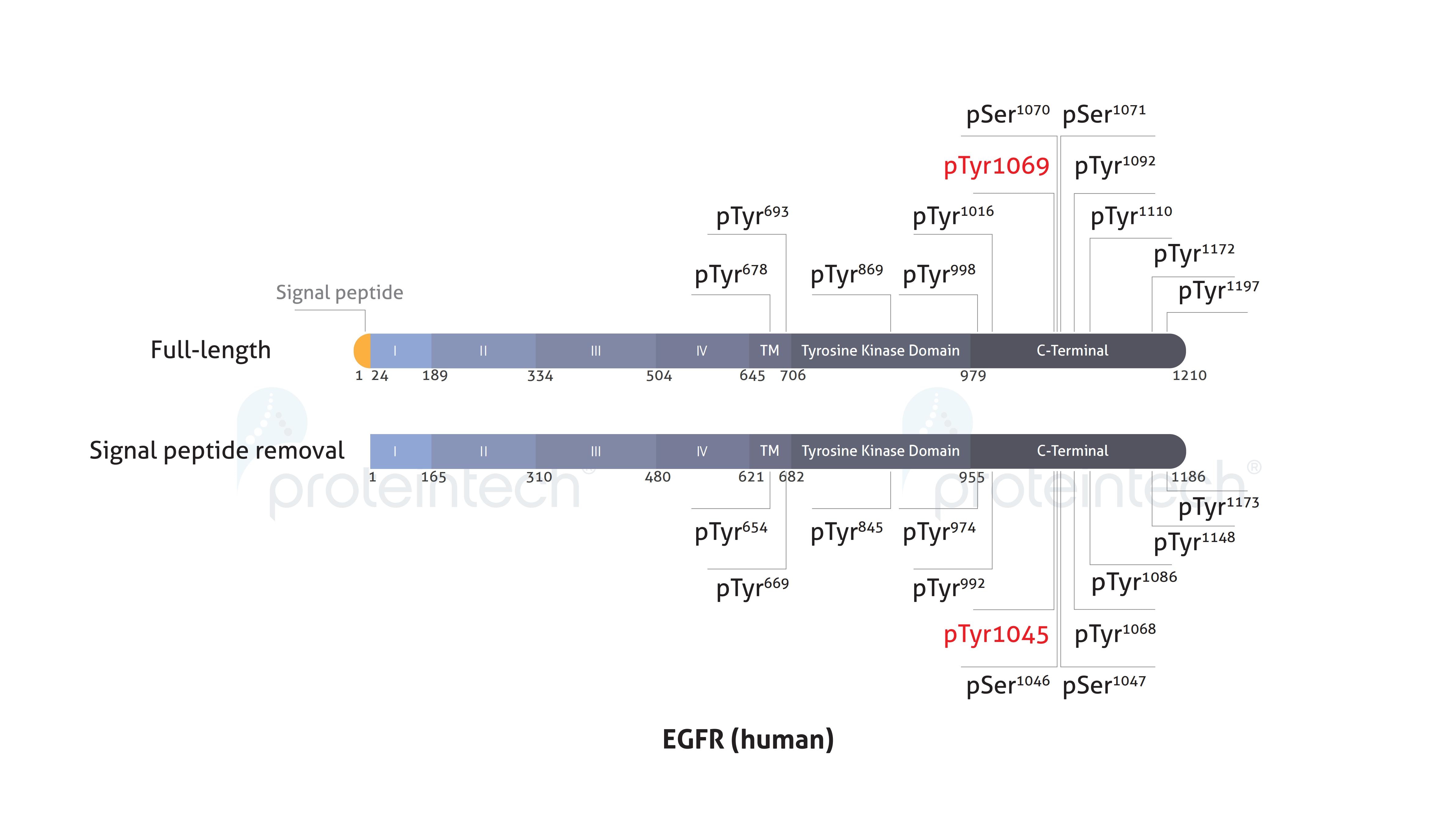
This antibody, also known as EGFR Tyr1045, is the site where the signal peptide is removed.
Recommended dilution
| Application | Dilution |
|---|---|
| Western Blot (WB) | WB : 1:500-1:2000 |
| It is recommended that this reagent should be titrated in each testing system to obtain optimal results. | |
| Sample-dependent, Check data in validation data gallery. | |
Product Information
30277-1-AP targets Phospho-EGFR (Tyr1069) in WB, IF, ELISA applications and shows reactivity with human samples.
| Tested Reactivity | human |
| Cited Reactivity | human, mouse, rat, bovine |
| Host / Isotype | Rabbit / IgG |
| Class | Polyclonal |
| Type | Antibody |
| Immunogen |
Peptide Predict reactive species |
| Full Name | epidermal growth factor receptor (erythroblastic leukemia viral (v-erb-b) oncogene homolog, avian) |
| Calculated Molecular Weight | 1210 aa, 134 kDa |
| Observed Molecular Weight | 170 kDa |
| GenBank Accession Number | BC094761 |
| Gene Symbol | EGFR |
| Gene ID (NCBI) | 1956 |
| RRID | AB_3085349 |
| Conjugate | Unconjugated |
| Form | Liquid |
| Purification Method | Antigen affinity purification |
| UNIPROT ID | P00533 |
| Storage Buffer | PBS with 0.02% sodium azide and 50% glycerol, pH 7.3. |
| Storage Conditions | Store at -20°C. Stable for one year after shipment. Aliquoting is unnecessary for -20oC storage. 20ul sizes contain 0.1% BSA. |
Background Information
Epidermal Growth Factor Receptor (EGFR) is one of the receptor tyrosine kinases (RTKs), members of the ErbB/HER family which consists of ErbB1 (EGFR or HER1), ErbB2 (HER2 or Neu), ErbB3 (HER3), and ErbB4 (HER4). Aberrant activation of EGFR is among the most common oncogenic driving events in human cancer, which is mediated largely through different classes of genomic alterations within the EGFR gene. Phosphorylation of EGFR Tyr1069 acts as the degron of EGFR and is recognized by c-Cbl, enhancing the ubiquitination and degradation of EGFR. EGFR stability is tightly regulated upon EGF stimulation. (PMID: 35164092, PMID: 29464683, PMID: 37085908). Some scientists call EGFR Tyr1069 as EGFR Tyr1045, the site where the signaling peptide is removed.
Protocols
| Product Specific Protocols | |
|---|---|
| WB protocol for Phospho-EGFR (Tyr1069) antibody 30277-1-AP | Download protocol |
| Standard Protocols | |
|---|---|
| Click here to view our Standard Protocols |
Publications
What published studies show
30277-1-AP (EGFR antibody) has 21 citations across journals including Biomaterials, Cell Death & Disease, Pharmacological Research, Journal of Autoimmunity, Life Sciences, Cells, Scientific Reports, and Neoplasia. Research fields span oncology (lung, breast, prostate, ovarian, bladder, and skin cancers), inflammation, cardiac fibrosis, immunotherapy, and EGFR/MAPK and EGFR/PI3K/AKT signaling pathway studies, primarily using Western blot in human and mouse models.
| Species | Application | Title |
|---|---|---|
Biomaterials Engineered bacterial outer membrane vesicles enhanced tumor immunotherapy through remodeling tumor stroma and targeted delivery of CD73 siRNA. | ||
Cell Death Dis PLSCR1 drives chemoresistance in TNBC via METTL3/IGF2BP3-mediated mRNA stabilization and EGFR-MAPK pathway activation. | ||
Pharmacol Res ACSS2 drives Lenvatinib resistance in hepatocellular carcinoma through palmitoylation. | ||
Antioxidants (Basel) Danthron Attenuates Intestinal Inflammation by Modulating Oxidative Stress via the EGFR-PI3K-AKT and Nrf2-HO-1 Pathways. | ||
J Autoimmun Mechanistic studies on the regulation of systemic sclerosis progression by imbalance in angiogenic T cell subsets. | ||
Ecotoxicol Environ Saf DEHP exposure and cardiac fibrosis risk: An integrated network toxicology and molecular experimental investigation. |



