
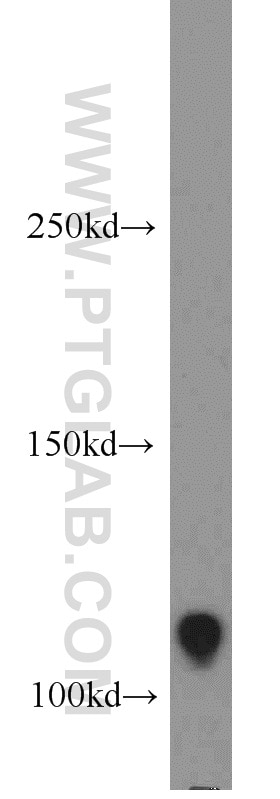
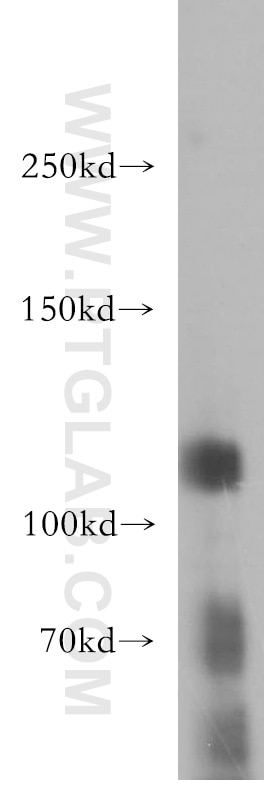

Tested Applications
| Positive WB detected in | HT-1080 cells |
Recommended dilution
| Application | Dilution |
|---|---|
| Western Blot (WB) | WB : 1:500-1:1000 |
| It is recommended that this reagent should be titrated in each testing system to obtain optimal results. | |
| Sample-dependent, Check data in validation data gallery. | |
Product Information
17218-1-AP targets RB1 in WB, ELISA applications and shows reactivity with human samples.
| Tested Reactivity | human |
| Cited Reactivity | human, zebrafish |
| Host / Isotype | Rabbit / IgG |
| Class | Polyclonal |
| Type | Antibody |
| Immunogen |
CatNo: Ag11035 Product name: Recombinant human RB1 protein Source: e coli.-derived, PGEX-4T Tag: GST Domain: 577-928 aa of BC039060 Sequence: KDREGPTDHLESACPLNLPLQNNHTAADMYLSPVRSPKKKGSTTRVNSTANAETQATSAFQTQKPLKSTSLSLFYKKVYRLAYLRLNTLCERLLSEHPELEHIIWTLFQHTLQNEYELMRDRHLDQIMMCSMYGICKVKNIDLKFKIIVTAYKDLPHAVQETFKRVLIKEEEYDSIIVFYNSVFMQRLKTNILQYASTRPPTLSPIPHIPRSPYKFPSSPLRIPGGNIYISPLKSPYKISEGLPTPTKMTPRSRILVSIGESFGTSEKFQKINQMVCNSDRVLKRSAEGSNPPKPLKKLRFDIEGSDEADGSKHLPGESKFQQKLAEMTSTRTRMQKQKMNDSMDTSNKEEK Predict reactive species |
| Full Name | retinoblastoma 1 |
| Calculated Molecular Weight | 928 aa, 106 kDa |
| Observed Molecular Weight | 110 kDa |
| GenBank Accession Number | BC039060 |
| Gene Symbol | RB1 |
| Gene ID (NCBI) | 5925 |
| RRID | AB_2177206 |
| Conjugate | Unconjugated |
| Form | Liquid |
| Purification Method | Antigen affinity purification |
| UNIPROT ID | P06400 |
| Storage Buffer | PBS with 0.02% sodium azide and 50% glycerol, pH 7.3. |
| Storage Conditions | Store at -20°C. Stable for one year after shipment. Aliquoting is unnecessary for -20oC storage. 20ul sizes contain 0.1% BSA. |
Background Information
RB1, also named as pp110, pRb and p105 Rb, belongs to the retinoblastoma protein (RB) family. It is a key regulator of entry into cell division that acts as a tumor suppressor. RB1 acts as a transcription repressor of E2F1 target genes. The underphosphorylated, active form of RB1 interacts with E2F1 and represses its transcription activity, leading to cell cycle arrest. It is directly involved in heterochromatin formation by maintaining overall chromatin structure and, in particular, that of constitutive heterochromatin by stabilizing histone methylation. It recruits and targets histone methyltransferases SUV39H1, SUV420H1 and SUV420H2, leading to epigenetic transcriptional repression. RB1 controls histone H4 'Lys-20' trimethylation and inhibits the intrinsic kinase activity of TAF1. It mediates transcriptional repression by SMARCA4/BRG1 by recruiting a histone deacetylase (HDAC) complex to the c-FOS promoter. In resting neurons, transcription of the c-FOS promoter is inhibited by BRG1-dependent recruitment of a phospho-RB1-HDAC1 repressor complex. Upon calcium influx, RB1 is dephosphorylated by calcineurin, which leads to release of the repressor complex. In case of viral infections, interactions with SV40 large T antigen, HPV E7 protein or adenovirus E1A protein induce the disassembly of RB1-E2F1 complex thereby disrupting RB1's activity. This antibody is a rabbit polyclonal antibody raised against residues near the C terminus of human RB1.
Protocols
| Product Specific Protocols | |
|---|---|
| WB protocol for RB1 antibody 17218-1-AP | Download protocol |
| Standard Protocols | |
|---|---|
| Click here to view our Standard Protocols |
Publications
What published studies show
RB1 Polyclonal Antibody (Cat# 17218-1-AP) has 31 citations across 28 journals, including Nature Communications, Cell Reports, Cell Death & Disease, Journal of Biological Chemistry, Oncotarget, Aging Cell, and Apoptosis. Associated research fields include oncology (gastric, colon, pancreatic, hepatocellular, lung, breast, endometrial, and colorectal cancers), cell cycle regulation, cellular senescence, ferroptosis, apoptosis, neurotoxicity, cardiovascular biology, bone healing, and T cell development.
| Species | Application | Title |
|---|---|---|
Nat Commun Whole-exome sequencing of alpha-fetoprotein producing gastric carcinoma reveals genomic profile and therapeutic targets. | ||
Cell Death Dis Ciclopirox drives growth arrest and autophagic cell death through STAT3 in gastric cancer cells | ||
Cell Mol Biol Lett RSL3 promotes PARP1 apoptotic functions by distinct mechanisms during ferroptosis. | ||
Cancer Genet Galectin-9 promotes colon cancer development by polarizing macrophages toward the M2 phenotype. | ||
J Hazard Mater Neurotoxicity of aluminum oxide nanoparticles and their mechanistic role in dopaminergic neuron injury involving p53-related pathways. |



