RNA pol II CTD phospho Ser5 antibody (pAb)
Host / Isotype
Rabbit / Serum
Reactivity
Human, Mouse, Wide Range Predicted
Applications
ChIP, ICC, IF, WB

Cat No : 39233,39234 39233
Synonyms
Validation Data Gallery
Product Information
| Tested Applications |
ChIP, ICC, IF, WB
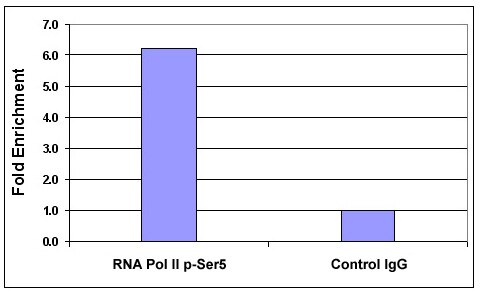
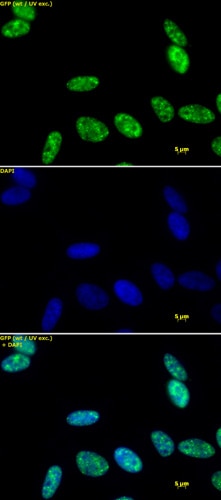
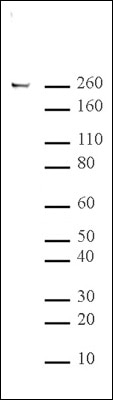
Applications Validated by Active Motif: ChIP: 10 ul per ChIP ICC/IF: 1:250 - 1:500 dilution WB: 1:500 - 1:2,000 dilution For RNA pol II CTD phospho Ser5, we also offer AbFlex RNA pol II CTD phospho Ser5 Recombinant Antibody (rAb). For details, see Catalog No. 91119. |
| Tested Reactivity | Human, Mouse, Wide Range Predicted |
| Host / Isotype | Rabbit / Serum |
| Class | Polyclonal |
| Type | Antibody |
| Modification | Phosphorylated |
| Immunogen | This RNA pol II CTD phospho Ser5 antibody was raised against synthetic peptide containing the RNA Pol II heptad repeat consensus sequence phosphorylated at serine 5. |
| Full Name | RNA pol II CTD phospho Ser5 antibody (pAb) |
| Synonyms | RNA pol II, heptad, repeat, pAb, polyclonal, RNA Polymerase II, antibody, antibodies, chip, chromatin immunoprecipitation, sample, gtfabs |
| Molecular weight | 210 kDa |
| GenBank accession number | NP_000928 |
| RRID | AB_2793198 |
| Purification Method | None |
| Buffer | Rabbit serum containing 30% glycerol and 0.035% sodium azide. Sodium azide is highly toxic. For your convenience, an IgG version (Catalog No. 39749) of this antibody that was purified by Protein A Chromatography is also available. |
| Storage | Some products may be shipped at room temperature. This will not affect their stability or performance. Avoid repeated freeze/thaw cycles by aliquoting items into single-use fractions for storage at -20°C for up to 2 years. Keep all reagents on ice when not in storage. |
Background Information
RNA pol II (RNA polymerase II) is responsible for synthesizing messenger RNA in eukaryotes. RNA pol II contains a carboxy terminal domain composed of heptapeptide repeats that are essential for polymerase activity. These repeats contain serine and threonine residues that are phosphorylated in actively transcribing RNA polymerase. In addition, RNA pol II, in combination with several other polymerase subunits, form the DNA binding domain of the polymerase, a groove in which the DNA template is transcribed into RNA. During the transcription cycle, the CTD of the large subunit of RNA pol II is reversibly phosphorylated. RNA pol II containing unphosphorylated CTD is recruited to the promoter, whereas the hyperphosphorylated CTD form is involved in active transcription. Phosphorylation occurs at two sites within the heptapeptide repeat, at Serine 5 and Serine 2. RNA pol II Serine 5 phosphorylation is confined to promoter regions and is necessary for the initiation of transcription.