

Tested Applications
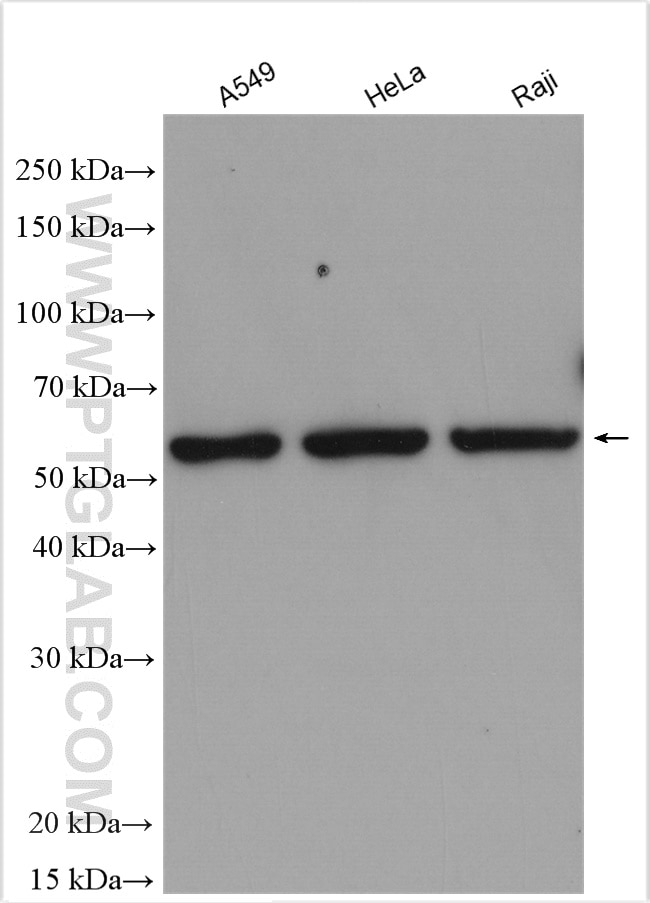
| Positive WB detected in | HeLa cells, A549 cells, Raji cells |
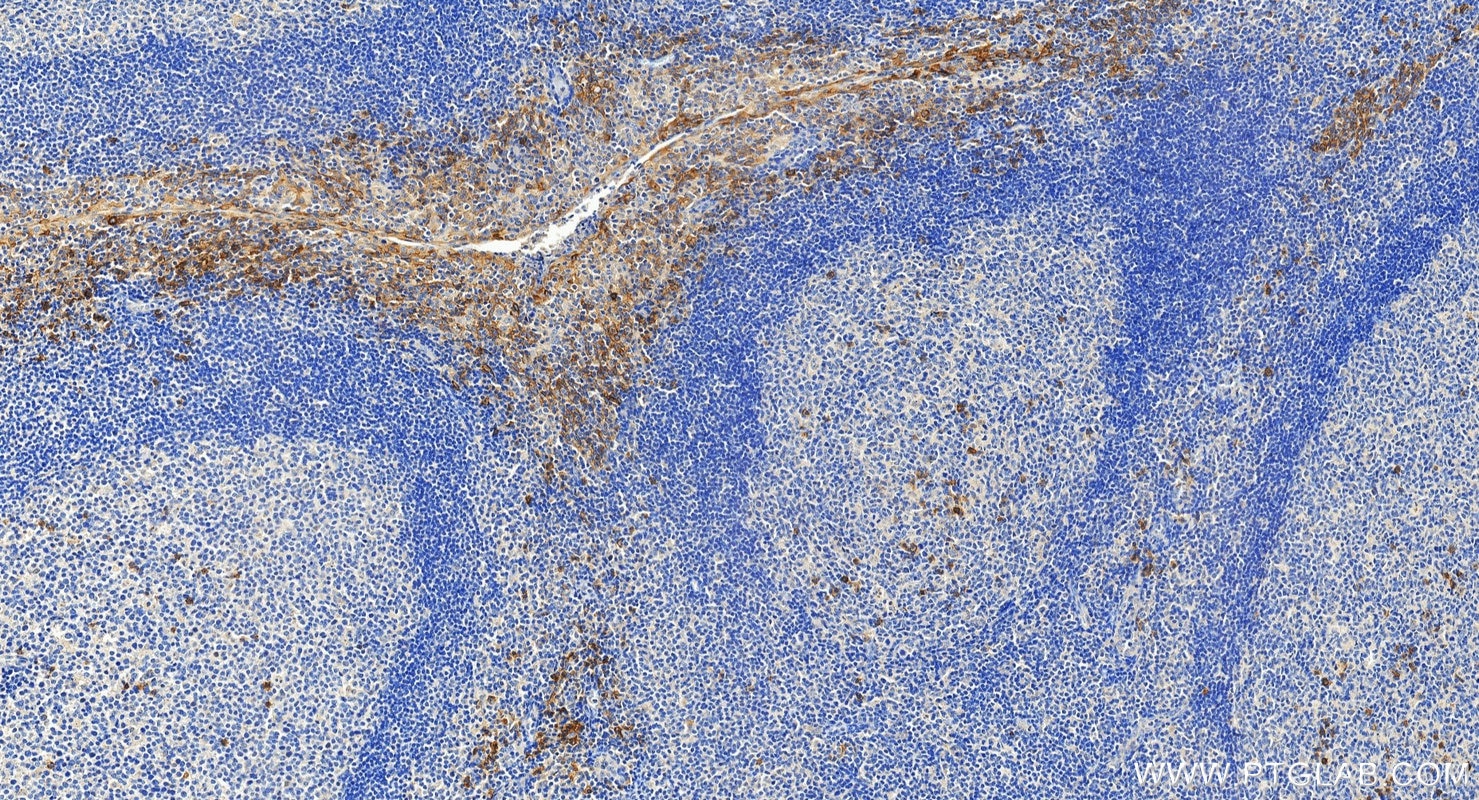
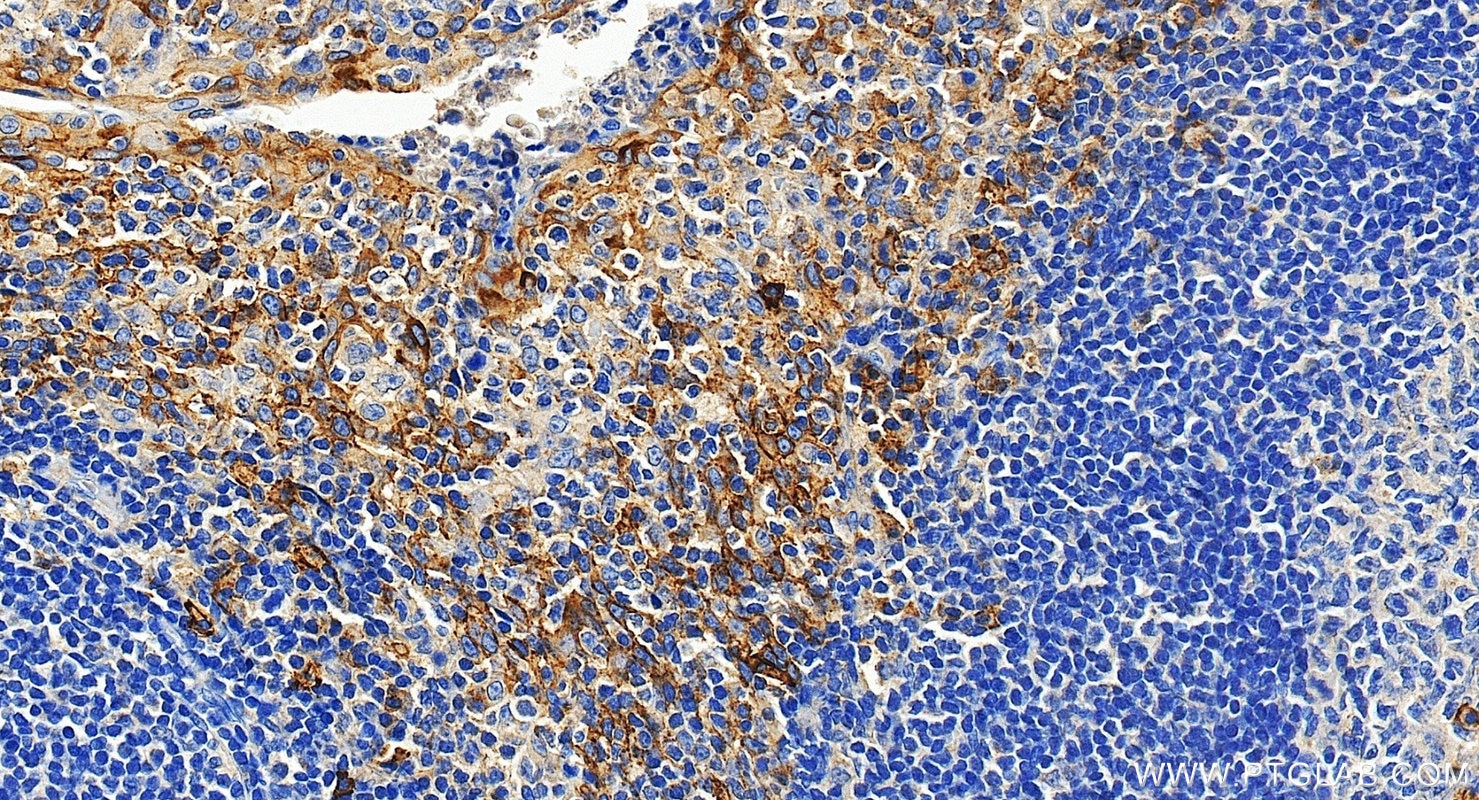
| Positive IHC detected in | human tonsillitis tissue Note: suggested antigen retrieval with TE buffer pH 9.0; (*) Alternatively, antigen retrieval may be performed with citrate buffer pH 6.0 |
Recommended dilution
| Application | Dilution |
|---|---|
| Western Blot (WB) | WB : 1:500-1:2000 |
| Immunohistochemistry (IHC) | IHC : 1:800-1:3200 |
| It is recommended that this reagent should be titrated in each testing system to obtain optimal results. | |
| Sample-dependent, Check data in validation data gallery. | |
Product Information
10593-1-AP targets CD138/Syndecan-1 in WB, IHC, IF, IP, CoIP, ELISA applications and shows reactivity with human, mouse samples.
| Tested Reactivity | human, mouse |
| Cited Reactivity | human, mouse, rat, pig, monkey |
| Host / Isotype | Rabbit / IgG |
| Class | Polyclonal |
| Type | Antibody |
| Immunogen |
CatNo: Ag0823 Product name: Recombinant human SDC1,CD138 protein Source: e coli.-derived, PGEX-4T Tag: GST Domain: 1-310 aa of BC008765 Sequence: MRRAALWLWLCALALSLQPALPQIVATNLPPEDQDGSGDDSDNFSGSGAGALQDITLSQQTPSTWKDTQLLTAIPTSPEPTGLEATAASTSTLPAGEGPKEGEAVVLPEVEPGLTAREQEATPRPRETTQLPTTHQASTTTATTAQEPATSHPHRDMQPGHHETSTPAGPSQADLHTPHTEDGGPSATERAAEDGASSQLPAAEGSGEQDFTFETSGENTAVVAVEPDRRNQSPVDQGATGASQGLLDRKEVLGGVIAVGLVGLIFAVCLVGFMLYRMKKKDEGSYSLEEPKQANGGAYQKPTKQEEFYA Predict reactive species |
| Full Name | syndecan 1 |
| Calculated Molecular Weight | 32.5 kDa |
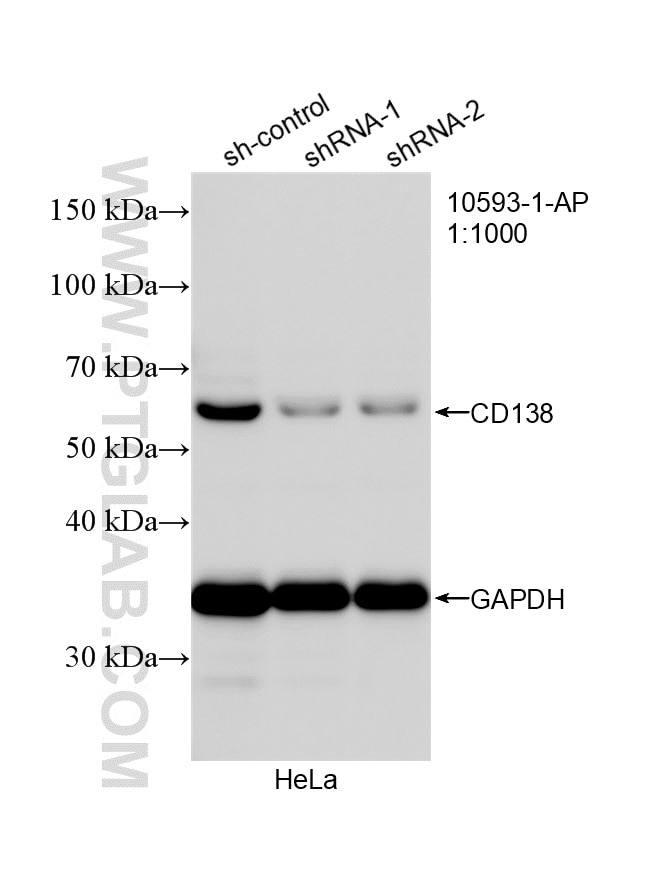
| Observed Molecular Weight | 60-100 kDa, 130 kDa |
| GenBank Accession Number | BC008765 |
| Gene Symbol | CD138 |
| Gene ID (NCBI) | 6382 |
| RRID | AB_2182736 |
| Conjugate | Unconjugated |
| Form | Liquid |
| Purification Method | Antigen affinity purification |
| UNIPROT ID | P18827 |
| Storage Buffer | PBS with 0.02% sodium azide and 50% glycerol, pH 7.3. |
| Storage Conditions | Store at -20°C. Stable for one year after shipment. Aliquoting is unnecessary for -20oC storage. 20ul sizes contain 0.1% BSA. |
Background Information
CD138, also named as Syndecan-1 (SDC1), is an integral membrane protein. It participates in cell proliferation, cell migration and cell-matrix interactions via its receptor for extracellular matrix proteins. It is a heparan sulfate proteoglycan expressed on the surface of, and actively shed by, myeloma cells. Altered syndecan-1 expression has been detected in several different tumor types. CD138 was regarded as a useful marker for labeling normal and neoplastic plasma cells and plasmacytoid lymphomas. CD138 has a calculated molecular weight of 32.5 kDa, the apparent molecular weight is higher due to extensive glycosylation.
Protocols
| Product Specific Protocols | |
|---|---|
| IHC protocol for CD138/Syndecan-1 antibody 10593-1-AP | Download protocol |
| WB protocol for CD138/Syndecan-1 antibody 10593-1-AP | Download protocol |
| Standard Protocols | |
|---|---|
| Click here to view our Standard Protocols |
Publications
What published studies show
The CD138/Syndecan-1 Polyclonal antibody (Cat# 10593-1-AP) has accumulated 61 citations. Publications appear in high-impact journals including Nature Medicine, Cell, Nature Cancer, Nature Communications, Gastroenterology, Gut, Science Translational Medicine, Theranostics, Advanced Science, Leukemia, and Brain Pathology. Research fields covered include multiple myeloma, various cancers (colorectal, breast, pancreatic, glioblastoma, thyroid), autoimmune diseases (lupus, ankylosing spondylitis), neurodegeneration, inflammation, immune response, vascular biology, and kidney disease.
| Species | Application | Title |
|---|---|---|
Nat Med Re-administration of AAV-mediated gene therapy for OTOF-related deafness: a single-arm trial. | ||
Gastroenterology Acetyl-Coenzyme A Synthetase 2 Potentiates Macropinocytosis and Muscle Wasting Through Metabolic Reprogramming in Pancreatic Cancer | ||
Nat Cancer Efficacy and tolerability of neoadjuvant therapy with Talimogene laherparepvec in cutaneous basal cell carcinoma: a phase II trial (NeoBCC trial) | ||
Mol Neurodegener Amelioration of amyloid-β-induced deficits by DcR3 in an Alzheimer's disease model. |





