SIP1 antibody (pAb)
Host / Isotype
Rabbit / IgG
Reactivity
Human
Applications
WB

Cat No : 61113,61114 61113
Synonyms
Validation Data Gallery
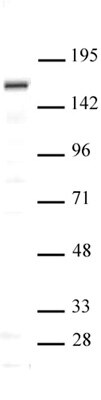
Product Information
| Tested Applications |
WB
Applications Validated by Active Motif: WB*: 1:500 - 1:1,000 dilution *Note: many chromatin-bound proteins are not soluble in a low salt nuclear extract and fractionate to the pellet. Therefore, we recommend a High Salt / Sonication Protocol when preparing nuclear extracts for Western blot. |
| Tested Reactivity | Human |
| Host / Isotype | Rabbit / IgG |
| Class | Polyclonal |
| Type | Antibody |
| Immunogen | This SIP1 antibody was raised against a peptide from the N-terminus of human SIP1. |
| Full Name | SIP1 antibody (pAb) |
| Synonyms | SIP1, Smad-interacting protein 1, ZEB2, Zinc finger E-box-binding homeobox 2, sequence-specific DNA binding protein, transcriptional repressor, embryonic development of neural structures, neural crest, delta-EF1/Zfh1 family of 2-handed zinc finger/homeodomain, SMAD1, SMAD2, SMAD3, CBX4, CTBP1, Hirschsprung disease, HSCR, sample, dbdabs |
| Molecular weight | 180 kDa |
| GenBank accession number | NP_055610 |
| RRID | AB_2793511 |
| Purification Method | Affinity Purified |
| Buffer | Purified IgG in PBS with 30% glycerol and 0.035% sodium azide. Sodium azide is highly toxic. |
| Storage | Some products may be shipped at room temperature. This will not affect their stability or performance. Avoid repeated freeze/thaw cycles by aliquoting items into single-use fractions for storage at -20°C for up to 2 years. Keep all reagents on ice when not in storage. |
Background Information
SIP1 (Smad-interacting protein 1, aka ZEB2, Zinc finger E-box-binding homeobox 2) is a sequence-specific DNA binding protein and transcriptional repressor that is involved in normal embryonic development of neural structures and the neural crest. SIP1 belongs to the delta-EF1/Zfh1 family of 2-handed zinc finger/homeodomain proteins and contains a SMAD-binding domain, a homeodomain and two clusters of zinc fingers on the N- and C-termini. SIP1 interacts directly with activated forms of SMAD1, SMAD2 and SMAD3, as well as CBX4 and CTBP1. Mutations in the SIP1 gene cause a form of Hirschsprung disease (HSCR).