
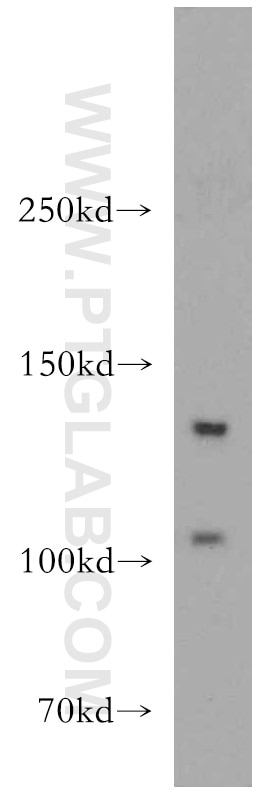
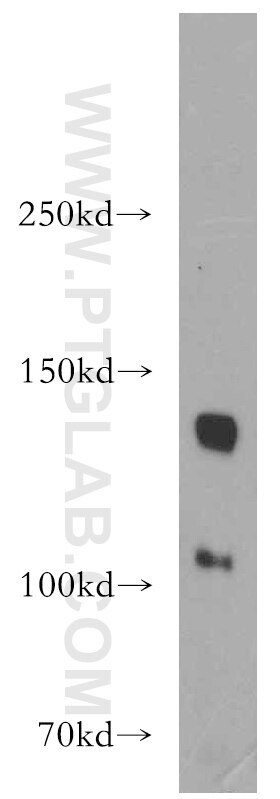

Tested Applications
| Positive WB detected in | A549 cells, A431 cells |
Recommended dilution
| Application | Dilution |
|---|---|
| Western Blot (WB) | WB : 1:500-1:2000 |
| It is recommended that this reagent should be titrated in each testing system to obtain optimal results. | |
| Sample-dependent, Check data in validation data gallery. | |
Product Information
20000-1-AP targets TGFBR3-Specific in WB, IHC, IF, ELISA applications and shows reactivity with human samples.
| Tested Reactivity | human |
| Cited Reactivity | human, mouse, goat |
| Host / Isotype | Rabbit / IgG |
| Class | Polyclonal |
| Type | Antibody |
| Immunogen |
Peptide Predict reactive species |
| Full Name | transforming growth factor, beta receptor III |
| Calculated Molecular Weight | 93 kDa |
| Observed Molecular Weight | 110-150 kDa |
| GenBank Accession Number | NM_003243 |
| Gene Symbol | TGFBR3 |
| Gene ID (NCBI) | 7049 |
| RRID | AB_10664930 |
| Conjugate | Unconjugated |
| Form | Liquid |
| Purification Method | Antigen affinity purification |
| UNIPROT ID | Q03167 |
| Storage Buffer | PBS with 0.02% sodium azide and 50% glycerol, pH 7.3. |
| Storage Conditions | Store at -20°C. Stable for one year after shipment. Aliquoting is unnecessary for -20oC storage. 20ul sizes contain 0.1% BSA. |
Background Information
Transforming growth factor β (TGF-β) is a multifunctional cytokine that plays important roles in normal development and homeostasis (PMID: 8530052). There are three TGF-β forms: TGF-β1, TGF-β2, and TGF-β3. The diverse effects of TGF-β are mediated by the TGF-β receptors and cell surface-binding proteins. Three TGF-beta receptors exist: TGFBR1, TFGBR2, TGFBR3 (PMID: 8530052; 30184463). TGFBR3, also known as betaglycan, is a transmembrane proteoglycan that often functions as a co-receptor with other TGF-beta receptor superfamily members. In addition to the transmembrane form, the extracellular domain of TGFBR3 can be cleaved to a soluble form (sTGFBR3), which may serve as an antagonist of TGF-β to inhibit TGF-β signaling (PMID: 30184463). TGFBR3 has a larger apparent molecular weight than the calculated molecular weight, due to extensive carbohydrate modifications (PMID: 1556106). This antibody is specific to TGFBR3.
Publications
What published studies show
The TGFBR3-Specific Polyclonal Antibody (Cat# 20000-1-AP) has 10 total citations appearing in Nature Immunology, Nature Communications, Cancer Research, Redox Biology, Cell Proliferation, International Immunopharmacology, Experimental Cell Research, Molecular and Cellular Endocrinology, Biochemical and Biophysical Research Communications, and bioRxiv. Associated research fields include TGF-β signaling, rheumatoid arthritis, prostate cancer metastasis, cardiac remodeling, adipose biology, intervertebral disc degeneration, pulmonary fibrosis, and various carcinomas.
| Species | Application | Title |
|---|---|---|
Nat Immunol Spatial patterning of fibroblast TGFβ signaling underlies treatment resistance in rheumatoid arthritis. | ||
Cancer Res Osteoblast-secreted factors mediate dormancy of metastatic prostate cancer in the bone via activation of the TGFβRIII-p38MAPK-pS249/T252RB pathway.
| ||
Nat Commun Ultra-flexible optoelectronic stimulator converts tissue-attenuated weak light into electrical signals for cardiac remodeling. | ||
Redox Biol FoxO1 regulates adipose transdifferentiation and iron influx by mediating Tgfβ1 signaling pathway | ||
Cell Prolif Spatially multicellular variability of intervertebral disc degeneration by comparative single-cell analysis | ||
Int Immunopharmacol Vitamin D3 alleviates pulmonary fibrosis by regulating the MAPK pathway via targeting PSAT1 expression in vivo and in vitro. |
Reviews
What customers say
Both reviewers gave this antibody a perfect 5-star rating and highly recommend it. One user used it at 1:200 for immunofluorescence on mouse kidney tissue, reporting robust signal when labeling TGF-β receptor type 3, and specifically praised its KO-validated status. The other user applied it at 1:1000 for Western Blot on PBMCs, successfully detecting the protein of interest at the expected 94 kDa molecular weight. Overall, customers report reliable performance across applications with clear, strong signals.
The reviews below have been submitted by verified Proteintech customers who received an incentive for providing their feedback.
Kenzo (Verified Customer) (08-15-2023) | This antibody worked well for labeling TGF beta receptor type 3 in mouse kidney. I was able to acquire robust immunofluorescence signals with the antibody and highly recommend this KO validated antibody.
|
Manfred (Verified Customer) (05-09-2022) | I highly recommend this anitbody. Protein of interest was detected at 94kDa.
|



