
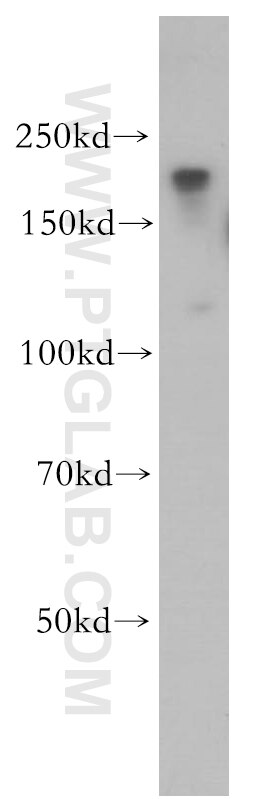



Tested Applications
| Positive WB detected in | MCF7 cells, HEK-293T cells, HeLa cells, human brain tissue |
| Positive IP detected in | MCF-7 cells |
| Positive IF/ICC detected in | HepG2 cells |
Recommended dilution
| Application | Dilution |
|---|---|
| Western Blot (WB) | WB : 1:500-1:1000 |
| Immunoprecipitation (IP) | IP : 0.5-4.0 ug for 1.0-3.0 mg of total protein lysate |
| Immunofluorescence (IF)/ICC | IF/ICC : 1:50-1:500 |
| It is recommended that this reagent should be titrated in each testing system to obtain optimal results. | |
| Sample-dependent, Check data in validation data gallery. | |
Product Information
18980-1-AP targets ZCCHC11 in WB, IF/ICC, IP, CoIP, ELISA applications and shows reactivity with human, mouse samples.
| Tested Reactivity | human, mouse |
| Cited Reactivity | human, mouse |
| Host / Isotype | Rabbit / IgG |
| Class | Polyclonal |
| Type | Antibody |
| Immunogen |
Peptide Predict reactive species |
| Full Name | zinc finger, CCHC domain containing 11 |
| Calculated Molecular Weight | 185 kDa |
| Observed Molecular Weight | 185 kDa |
| GenBank Accession Number | NM_015269 |
| Gene Symbol | ZCCHC11 |
| Gene ID (NCBI) | 23318 |
| RRID | AB_10598327 |
| Conjugate | Unconjugated |
| Form | Liquid |
| Purification Method | Antigen affinity purification |
| UNIPROT ID | Q5TAX3 |
| Storage Buffer | PBS with 0.02% sodium azide and 50% glycerol, pH 7.3. |
| Storage Conditions | Store at -20°C. Stable for one year after shipment. Aliquoting is unnecessary for -20oC storage. 20ul sizes contain 0.1% BSA. |
Background Information
ZCCHC11, also named as KIAA0191 and TUT4, is an uridylyltransferase that acts as a suppressor of microRNA (miRNA) biogenesis by specifically mediating the terminal uridylation of some miRNAs. ZCCHC11 catalyzes the 3' uridylation of precursor let-7 (pre-let-7), a miRNA precursor. Uridylated pre-let-7 miRNAs fail to be processed by Dicer and undergo degradation. Degradation of pre-let-7 contributes to the maintenance of embryonic stem (ES) cells and is required for ES cells to maintain pluripotency. ZCCHC11 can't bind RNA by itself, recruited to pre-let-7 miRNAs via its interaction with LIN28 and LIN28B. Also catalyzes the 3' uridylation of miR-26A, a miRNA that represses IL6 transcript, leading to abrogate IL6 transcript repression and promote cytokine expression. ZCCHC11 may also suppress Toll-like receptor-induced NF-kappa-B activity via binding to T2BP.This antibody is specifical to the 185 kd ZCCHCC11 protein.
Protocols
| Product Specific Protocols | |
|---|---|
| IF protocol for ZCCHC11 antibody 18980-1-AP | Download protocol |
| IP protocol for ZCCHC11 antibody 18980-1-AP | Download protocol |
| WB protocol for ZCCHC11 antibody 18980-1-AP | Download protocol |
| Standard Protocols | |
|---|---|
| Click here to view our Standard Protocols |
Publications
What published studies show
The anti-TUT4 antibody (Cat# 18980-1-AP) has 26 total citations across 14 journals, including Nature, Cell, Nature Communications, Molecular Cell, Nucleic Acids Research, Cell Reports, and RNA. Research fields span RNA uridylation, microRNA biogenesis and turnover, mRNA degradation, retrotransposition, spermatogenesis, cancer biology, inflammation, and stem cell differentiation. Applications are predominantly Western blotting, with some IF, CoIP, and IP.
| Species | Application | Title |
|---|---|---|
Nature A role for the Perlman syndrome exonuclease Dis3l2 in the Lin28-let-7 pathway.
| ||
Nature mRNA 3' uridylation and poly(A) tail length sculpt the mammalian maternal transcriptome.
| ||
Cell Lin28A and Lin28B inhibit let-7 microRNA biogenesis by distinct mechanisms.
| ||
Cell Res A programmed wave of uridylation-primed mRNA degradation is essential for meiotic progression and mammalian spermatogenesis.
| ||
Cancer Commun (Lond) YB1 regulates miR-205/200b-ZEB1 axis by inhibiting microRNA maturation in hepatocellular carcinoma. |



