

Tested Applications
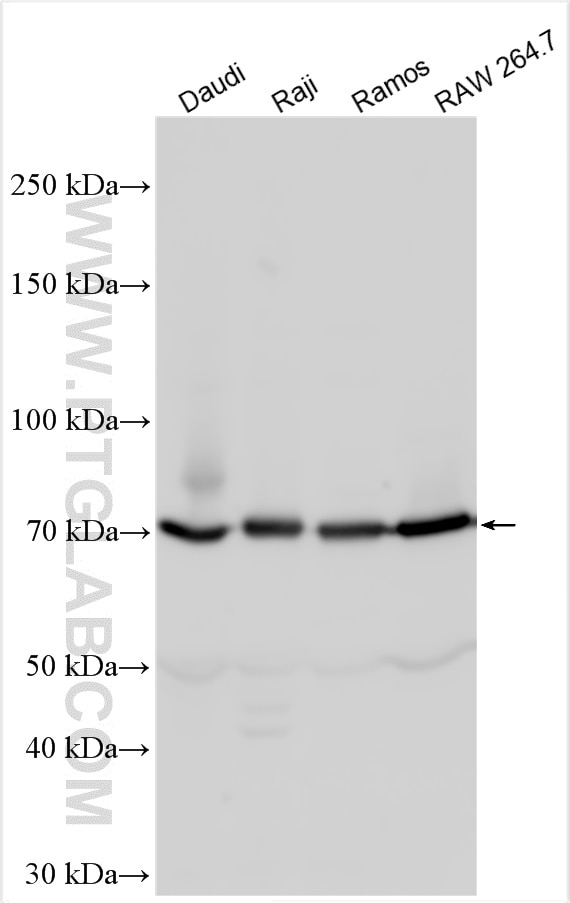
| Positive WB detected in | Daudi cells, Raji cells, Ramos cells, RAW 264.7 cells |
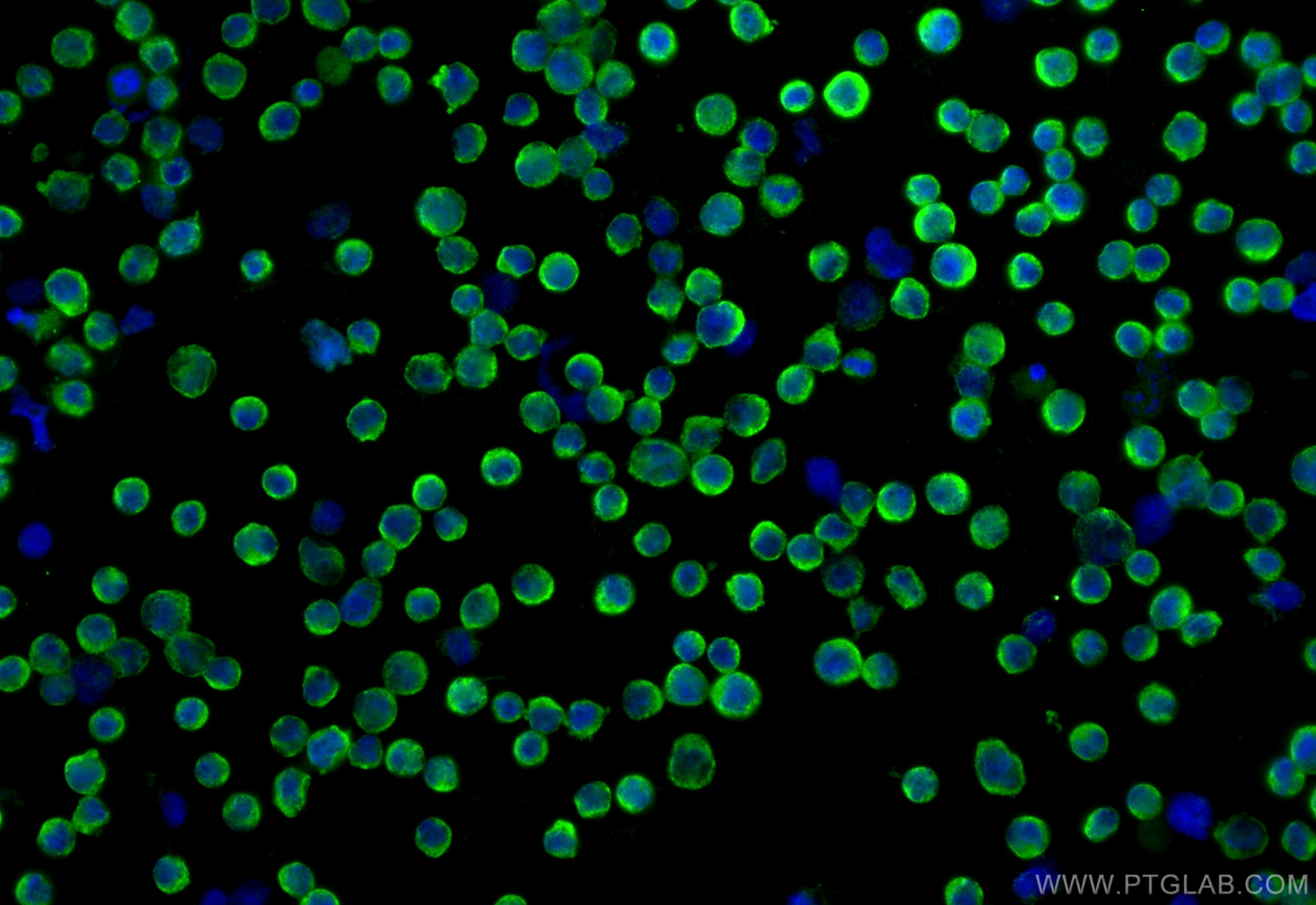
| Positive IF/ICC detected in | Raji cells |
Recommended dilution
| Application | Dilution |
|---|---|
| Western Blot (WB) | WB : 1:1000-1:4000 |
| Immunofluorescence (IF)/ICC | IF/ICC : 1:200-1:800 |
| It is recommended that this reagent should be titrated in each testing system to obtain optimal results. | |
| Sample-dependent, Check data in validation data gallery. | |
Product Information
13395-1-AP targets CD86 in WB, IF/ICC, ELISA, Cell treatment applications and shows reactivity with human, mouse samples.
| Tested Reactivity | human, mouse |
| Cited Reactivity | human, mouse, rat, rabbit |
| Host / Isotype | Rabbit / IgG |
| Class | Polyclonal |
| Type | Antibody |
| Immunogen |
CatNo: Ag4063 Product name: Recombinant human CD86 protein Source: e coli.-derived, PGEX-4T Tag: GST Domain: 27-247 aa of BC040261 Sequence: KIQAYFNETADLPCQFANSQNQSLSELVVFWQDQENLVLNEVYLGKEKFDSVHSKYMGRTSFDSDSWTLRLHNLQIKDKGLYQCIIHHKKPTGMIRIHQMNSELSVLANFSQPEIVPISNITENVYINLTCSSIHGYPEPKKMSVLLRTKNSTIEYDGIMQKSQDNVTELYDVSISLSVSFPDVTSNMTIFCILETDKTRLLSSPFSIELEDPQPPPDHIP Predict reactive species |
| Full Name | CD86 molecule |
| Calculated Molecular Weight | 329 aa, 38 kDa |
| Observed Molecular Weight | 60-80 kDa |
| GenBank Accession Number | BC040261 |
| Gene Symbol | CD86 |
| Gene ID (NCBI) | 942 |
| ENSEMBL Gene ID | ENSG00000114013 |
| RRID | AB_2074882 |
| Conjugate | Unconjugated |
| Form | Liquid |
| Purification Method | Antigen affinity purification |
| UNIPROT ID | P42081 |
| Storage Buffer | PBS with 0.02% sodium azide and 50% glycerol, pH 7.3. |
| Storage Conditions | Store at -20°C. Stable for one year after shipment. Aliquoting is unnecessary for -20oC storage. 20ul sizes contain 0.1% BSA. |
Background Information
CD86 (also known as B7.2) is a costimulatory molecule belonging to the immunoglobulin superfamily. Primarily expressed on antigen-presenting cells (APCs), including B cells, dendritic cells, and macrophages, CD86 is the ligand for two proteins at the cell surface of T cells, CD28 antigen and cytotoxic T-lymphocyte-associated protein 4. Binding of CD86 with CD28 antigen is a costimulatory signal for activation of the T-cell. Binding of CD86 with cytotoxic T-lymphocyte-associated protein 4 negatively regulates T-cell activation and diminishes the immune response. This antibody detects a band of approximately 65-70 kDa, consistent with glycosylated form of CD86 (PMID: 8592066, 21849678).
Protocols
| Product Specific Protocols | |
|---|---|
| IF protocol for CD86 antibody 13395-1-AP | Download protocol |
| WB protocol for CD86 antibody 13395-1-AP | Download protocol |
| Standard Protocols | |
|---|---|
| Click here to view our Standard Protocols |
Publications
What published studies show
CD86 Polyclonal Antibody (Cat# 13395-1-AP) has accumulated 503 citations in journals including Nature Communications, Advanced Materials, Bioactive Materials, Biomaterials, Theranostics, ACS Nano, Journal of Nanobiotechnology, Advanced Science, and Acta Pharmaceutica Sinica B. Associated research fields encompass macrophage polarization and immunomodulation, tissue engineering and biomaterials, diabetic wound healing, neuroinflammation and neurodegeneration, cancer immunotherapy, bone regeneration, and inflammatory diseases.
| Species | Application | Title |
|---|---|---|
Gastroenterology Macrophage-derived cathepsin S remodels the extracellular matrix to promote liver fibrogenesis | ||
Adv Mater Engineered Bacterial Outer Membrane Vesicles as Controllable Two-way Adaptors to Activate Macrophage Phagocytosis for Improved Tumor Immunotherapy | ||
Adv Mater Efficient Delivery of Lomitapide Using Hybrid Membrane-Coated Tetrahedral DNA Nanostructures for Glioblastoma Therapy | ||
Adv Mater Photosensitive Biomimetic Nanomedicine-Mediated Recombination of Adipose Microenvironments for Antiobesity Therapy | ||
Adv Mater Photothermal and Photocatalytic Glycol Chitosan and Polydopamine-Grafted Oxygen Vacancy Bismuth Oxyiodide (BiO1-x I) Nanoparticles for the Diagnosis and Targeted Therapy of Diabetic Wounds |
Reviews
What customers say
Both reviewers gave 5-star ratings. One used the antibody at 1:250 dilution for immunofluorescence to confirm differentiation of human iPSCs into macrophages and reported good results. The other used it at 1:300 dilution for immunohistochemistry and stated it was working very well. Overall, users report reliable performance across applications with strong satisfaction.
The reviews below have been submitted by verified Proteintech customers who received an incentive for providing their feedback.
Christin (Verified Customer) (01-26-2025) | I used this antibody to cofirm the differentiation of human iPSCs into macrophages with good results at 1:250 dilution.
|
Martin (Verified Customer) (09-28-2022) | Antibody is working very well
|



