




Tested Applications
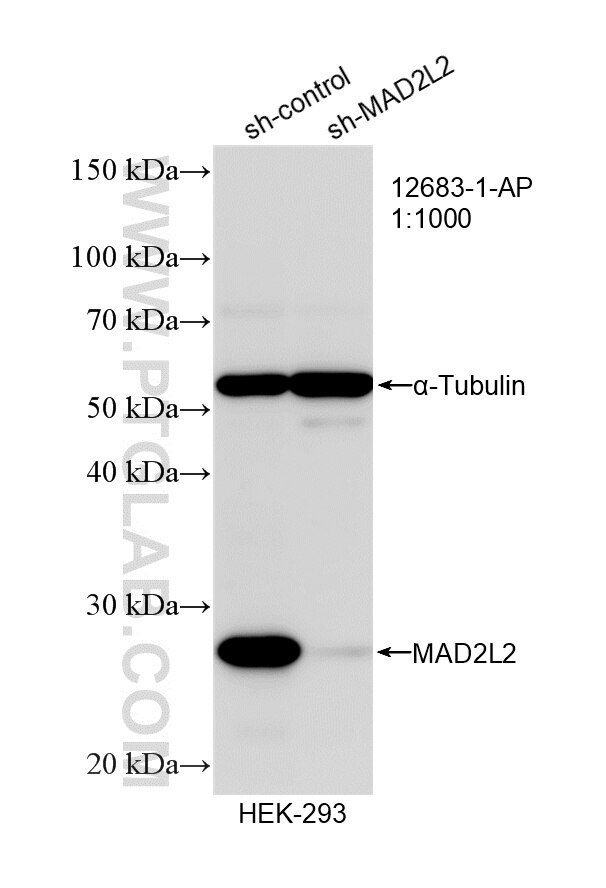
| Positive WB detected in | human brain tissue, A375 cells, human kidney tissue, human colon tissue, mouse brain tissue, HeLa cells, HEK-293 cells, K-562 cells, fetal human brain tissue |
| Positive IP detected in | mouse brain tissue |
| Positive IHC detected in | human ovary tumor tissue, human lymphoma tissue Note: suggested antigen retrieval with TE buffer pH 9.0; (*) Alternatively, antigen retrieval may be performed with citrate buffer pH 6.0 |
Recommended dilution
| Application | Dilution |
|---|---|
| Western Blot (WB) | WB : 1:500-1:2400 |
| Immunoprecipitation (IP) | IP : 0.5-4.0 ug for 1.0-3.0 mg of total protein lysate |
| Immunohistochemistry (IHC) | IHC : 1:50-1:500 |
| It is recommended that this reagent should be titrated in each testing system to obtain optimal results. | |
| Sample-dependent, Check data in validation data gallery. | |
Product Information
12683-1-AP targets MAD2L2 in WB, IHC, IF, IP, ELISA applications and shows reactivity with human, mouse, rat samples.
| Tested Reactivity | human, mouse, rat |
| Cited Reactivity | human, mouse |
| Host / Isotype | Rabbit / IgG |
| Class | Polyclonal |
| Type | Antibody |
| Immunogen |
CatNo: Ag3373 Product name: Recombinant human MAD2L2 protein Source: e coli.-derived, PGEX-4T Tag: GST Domain: 2-211 aa of BC015244 Sequence: TTLTRQDLNFGQVVADVLCEFLEVAVHLILYVREVYPVGIFQKRKKYNVPVQMSCHPELNQYIQDTLHCVKPLLEKNDVEKVVVVILDKEHRPVEKFVFEITQPPLLSISSDSLLSHVEQLLRAFILKISVCDAVLDHNPPGCTFTVLVHTREAATRNMEKIQVIKDFPWILADEQDVHMHDPRLIPLKTMTSDILKMQLYVEERAHKGS Predict reactive species |
| Full Name | MAD2 mitotic arrest deficient-like 2 (yeast) |
| Calculated Molecular Weight | 211 aa, 24 kDa |
| Observed Molecular Weight | 24 kDa |
| GenBank Accession Number | BC015244 |
| Gene Symbol | MAD2L2 |
| Gene ID (NCBI) | 10459 |
| RRID | AB_2139530 |
| Conjugate | Unconjugated |
| Form | Liquid |
| Purification Method | Antigen affinity purification |
| UNIPROT ID | Q9UI95 |
| Storage Buffer | PBS with 0.02% sodium azide and 50% glycerol, pH 7.3. |
| Storage Conditions | Store at -20°C. Stable for one year after shipment. Aliquoting is unnecessary for -20oC storage. 20ul sizes contain 0.1% BSA. |
Background Information
MAD family, together with BUB and Mps1,Cdc20k, play roles in the mitotic spindle checkpoint. MAD2L2 is one of the MAD family. It can mediate the second polymerase switching in translation DNA synthesis by mediating the interaction between the error-prone DNA polymerase zeta catalytic subunit REV3L and the inserter polymerase REV1. Through regulation of the JNK-mediate phosphorylation and activation of the transcriptional activator ELK1, MAD2L2 involves in cellular response to DNA damage. Also it has role in the progression of cell cycle and peithelial-mesenchymal transdifferentiation.
Protocols
| Product Specific Protocols | |
|---|---|
| IHC protocol for MAD2L2 antibody 12683-1-AP | Download protocol |
| IP protocol for MAD2L2 antibody 12683-1-AP | Download protocol |
| WB protocol for MAD2L2 antibody 12683-1-AP | Download protocol |
| Standard Protocols | |
|---|---|
| Click here to view our Standard Protocols |
Publications
What published studies show
The MAD2L2 (MAD2B/REV7) Polyclonal antibody, catalog number 12683-1-AP, has 21 citations. These appear in journals including Nature Communications, Nucleic Acids Research, Cell Reports, Cell Death & Disease, International Journal of Biological Sciences, Journal of Cell Biology, Journal of Medicinal Chemistry, Molecules, Cancer Science, Molecular Oncology, iScience, FASEB Journal, Biochemical and Biophysical Research Communications, bioRxiv, and Cureus. Research fields span DNA repair, DNA damage response, cell cycle regulation, and cancer biology.
| Species | Application | Title |
|---|---|---|
Nat Commun The RING finger E3 ligase RNF25 protects DNA replication forks independently of its canonical roles in ubiquitin signaling | ||
Nat Commun MAD2L2 dimerization and TRIP13 control shieldin activity in DNA repair.
| ||
Nat Commun SHLD1 is dispensable for 53BP1-dependent V(D)J recombination but critical for productive class switch recombination. | ||
Nucleic Acids Res REV1 and polymerase ζ facilitate homologous recombination repair.
| ||
Nucleic Acids Res REV7 associates with ATRIP and inhibits ATR kinase activity.
| ||
Nucleic Acids Res REV7 is essential for DNA damage tolerance via two REV3L binding sites in mammalian DNA polymerase ζ
|




