
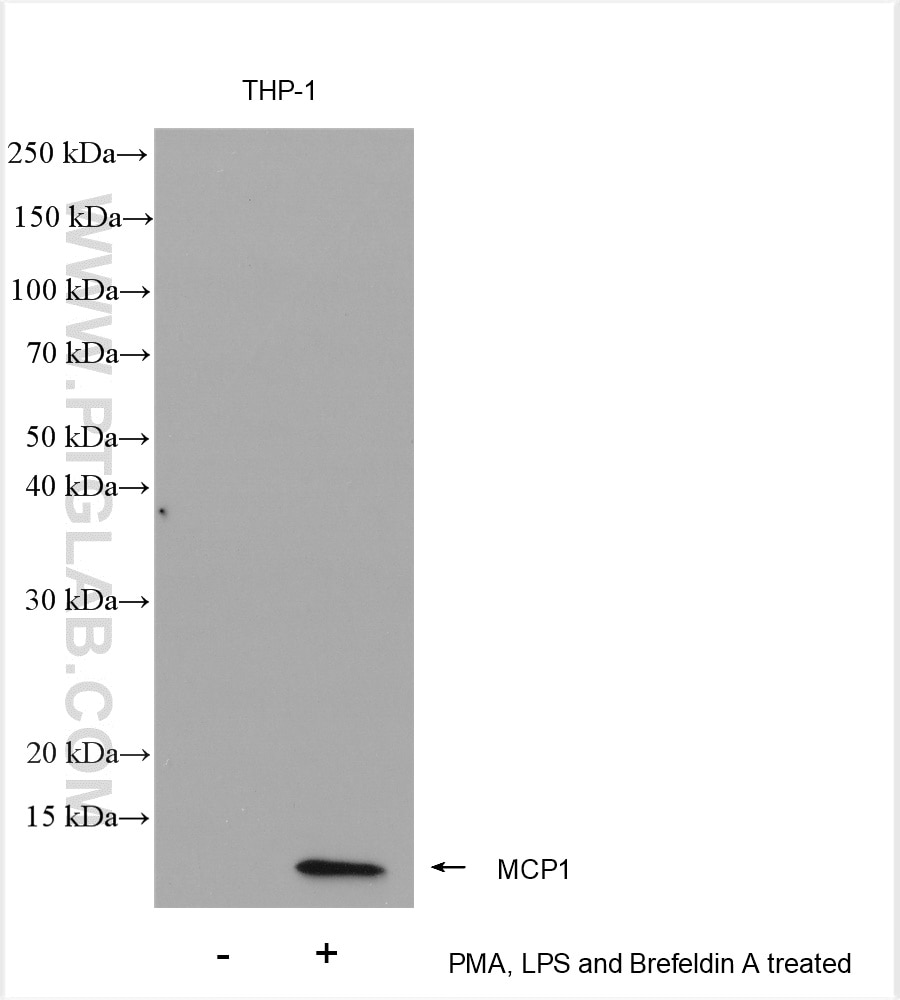

Tested Applications
| Positive WB detected in | PMA, LPS and Brefeldin A treated THP-1 cells |
Recommended dilution
| Application | Dilution |
|---|---|
| Western Blot (WB) | WB : 1:1000-1:4000 |
| It is recommended that this reagent should be titrated in each testing system to obtain optimal results. | |
| Sample-dependent, Check data in validation data gallery. | |
Product Information
29547-1-AP targets MCP-1/CCL2 in WB, IF, ELISA applications and shows reactivity with human samples.
| Tested Reactivity | human |
| Cited Reactivity | human |
| Host / Isotype | Rabbit / IgG |
| Class | Polyclonal |
| Type | Antibody |
| Immunogen |
Recombinant protein Predict reactive species |
| Full Name | chemokine (C-C motif) ligand 2 |
| Calculated Molecular Weight | 99 aa, 11 kDa |
| Observed Molecular Weight | 11 kDa |
| GenBank Accession Number | BC009716 |
| Gene Symbol | MCP-1/CCL2 |
| Gene ID (NCBI) | 6347 |
| RRID | AB_2918323 |
| Conjugate | Unconjugated |
| Form | Liquid |
| Purification Method | Antigen affinity purification |
| UNIPROT ID | P13500 |
| Storage Buffer | PBS with 0.02% sodium azide and 50% glycerol, pH 7.3. |
| Storage Conditions | Store at -20°C. Stable for one year after shipment. Aliquoting is unnecessary for -20oC storage. 20ul sizes contain 0.1% BSA. |
Background Information
MCP-1, ( also named as CCL2) is a member of the chemokine family. MCP-1 recruits monocytes, memory T cells, and dendritic cells to the sites of inflammation produced by either tissue injury or infection. MCP-1 has been implicated in the pathogenesis of diseases characterized by monocytic infiltrates, like psoriasis, rheumatoid arthritis and atherosclerosis. It binds to chemokine receptors CCR2 and CCR4. Elevated expression of MCP-1 is associated with severe acute respiratory syndrome coronavirus 2 infection.
Protocols
| Product Specific Protocols | |
|---|---|
| WB protocol for MCP-1/CCL2 antibody 29547-1-AP | Download protocol |
| Standard Protocols | |
|---|---|
| Click here to view our Standard Protocols |
Publications
What published studies show
The MCP-1/CCL2 Polyclonal antibody (29547-1-AP) has 8 citations across journals including Cell Death & Disease Discovery, Frontiers in Immunology, Toxics, Journal of Inflammation Research, Experimental Biology and Medicine, Journal of Diabetes Investigation, Immunobiology, and Journal of Cardiovascular Development and Disease. Usage spans applications such as WB and IF in human samples. Research fields include cardiovascular disease (myocardial infarction, atherosclerosis, pulmonary arterial hypertension), immunology and inflammation (macrophage polarization, CCL2-CCR2 axis), reproductive medicine (recurrent spontaneous abortion, primary ovarian insufficiency), infectious disease (HIV-HPV), and colorectal cancer progression.
| Species | Application | Title |
|---|---|---|
Cell Death Discov Regulation of acute myocardial infarction by CircTMCC1 through mitochondrial dysfunction and AMPK/mTOR-driven M1 macrophage polarization: role in QFR assessment. | ||
Front Immunol Reciprocal activation between M1 macrophages and trophoblasts through CXCL9/STAT1/ZEB1/CCL2 axis promotes recurrent spontaneous abortion. | ||
Toxics Investigating the Potential Effects of F-53B on Pulmonary Arterial Hypertension Through Network Toxicology, Molecular Docking, and In Vitro Validation. | ||
J Inflamm Res Genetic Association and Drug Target Exploration Between Inflammation-Related Proteins and the Risk of Primary Ovarian Insufficiency. | ||
Exp Biol Med (Maywood) HIV-HPV interactions via extracellular vesicles among tobacco smokers and nonsmokers. | ||
J Diabetes Investig Heat shock protein 72 attenuates atherosclerosis in apolipoprotein E-deficient mice. |


