

Tested Applications
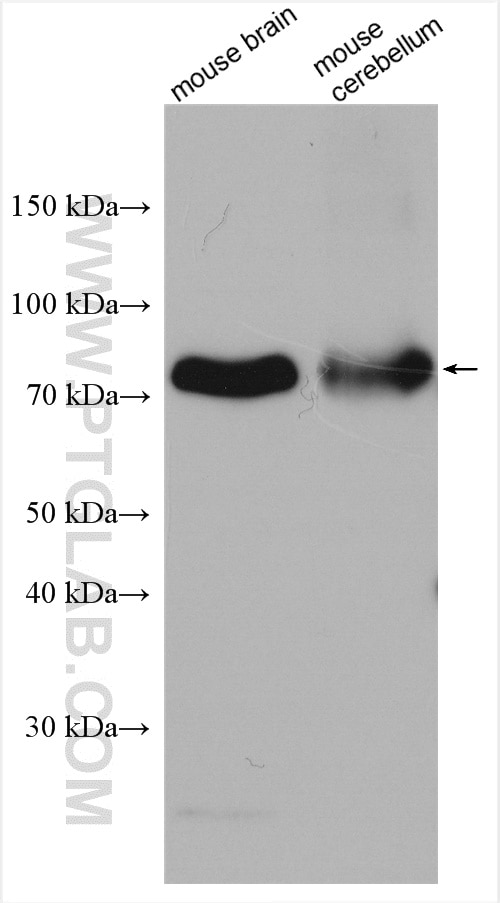
| Positive WB detected in | mouse brain tissue, mouse cerebellum tissue |
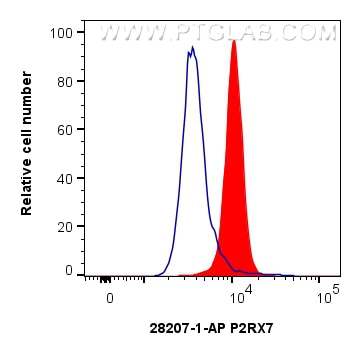
| Positive FC (Intra) detected in | RAW 264.7 cells |
Recommended dilution
| Application | Dilution |
|---|---|
| Western Blot (WB) | WB : 1:500-1:3000 |
| Flow Cytometry (FC) (INTRA) | FC (INTRA) : 0.50 ug per 10^6 cells in a 100 µl suspension |
| It is recommended that this reagent should be titrated in each testing system to obtain optimal results. | |
| Sample-dependent, Check data in validation data gallery. | |
Product Information
28207-1-AP targets P2RX7 in WB, IHC, IF, FC (Intra), CoIP, ELISA applications and shows reactivity with human, mouse samples.
| Tested Reactivity | human, mouse |
| Cited Reactivity | human, mouse, rat, pig |
| Host / Isotype | Rabbit / IgG |
| Class | Polyclonal |
| Type | Antibody |
| Immunogen |
CatNo: Ag27700 Product name: Recombinant human P2RX7 protein Source: e coli.-derived, PET28a Tag: 6*His Domain: 382-589 aa of BC011913 Sequence: YYYRKKCESIVEPKPTLKYVSFVDESHIRMVNQQLLGRSLQDVKGQEVPRPAMDFTDLSRLPLALHDTPPIPGQPEEIQLLRKEATPRSRDSPVWCQCGSCLPSQLPESHRCLEELCCRKKPGACITTSELFRKLVLSRHVLQFLLLYQEPLLALDVDSTNSRLRHCAYRCYATWRFGSQDMADFAILPSCCRWRIRKEFPKSEGQYS Predict reactive species |
| Full Name | purinergic receptor P2X, ligand-gated ion channel, 7 |
| Calculated Molecular Weight | 69 kDa |
| Observed Molecular Weight | 70-80 kDa |
| GenBank Accession Number | BC011913 |
| Gene Symbol | P2RX7 |
| Gene ID (NCBI) | 5027 |
| RRID | AB_2881088 |
| Conjugate | Unconjugated |
| Form | Liquid |
| Purification Method | Antigen affinity purification |
| UNIPROT ID | Q99572 |
| Storage Buffer | PBS with 0.02% sodium azide and 50% glycerol, pH 7.3. |
| Storage Conditions | Store at -20°C. Stable for one year after shipment. Aliquoting is unnecessary for -20oC storage. 20ul sizes contain 0.1% BSA. |
Background Information
Nucleotides, the structural subunits of the nucleic acids, are also important extracellular signaling molecules. P2 receptors are a family of cell surface receptors that mediate a wide variety of physiologic effects in response to extracellular nucleotides. These receptors fall into two classes: P2X receptors, which are ligand-gated ion channels that mediate calcium and potassium fluxes in response to ATP, and P2Y receptors, which are G protein-coupled receptors (GPCRs) (PMID: 21724990). P2RX7 functions as a ligand-gated ion channel and is responsible for ATP-dependent lysis of macrophages through the formation of membrane pores permeable to large molecules. P2RX7 is highly expressed by cells of the haemopoietic lineage and can mediate cell death, killing of infectious organisms, and regulation of the inflammatory response (PMID: 22102807).
Protocols
| Product Specific Protocols | |
|---|---|
| FC protocol for P2RX7 antibody 28207-1-AP | Download protocol |
| WB protocol for P2RX7 antibody 28207-1-AP | Download protocol |
| Standard Protocols | |
|---|---|
| Click here to view our Standard Protocols |
Publications
What published studies show
The P2RX7 Polyclonal antibody (Cat# 28207-1-AP) has accumulated 42 citations across journals such as Nature Aging, Nature Communications, Cell Reports, Journal of Neuroinflammation, Clinical Cancer Research, Redox Biology, and Purinergic Signaling. Associated research fields include neuroinflammation, pyroptosis, ferroptosis, cancer biology, liver fibrosis, cardiovascular disease, diabetes, pain, and immunology. Applications span WB, IF, IHC, and CoIP in mouse, rat, human, and pig models.
| Species | Application | Title |
|---|---|---|
Nat Aging Extracellular vesicles derived from senescent hepatocytes drive pan-cancer metastasis in aging | ||
Nat Commun KNN-based frequency-adjustable ferroelectric heterojunction and biomedical applications | ||
Nat Commun Astrocytic neuroligin 3 regulates social memory and synaptic plasticity through adenosine signaling in male mice | ||
J Adv Res The purinergic receptor P2rx7 mediated ATP sensing is required to prevent bone aging by directing mitochondrial fitness of MSCs | ||
Redox Biol Islet regeneration protein Reg3g promotes macrophage clearance of β cell-derived dysfunctional mitochondria-rich vesicles to mitigate T2DM. | ||
J Nanobiotechnology Carbon dots from purple sweet potato as a promising anti-inflammatory biomaterial for alleviating the LPS-induced inflammation in macrophages |



