

Tested Applications
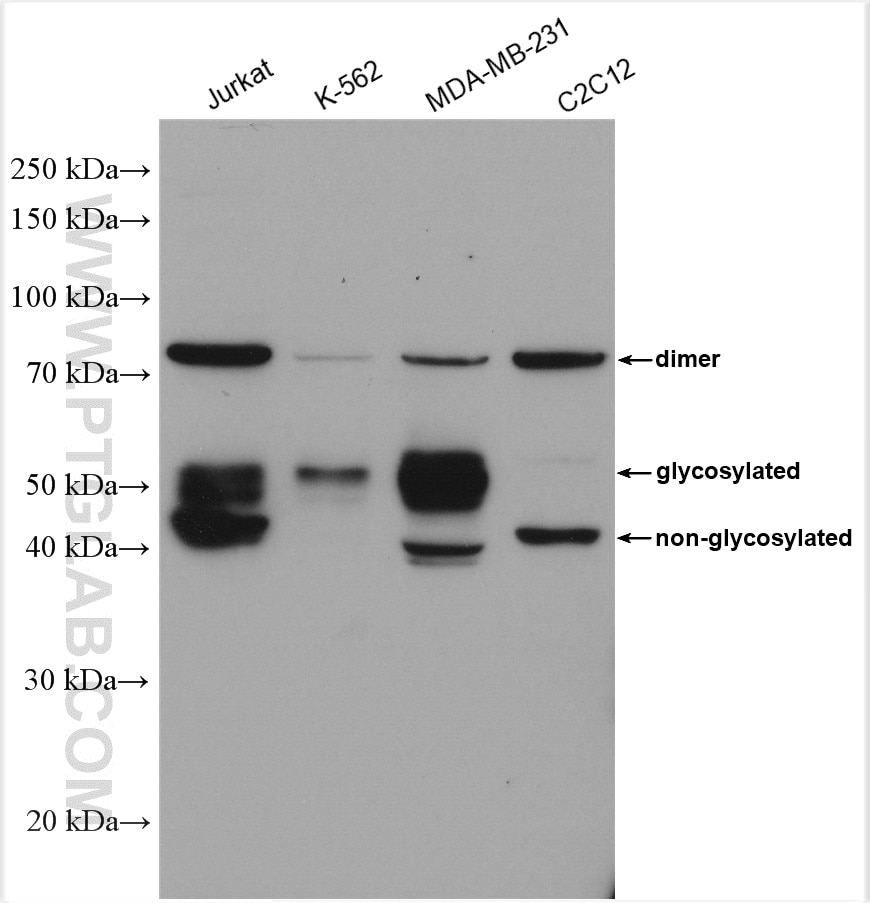
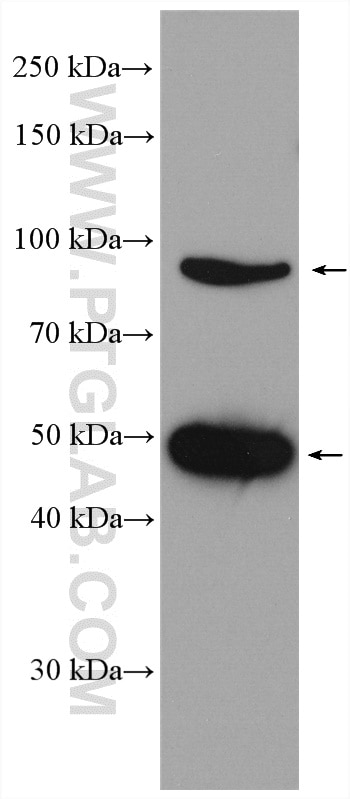
| Positive WB detected in | Jurkat cells, SH-SY5Y cells, K-562 cells, MDA-MB-231 cells, C2C12 cells |
Recommended dilution
| Application | Dilution |
|---|---|
| Western Blot (WB) | WB : 1:1000-1:6000 |
| It is recommended that this reagent should be titrated in each testing system to obtain optimal results. | |
| Sample-dependent, Check data in validation data gallery. | |
Product Information
12595-1-AP targets PANX1 in WB, IHC, IF, ELISA applications and shows reactivity with human, mouse samples.
| Tested Reactivity | human, mouse |
| Cited Reactivity | human, mouse, rat |
| Host / Isotype | Rabbit / IgG |
| Class | Polyclonal |
| Type | Antibody |
| Immunogen |
CatNo: Ag3174 Product name: Recombinant human PANX1 protein Source: e coli.-derived, PGEX-4T Tag: GST Domain: 126-426 aa of BC016931 Sequence: FWRFAAAPHICSDLKFIMEELDKVYNRAIKAAKSARDLDMRDGACSVPGVTENLGQSLWEVSESHFKYPIVEQYLKTKKNSNNLIIKYISCRLLTLIIILLACIYLGYYFSLSSLSDEFVCSIKSGILRNDSTVPDQFQCKLIAVGIFQLLSVINLVVYVLLAPVVVYTLFVPFRQKTDVLKVYEILPTFDVLHFKSEGYNDLSLYNLFLEENISEVKSYKCLKVLENIKSSGQGIDPMLLLTNLGMIKMDVVDGKTPMSAEMREEQGNQTAELQGMNIDSETKANNGEKNARQRLLDSSC Predict reactive species |
| Full Name | pannexin 1 |
| Calculated Molecular Weight | 426 aa, 48 kDa |
| Observed Molecular Weight | 45-50 kDa, 90 kDa |
| GenBank Accession Number | BC016931 |
| Gene Symbol | PANX1 |
| Gene ID (NCBI) | 24145 |
| RRID | AB_2159186 |
| Conjugate | Unconjugated |
| Form | Liquid |
| Purification Method | Antigen affinity purification |
| UNIPROT ID | Q96RD7 |
| Storage Buffer | PBS with 0.02% sodium azide and 50% glycerol, pH 7.3. |
| Storage Conditions | Store at -20°C. Stable for one year after shipment. Aliquoting is unnecessary for -20oC storage. 20ul sizes contain 0.1% BSA. |
Background Information
PANX1, also named as MRS1, belongs to the pannexin family. It plays a role as a Ca2+-leak channel to regulate ER Ca2+ homeostasis. It is a structural component of the gap junctions and the hemichannels. PANX1 induced the formation of intercellular channels with characteristics of gap junctions. PANX1 is 48-kDa protein which contains 4 transmembrane domains and cytoplasmic N and C termini. It is a mediator of find-me signal/nucleotide release from apoptotic cells. Western blot for Panx1 was also seen in two bands at 45~50 kDa and ~90 kDa. The band of ~90 kDa corresponding to the Panx1 dimer size. (PMID: 24590064, PMID: 19009624)
Protocols
| Product Specific Protocols | |
|---|---|
| WB protocol for PANX1 antibody 12595-1-AP | Download protocol |
| Standard Protocols | |
|---|---|
| Click here to view our Standard Protocols |
Publications
What published studies show
The anti-Pannexin-1 antibody (Cat# 12595-1-AP) has 23 citations across journals including Theranostics, Br J Pharmacol, Sci Signal, Life Sci, Int J Mol Sci, PLoS Pathog, Cancer Sci, Sci Rep, Neurochem Res, Front Oncol, PLoS One, and Elife. Research fields span oncology (pancreatic, lung cancers), neurology (epilepsy, cerebral ischemia), immunology (sepsis, inflammasome activation), metabolic regulation (hepatic lipogenesis, diabetic cardiomyopathy), cell death (pyroptosis, ferroptosis), and structural biology.
| Species | Application | Title |
|---|---|---|
Mil Med Res PANX1-mediated ATP release confers FAM3A's suppression effects on hepatic gluconeogenesis and lipogenesis | ||
Theranostics Mitochondrial Protein UQCRC1 is Oncogenic and a Potential Therapeutic Target for Pancreatic Cancer. | ||
Br J Pharmacol Exploring the pathophysiology underlying clozapine-induced enhancement of glutamatergic transmission through L-glutamate and D-serine release associated with pannexin1 hemichannels | ||
Sci Signal Structures of human pannexin-1 in nanodiscs reveal gating mediated by dynamic movement of the N terminus and phospholipids. | ||
Life Sci Inhibiting pannexin-1 alleviates sepsis-induced acute kidney injury via decreasing NLRP3 inflammasome activation and cell apoptosis.
| ||
Int J Mol Sci Subcortical Circuits Among Pedunculopontine Nucleus, Thalamus and Basal Ganglia Play Important Roles in Paroxysmal Arousal in Genetic Rat Models of Autosomal Dominant Sleep-Related Hypermotor Epilepsy |



