
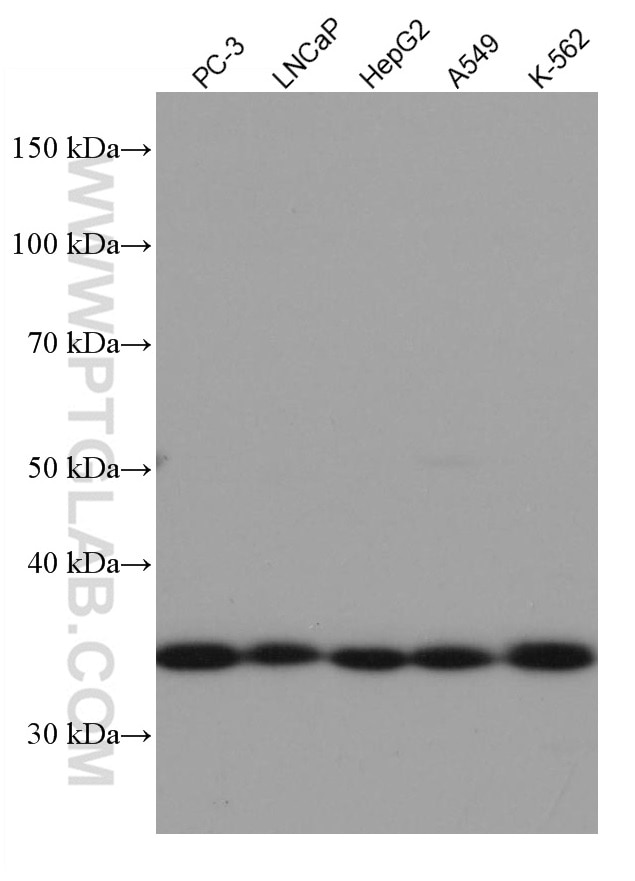
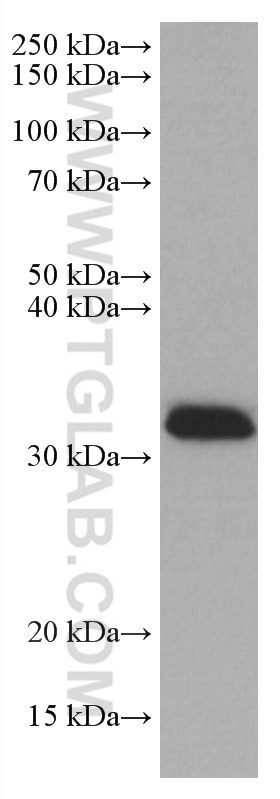

Tested Applications
| Positive WB detected in | PC-3 cells, HeLa cells, LNCaP cells, HepG2 cells, A549 cells, K-562 cells |
Recommended dilution
| Application | Dilution |
|---|---|
| Western Blot (WB) | WB : 1:1000-1:8000 |
| It is recommended that this reagent should be titrated in each testing system to obtain optimal results. | |
| Sample-dependent, Check data in validation data gallery. | |
Product Information
67059-1-Ig targets REDD1/DDIT4 in WB, ELISA applications and shows reactivity with human, mouse samples.
| Tested Reactivity | human, mouse |
| Cited Reactivity | human |
| Host / Isotype | Mouse / IgG1 |
| Class | Monoclonal |
| Type | Antibody |
| Immunogen |
CatNo: Ag0965 Product name: Recombinant human REDD1 protein Source: e coli.-derived, PGEX-4T Tag: GST Domain: 1-232 aa of BC007714 Sequence: MPSLWDRFSSSSTSSSPSSLPRTPTPDRPPRSAWGSATREEGFDRSTSLESSDCESLDSSNSGFGPEEDTAYLDGVSLPDFELLSDPEDEHLCANLMQLLQESLAQARLGSRRPARLLMPSQLVSQVGKELLRLAYSEPCGLRGALLDVCVEQGKSCHSVGQLALDPSLVPTFQLTLVLRLDSRLWPKIQGLFSSANSPFLPGFSQSLTLSTGFRVIKKKLYSSEQLLIEEC Predict reactive species |
| Full Name | DNA-damage-inducible transcript 4 |
| Calculated Molecular Weight | 25 kDa |
| Observed Molecular Weight | 32-35 kDa |
| GenBank Accession Number | BC007714 |
| Gene Symbol | REDD1/DDIT4 |
| Gene ID (NCBI) | 54541 |
| RRID | AB_2882369 |
| Conjugate | Unconjugated |
| Form | Liquid |
| Purification Method | Protein G purification |
| UNIPROT ID | Q9NX09 |
| Storage Buffer | PBS with 0.02% sodium azide and 50% glycerol, pH 7.3. |
| Storage Conditions | Store at -20°C. Stable for one year after shipment. Aliquoting is unnecessary for -20oC storage. 20ul sizes contain 0.1% BSA. |
Background Information
REDD1, also named as RTP801 and DDIT4, belongs to the DDIT4 family. REDD1 promotes neuronal cell death. It is a novel transcriptional target of p53 implicated ROS in the p53-dependent DNA damage response. REDD1 controlled cell growth under energy stress, as an essential regulator of TOR activity through the TSC1/2 complex. REDD-1 expression has also been linked to apoptosis, Aβ toxicity and the pathogenesis of ischemic diseases. As an HIF-1-responsive gene, REDD-1 exhibits strong hypoxia-dependent upregulation in ischemic cells of neuronal origin[PMID: 19996311]. In response to stress due to DNA damage and glucocorticoid treatment, REDD-1 is upregulated at the transcriptional level[PMID: 21733849]. REDD-1 negatively regulates the mammalian target of Rapamycin, a serine/threonine kinase often referred to as mTOR[PMID: 22951983]. It is crucial in the coupling of extra- and intracellular cues to mTOR regulation. The absence of REDD-1 is associated with the development of retinopathy, a major cause of blindness[PMID: 22304497]. REDD1 is a new host defense factor, and chemical activation of REDD1 expression represents a potent antiviral intervention strategy[PMID: 21909097]. The calculated molecular weight of REDD1 is 25 kDa. Because of multiple lysines in the proteins, REDD1 offen migrates around 35 kDa on Western blot[PMID: 19221489].
Protocols
| Product Specific Protocols | |
|---|---|
| WB protocol for REDD1/DDIT4 antibody 67059-1-Ig | Download protocol |
| Standard Protocols | |
|---|---|
| Click here to view our Standard Protocols |
Publications
What published studies show
The REDD1/DDIT4 Monoclonal antibody (3A2C10), catalog number 67059-1-Ig, has 3 total citations. These appear in Frontiers in Immunology, The Journal of Physiology, and FEBS Open Biology. The research fields span lung adenocarcinoma prognosis and immunotherapy response prediction, oxidative stress and mTOR signaling in exercise physiology, and hypoxia-inducible factor 1–mediated gene expression in endothelial cells. All cited applications are Western blot in human samples.
| Species | Application | Title |
|---|---|---|
Front Immunol A programmed cell death-related model based on machine learning for predicting prognosis and immunotherapy responses in patients with lung adenocarcinoma
| ||
J Physiol Passive dehydration increases oxidative stress and mTOR signalling pathway activation in young men following resistance exercise | ||
FEBS Open Bio FLI1 mediates the selective expression of hypoxia-inducible factor 1 target genes in endothelial cells under hypoxic conditions. |



