
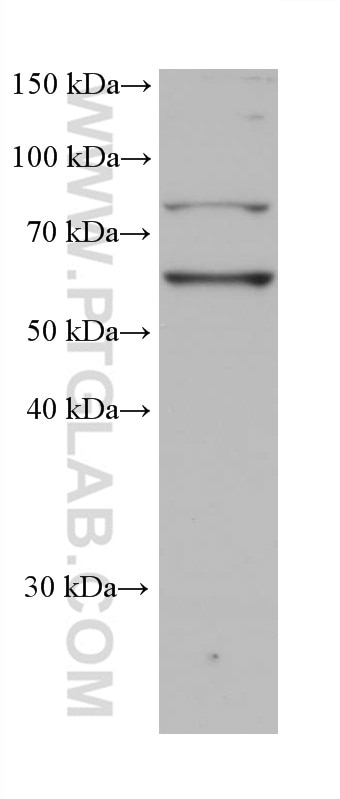
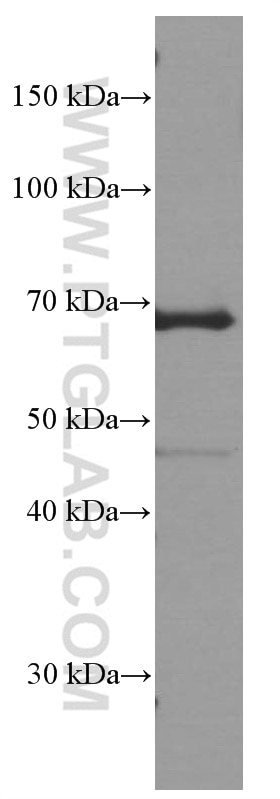
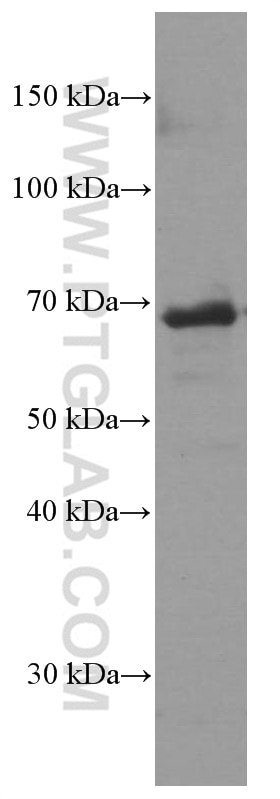

Tested Applications
| Positive WB detected in | Raji cells, DC2.4 cells, Daudi cells |
Recommended dilution
| Application | Dilution |
|---|---|
| Western Blot (WB) | WB : 1:1000-1:4000 |
| It is recommended that this reagent should be titrated in each testing system to obtain optimal results. | |
| Sample-dependent, Check data in validation data gallery. | |
Product Information
66406-1-Ig targets CD80 in WB, IF, ELISA applications and shows reactivity with human, mouse, pig samples.
| Tested Reactivity | human, mouse, pig |
| Cited Reactivity | human, mouse, rat, pig, rabbit |
| Host / Isotype | Mouse / IgG1 |
| Class | Monoclonal |
| Type | Antibody |
| Immunogen |
CatNo: Ag5615 Product name: Recombinant human B7-1 protein Source: e coli.-derived, PGEX-4T Tag: GST Domain: 36-228 aa of BC042665 Sequence: IHVTKEVKEVATLSCGHNVSVEELAQTRIYWQKEKKMVLTMMSGDMNIWPEYKNRTIFDITNNLSIVILALRPSDEGTYECVVLKYEKDAFKREHLAEVTLSVKADFPTPSISDFEIPTSNIRRIICSTSGGFPEPHLSWLENGEELNAINTTVSQDPETELYAVSSKLDFNMTTNHSFMCLIKYGHLRVNQT Predict reactive species |
| Full Name | CD80 molecule |
| Calculated Molecular Weight | 33 kDa |
| Observed Molecular Weight | 68 kDa |
| GenBank Accession Number | BC042665 |
| Gene Symbol | CD80 |
| Gene ID (NCBI) | 941 |
| RRID | AB_2827408 |
| Conjugate | Unconjugated |
| Form | Liquid |
| Purification Method | Protein G purification |
| UNIPROT ID | P33681 |
| Storage Buffer | PBS with 0.02% sodium azide and 50% glycerol, pH 7.3. |
| Storage Conditions | Store at -20°C. Stable for one year after shipment. Aliquoting is unnecessary for -20oC storage. 20ul sizes contain 0.1% BSA. |
Background Information
CD80 (also known as B7-1) is a type I membrane protein that is a member of the immunoglobulin superfamily, with an extracellular immunoglobulin constant-like domain and a variable-like domain required for receptor binding. It is expressed on antigen-presenting cells (APCs), including B cells, dendritic cells, monocytes, and macrophages. CD80 is the receptor for the proteins CD28 and CTLA-4 found on the surface of T-cells. It is involved in the costimulatory signal essential for T-lymphocyte activation. T-cell proliferation and cytokine production is induced by the binding of CD28, binding to CTLA-4 has opposite effects and inhibits T-cell activation. CD80 also acts as a cellular attachment receptor for adenovirus subgroup B. (PMID: 7545666; 12015893; 16920215)
Protocols
| Product Specific Protocols | |
|---|---|
| WB protocol for CD80 antibody 66406-1-Ig | Download protocol |
| Standard Protocols | |
|---|---|
| Click here to view our Standard Protocols |
Publications
What published studies show
CD80 Monoclonal Antibody (1E2F10), catalog number 66406-1-Ig, has accumulated 124 citations across more than 70 journals, including Nature Communications, ACS Nano, Theranostics, Biomaterials, Cell Reports, Journal of Experimental Medicine, Molecular Therapy, and Frontiers in Immunology. Associated research fields include cancer immunotherapy, macrophage M1/M2 polarization, inflammatory diseases, nanomedicine, neurology, cardiovascular disease, autoimmune disorders, wound healing, and pulmonary pathology.
| Species | Application | Title |
|---|---|---|
Adv Mater An OMV-Based Nanovaccine as Antigen Presentation Signal Enhancer for Cancer Immunotherapy | ||
J Extracell Vesicles Dendritic Cell Derived-Extracellular Vesicles Engineered to Express Interleukin-12 and Anti-CTLA-4 on Their Surface for Combinational Cancer Immunotherapy | ||
Nat Commun Neuropeptide SP protects against colitis and linked anxiety-like behavior through the putative roles of gut microbiota and metabolite inositol. | ||
ACS Nano Virus-Mimetic Extracellular-Vesicle Vaccine Boosts Systemic and Mucosal Immunity via Immune Recruitment | ||
ACS Nano Engineered Magneto-Piezoelectric Nanoparticles-Enhanced Scaffolds Disrupt Biofilms and Activate Oxidative Phosphorylation in Icam1+ Macrophages for Infectious Bone Defect Regeneration | ||
ACS Nano A Zinc-Citrate Metal-Organic Framework-Based Adaptable Hydrogen Sulfide Delivery System for Regulating Neuroregeneration Microenvironment in Spinal Cord Injury |




