
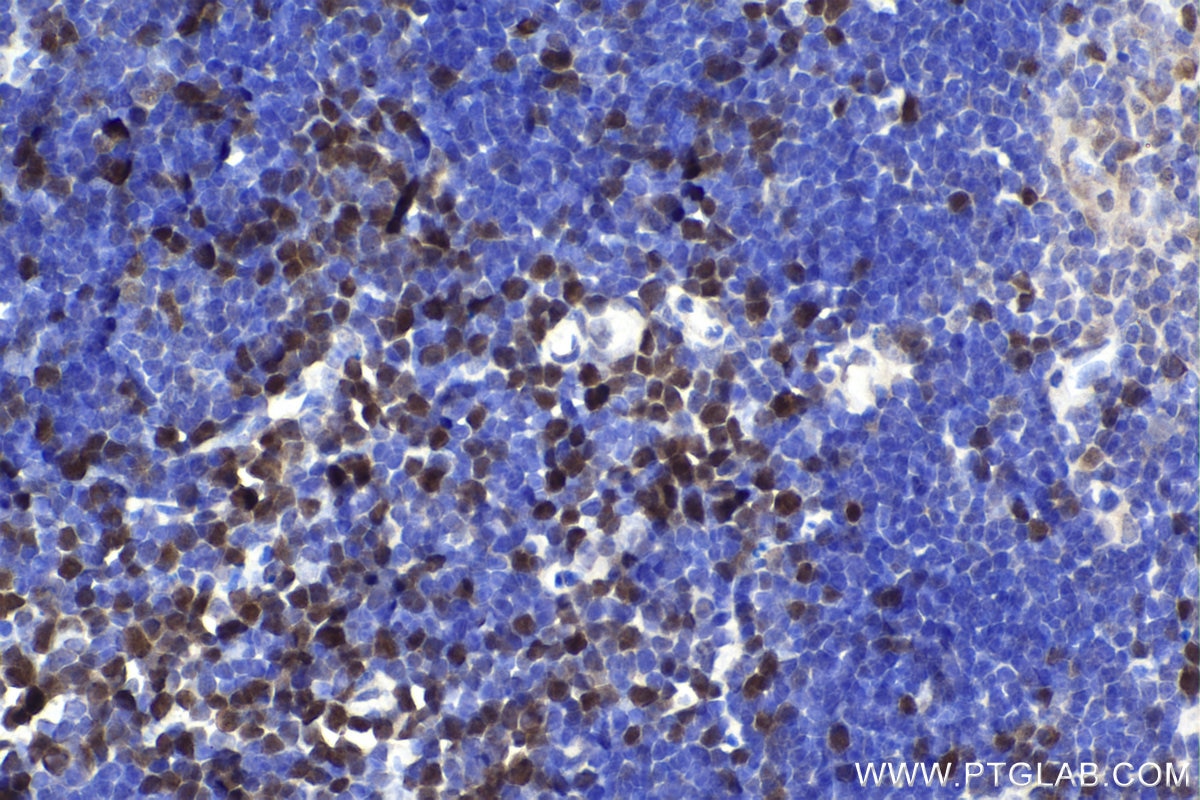

Tested Applications
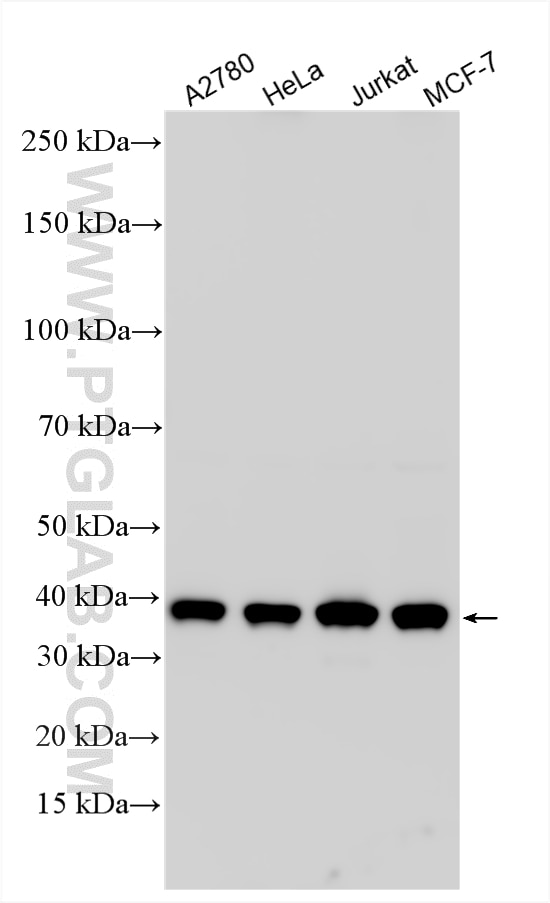
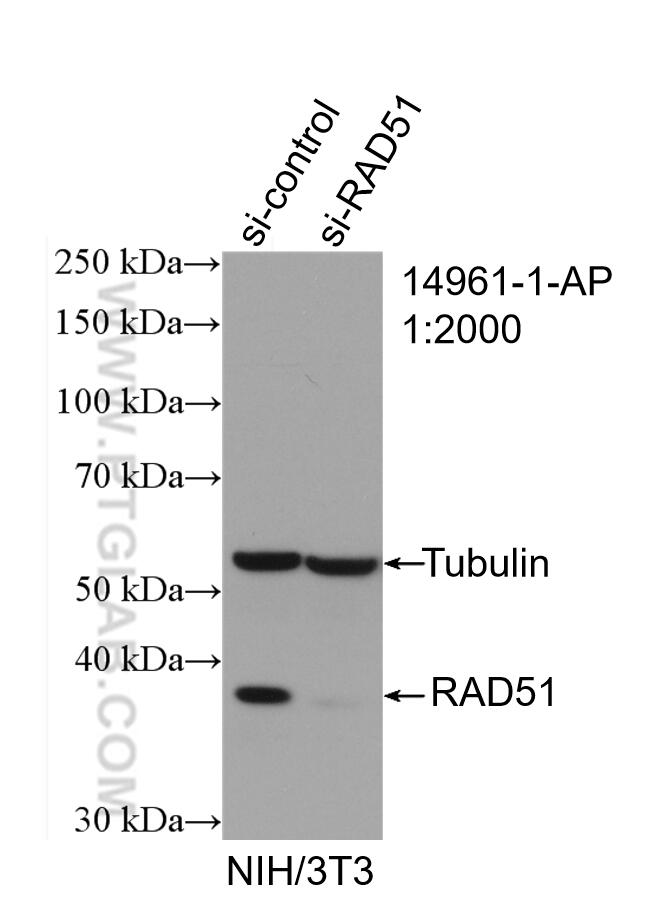
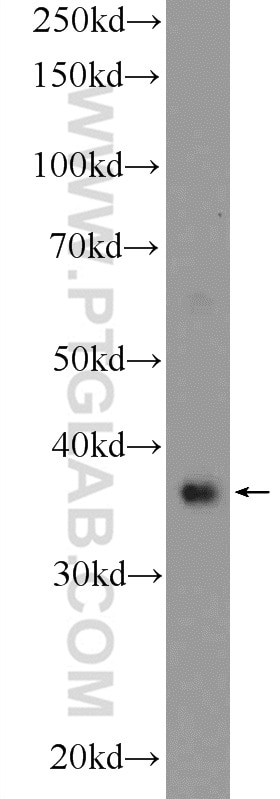
| Positive WB detected in | A2780 cells, mouse testis tissue, NIH/3T3 cells, HeLa cells, Jurkat cells, MCF-7 cells |
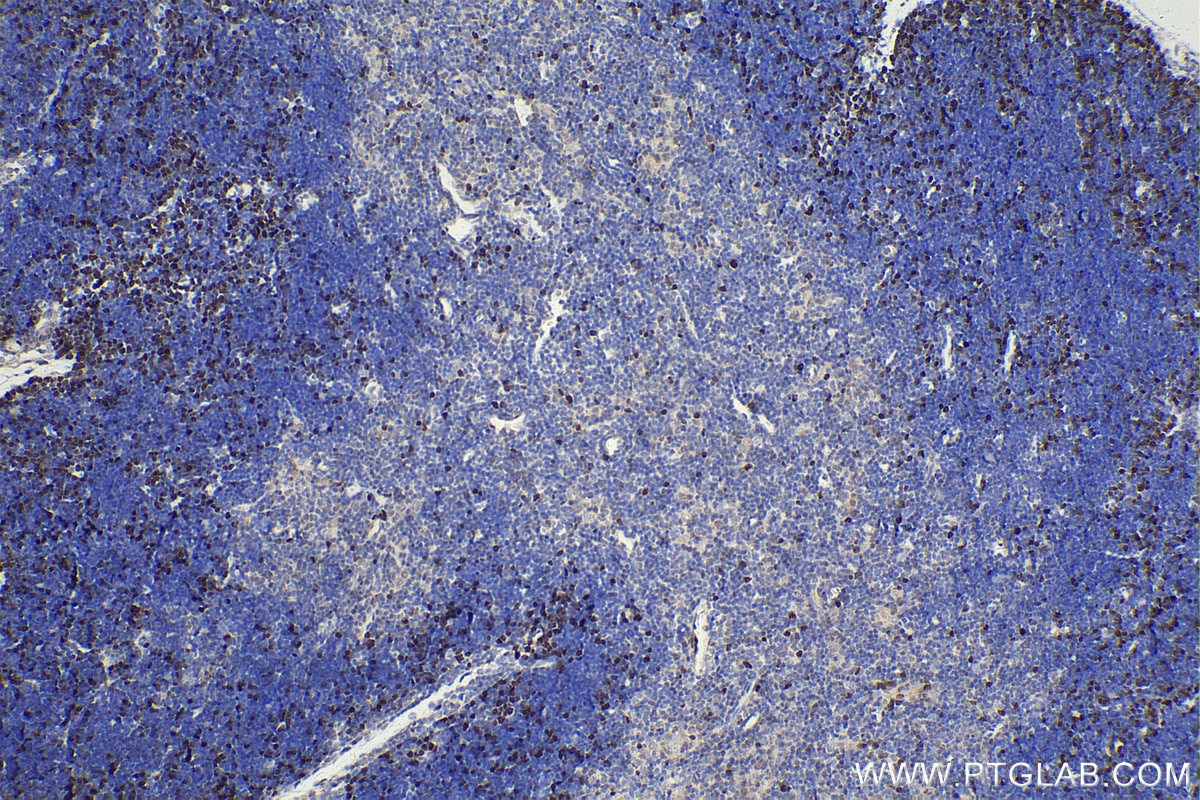
| Positive IHC detected in | mouse thymus tissue Note: suggested antigen retrieval with TE buffer pH 9.0; (*) Alternatively, antigen retrieval may be performed with citrate buffer pH 6.0 |
Recommended dilution
| Application | Dilution |
|---|---|
| Western Blot (WB) | WB : 1:5000-1:50000 |
| Immunohistochemistry (IHC) | IHC : 1:1000-1:4000 |
| It is recommended that this reagent should be titrated in each testing system to obtain optimal results. | |
| Sample-dependent, Check data in validation data gallery. | |
Product Information
14961-1-AP targets RAD51 in WB, IHC, IP, CoIP, ChIP, ELISA applications and shows reactivity with human, mouse samples.
| Tested Reactivity | human, mouse |
| Cited Reactivity | human, mouse, pig |
| Host / Isotype | Rabbit / IgG |
| Class | Polyclonal |
| Type | Antibody |
| Immunogen |
CatNo: Ag6823 Product name: Recombinant human RAD51 protein Source: e coli.-derived, PGEX-4T Tag: GST Domain: 1-242 aa of BC001459 Sequence: MAMQMQLEANADTSVEEESFGPQPISRLEQCGINANDVKKLEEAGFHTVEAVAYAPKKELINIKGISEAKADKILAVAERYGLSGSDVLDNVAYARAFNTDHQTQLLYQASAMMVESRYALLIVDSATALYRTDYSGRGELSARQMHLARFLRMLLRLADEFGVAVVITNQVVAQVDGAAMFAADPKKPIGGNIIAHASTTRLYLRKGRGETRICKIYDSPCLPEAEAMFAINADGVGDAKD Predict reactive species |
| Full Name | RAD51 homolog (RecA homolog, E. coli) (S. cerevisiae) |
| Calculated Molecular Weight | 37 kDa |
| Observed Molecular Weight | 37 kDa |
| GenBank Accession Number | BC001459 |
| Gene Symbol | RAD51 |
| Gene ID (NCBI) | 5888 |
| RRID | AB_2177083 |
| Conjugate | Unconjugated |
| Form | Liquid |
| Purification Method | Antigen affinity purification |
| UNIPROT ID | Q06609 |
| Storage Buffer | PBS with 0.02% sodium azide and 50% glycerol, pH 7.3. |
| Storage Conditions | Store at -20°C. Stable for one year after shipment. Aliquoting is unnecessary for -20oC storage. 20ul sizes contain 0.1% BSA. |
Background Information
RAD51 plays a critical role in the maintenance of genomic integrity by functioning in the repair of DNA double-strand breaks. It mediates homologous pairing and strand exchange in recombinatory structures known as RAD51foci in the nucleus. It also can bind to single and double stranded DNA and exhibits DNA-dependent ATPase activity. In addition, it has a role in regulating mitochondrial DNA copy number under conditions of oxidative stress in the presence of RAD51C and XRCC3.
Protocols
| Product Specific Protocols | |
|---|---|
| IHC protocol for RAD51 antibody 14961-1-AP | Download protocol |
| WB protocol for RAD51 antibody 14961-1-AP | Download protocol |
| Standard Protocols | |
|---|---|
| Click here to view our Standard Protocols |
Publications
What published studies show
Anti-RAD51 antibody (Cat# 14961-1-AP) has 120 citations in journals including Signal Transduction and Targeted Therapy, Molecular Cell, Nucleic Acids Research, Cell Reports, EMBO Reports, eLife, Oncogene, Cell Death & Disease, and Theranostics. Research fields predominantly cover DNA damage repair (homologous recombination), radioresistance, PARP inhibitor resistance, genomic stability, and cancer biology spanning breast, ovarian, lung, glioma, pancreatic, and other tumor types.
| Species | Application | Title |
|---|---|---|
Signal Transduct Target Ther PKMYT1 kinase ameliorates cisplatin sensitivity in osteosarcoma | ||
Signal Transduct Target Ther DNA/RNA-binding protein KIN17 supports esophageal cancer progression via resolving noncanonical STING activation induced by R-loop. | ||
Signal Transduct Target Ther KAT2A-driven succinylation of SRSF11 enforces spliceosome-mediated RAD52 splicing to promote homologous recombination and radioresistance in hepatocellular carcinoma | ||
Mol Cancer NSUN6-mediated 5-methylcytosine modification of NDRG1 mRNA promotes radioresistance in cervical cancer | ||
J Adv Res An interpretable artificial intelligence framework for designing synthetic lethality-based anti-cancer combination therapies | ||
Mol Cell DDX39A resolves replication fork-associated RNA-DNA hybrids to balance fork protection and cleavage for genomic stability maintenance |
Reviews
What customers say
Both reviewers rated this antibody 4 out of 5 stars. One user performed Western Blot on HeLa cells at a 1:1000 dilution with 20 µg of protein and detected the expected Rad51 band at 37 kDa. The other user confirmed it works well for both Western Blot (1:1000) and Immunofluorescence (1:200) on human liver cells. Overall, users report reliable performance in WB and IF applications with clear, specific detection.
The reviews below have been submitted by verified Proteintech customers who received an incentive for providing their feedback.
Resha (Verified Customer) (10-11-2023) | The antibody detected band at 37KDa for Rad51 protein. We used 1:1000 dilution for 20ug of protein.
|
ksh (Verified Customer) (01-17-2022) | This Antibody works for WB (1:1000) and IF (1:200).
|






