
Recombinant Mouse CD27 protein (His Tag)
Species
Mouse
Purity
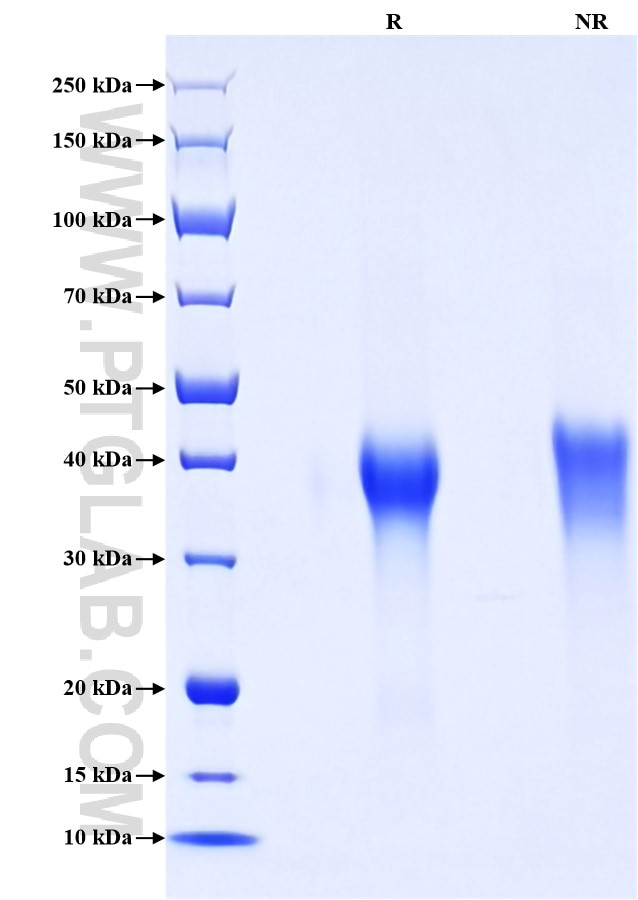
>90 %, SDS-PAGE
Tag
His Tag
Activity
not tested
Cat no : Eg1311
Validation Data Gallery
Product Information
| Purity | >90 %, SDS-PAGE |
| Endotoxin | <0.1 EU/μg protein, LAL method |
| Activity |
Not tested |
| Expression | HEK293-derived Mouse CD27 protein Thr21-Arg182 (Accession# P41272) with a His tag at the C-terminus. |
| GeneID | 21940 |
| Accession | P41272 |
| PredictedSize | 19.2 kDa |
| SDS-PAGE | 35-45 kDa, reducing (R) conditions |
| Formulation | Lyophilized from 0.22 μm filtered solution in PBS, pH 7.4. Normally 5% trehalose and 5% mannitol are added as protectants before lyophilization. |
| Reconstitution | Briefly centrifuge the tube before opening. Reconstitute at 0.1-0.5 mg/mL in sterile water. |
| Storage Conditions |
It is recommended that the protein be aliquoted for optimal storage. Avoid repeated freeze-thaw cycles.
|
| Shipping | The product is shipped at ambient temperature. Upon receipt, store it immediately at the recommended temperature. |
Background
CD27 (also known as TNFRSF7) is a type I glycoprotein expressed on some B cells and the majority of T cells, and is a member of the tumor necrosis factor (TNF) receptor family. CD27 is required for generation and long-term maintenance of T cell immunity. It is a receptor for CD70 (CD27L). Ligation of CD27 by CD70 induces strong ubiquitination of TRAF and the activation of both canonical and non-canonical NF-kappaB pathways, as well as the JNK pathway. CD27 may also play a role in apoptosis through association with SIVA1.
References:
1. Agematsu K. et al. (2000) Immunol Today. 21(5):204-6.
2. Hendriks J. et al. (2000) Nat Immunol. 1(5):433-40.
3. Nolte MA. et al. (2009) Immunol Rev. 229(1):216-31.
4. Singaravelu K. et al. (2011) Am J Physiol Renal Physiol. 300(5):F1130-41.