
Recombinant Human GPR132 protein (rFc Tag)
Species
Human
Purity
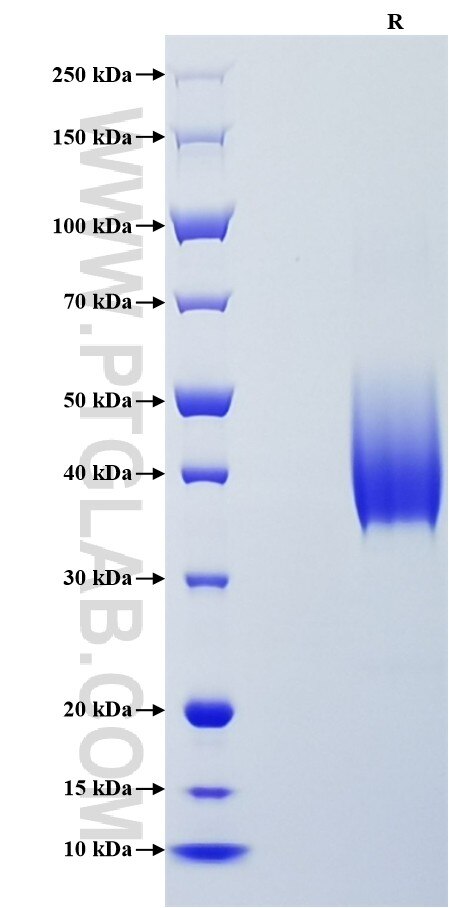
>90 %, SDS-PAGE
Tag
rFc Tag
Activity
not tested
Cat no : Eg1598
Validation Data Gallery
Product Information
| Purity | >90 %, SDS-PAGE |
| Endotoxin | <0.1 EU/μg protein, LAL method |
| Activity |
Not tested |
| Expression | HEK293-derived Human GPR132 protein Met1-Leu45 (Accession# Q9UNW8) with a rabbit IgG Fc tag at the C-terminus. |
| GeneID | 29933 |
| Accession | Q9UNW8 |
| PredictedSize | 31.1 kDa |
| SDS-PAGE | 35-50 kDa, reducing (R) conditions |
| Formulation | Lyophilized from 0.22 μm filtered solution in PBS, pH 7.4. Normally 5% trehalose and 5% mannitol are added as protectants before lyophilization. |
| Reconstitution | Briefly centrifuge the tube before opening. Reconstitute at 0.1-0.5 mg/mL in sterile water. |
| Storage Conditions |
It is recommended that the protein be aliquoted for optimal storage. Avoid repeated freeze-thaw cycles.
|
| Shipping | The product is shipped at ambient temperature. Upon receipt, store it immediately at the recommended temperature. |
Background
GPR132, which stands for G Protein-Coupled Receptor 132, is an important seven-transmembrane domain protein. It is primarily expressed in immune cells such as macrophages and functions as a sensor for microenvironmental signals, capable of specifically recognizing ligands like protons (H⁺) and oxidized lipids (e.g., 5-oxo-ETE). Its core role lies in connecting metabolism with immunity: in acidic tumor microenvironments or atherosclerotic plaques, GPR132 activation drives macrophages toward a pro-tumor or pro-inflammatory M2 phenotype, thereby promoting disease progression. Strong preclinical evidence indicates that inhibiting GPR132 can remodel the immune microenvironment and effectively suppress tumor growth and metastasis. As a result, GPR132 is regarded as a highly promising therapeutic target, particularly in the fields of cancer immunology and inflammatory diseases.
References:
1. Wang, Jia-Le et al. Nature metabolism vol. 5,10 (2023): 1726-1746.
2. Hui, Xinhui et al. Science advances vol. 11,10 (2025): eadr9395.
3. Chen, Peiwen et al. Proceedings of the National Academy of Sciences of the United States of America vol. 114,3 (2017): 580-585.
4. Liu, Ye et al. Cancer cell international vol. 23,1 253. 27 Oct. 2023.