
Recombinant Mouse FSTL1 protein (rFc Tag)
Species
Mouse
Purity
>90 %, SDS-PAGE
Tag
rFc Tag
Activity
not tested
Cat no : Eg2859
Validation Data Gallery
Product Information
| Purity | >90 %, SDS-PAGE |
| Endotoxin | <0.1 EU/μg protein, LAL method |
| Activity |
Not tested |
| Expression | HEK293-derived Mouse FSTL1 protein Glu19-Ile306 (Accession# P15144) with a rabbit IgG Fc tag at the C-terminus. |
| GeneID | 14314 |
| Accession | Q62356 |
| PredictedSize | 58.5 kDa |
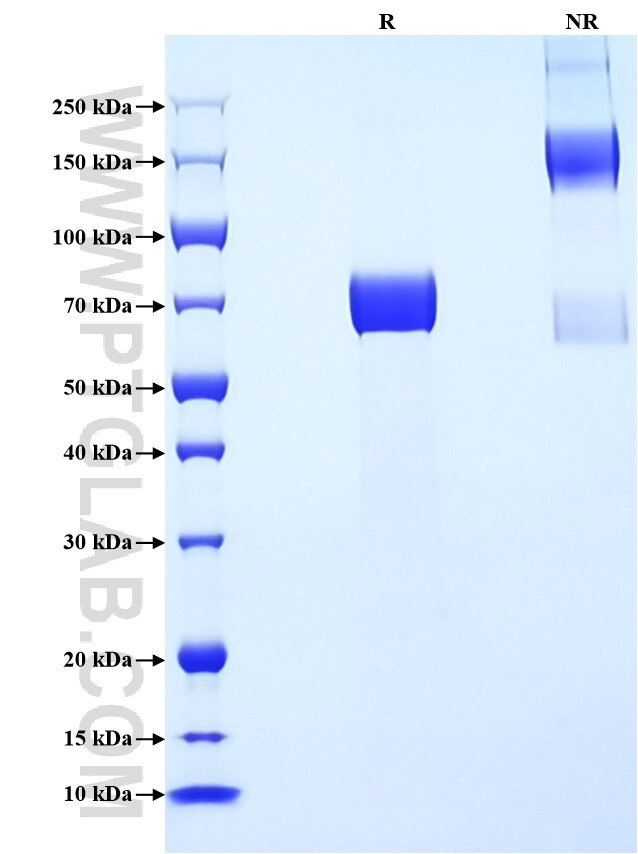
| SDS-PAGE | 65-75 kDa, reducing (R) conditions |
| Formulation | Lyophilized from 0.22 μm filtered solution in PBS, pH 7.4. Normally 5% trehalose and 5% mannitol are added as protectants before lyophilization. |
| Reconstitution | Briefly centrifuge the tube before opening. Reconstitute at 0.1-0.5 mg/mL in sterile water. |
| Storage Conditions |
It is recommended that the protein be aliquoted for optimal storage. Avoid repeated freeze-thaw cycles.
|
| Shipping | The product is shipped at ambient temperature. Upon receipt, store it immediately at the recommended temperature. |
Background
Follistatin-like 1 (FSTL1), initially discovered as a TGF-β1-induced gene, encodes a 308 amino acid secreted 45-55 kDa glycoprotein with a follistatin domain and two non-functional calcium-binding motifs. FSTL1 has been reported to be involved in the fate determination and maturation of epithelial cells. Ablation of the FSTL1 gene in the mouse results in several structural-developmental defects and neonatal lethality due to respiratory failure, demonstrating its functional importance. FSTL1 has been reported to exhibit both pro- and anti-inflammatory actions, with a specific anti-apoptotic and protective effect in cardiac or renal cell injury. detected several isoforms of FSTL1 with molecular masses of 40 to 48 kD which differs from the 50- to 55-kD products detected.
References:
1. Mouillet JF. et al. (2015). Placenta. 36(11):1231-8.
2. Sylva M. et al. (2013). Birth Defects Res C Embryo Today. 99(1):61-9.
3. Umezu T. et al. (2010). Proc Natl Acad Sci U S A. 107(10):4601-6.