
Recombinant Human IL-10 protein (rFc Tag)
Species
Human
Purity
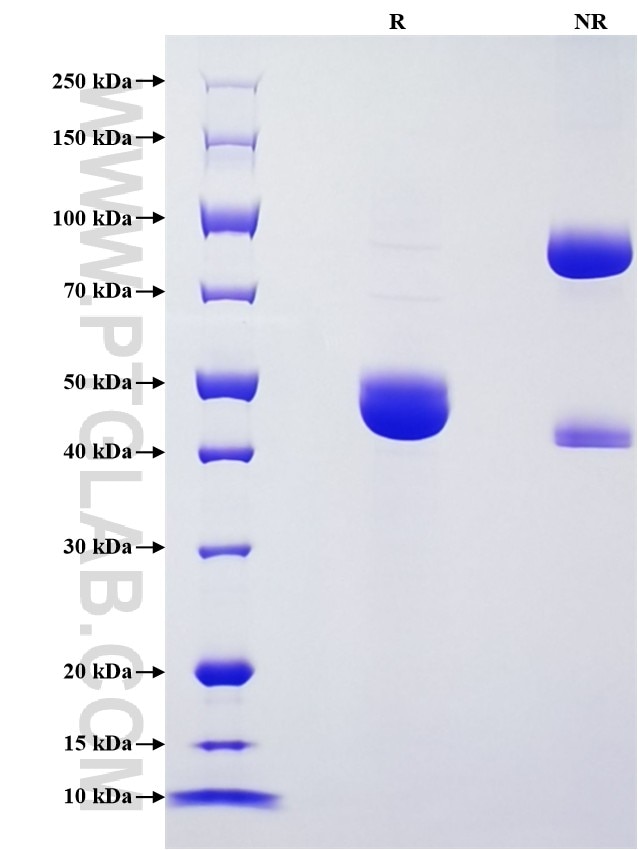
>90 %, SDS-PAGE
Tag
rFc Tag
Activity
not tested
Cat no : Eg3296
Validation Data Gallery
Product Information
| Purity | >90 %, SDS-PAGE |
| Endotoxin | <0.1 EU/μg protein, LAL method |
| Activity |
Not tested |
| Expression | HEK293-derived Human IL-10 protein Ser19-Asn178 (Accession# P22301) with a rabbit IgG Fc tag at the N-terminus. |
| GeneID | 3586 |
| Accession | P22301 |
| PredictedSize | 45.8 kDa |
| SDS-PAGE | 42-50 kDa, reducing (R) conditions |
| Formulation | Lyophilized from 0.22 μm filtered solution in PBS, pH 7.4. Normally 5% trehalose and 5% mannitol are added as protectants before lyophilization. |
| Reconstitution | Briefly centrifuge the tube before opening. Reconstitute at 0.1-0.5 mg/mL in sterile water. |
| Storage Conditions |
It is recommended that the protein be aliquoted for optimal storage. Avoid repeated freeze-thaw cycles.
|
| Shipping | The product is shipped at ambient temperature. Upon receipt, store it immediately at the recommended temperature. |
Background
Interleukin-10 is an anti-inflammatory cytokine, produced by T helper (Th) cells, macrophages, monocytes, and B cells, that plays a crucial role in preventing inflammatory and autoimmune pathologies. It downregulates the expression of Th1 cytokines, MHC class IL antigens, and co-stimulatory molecules on macrophages. It also enhances B cell survival, proliferation, and antibody production. IL-10 can block NF-κB activity, and is involved in the regulation of the JAK-STAT signaling pathway. IL-10, along with its receptors, describes an important role in pathogenesis of various diseases, including infectious, inflammatory, autoimmune diseases. IL-10 mutations are associated with an increased susceptibility to HIV-1 infection and rheumatoid arthritis.
References:
1. Mosmann TR. et al. (1994). Adv Immunol. 56: 1-26.
2. Kühn R. et al. (1993). Cell. 75: 263-74.
3. Turner DM. et al. (1997). EurJ Immunogenet. 24: 1-8.
4. Peng H. et al. (2013). Clin Rheumatol. 2013May 25.
5. Schall TJ. et al. (1990). Nature. 347: 669–671.
6. Cai G. et al. (1999). EurJ Immunol 29: 2658–2665.