
Recombinant Human RANK/TNFRSF11A protein (rFc Tag)
Species
Human
Purity
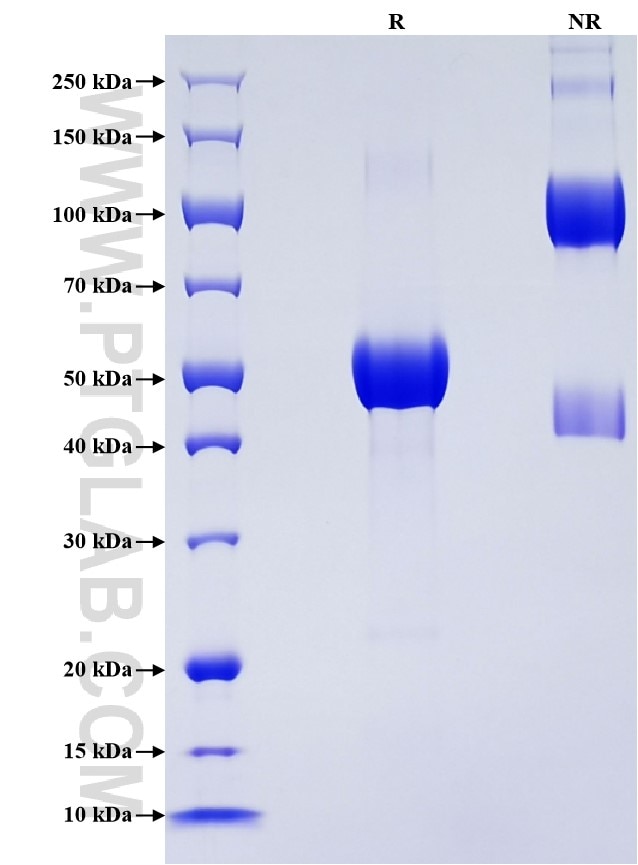
>90 %, SDS-PAGE
Tag
rFc Tag
Activity
not tested
Cat no : Eg3521
Validation Data Gallery
Product Information
| Purity | >90 %, SDS-PAGE |
| Endotoxin | <0.1 EU/μg protein, LAL method |
| Activity |
Not tested |
| Expression | HEK293-derived Human RANK protein Ile30-Pro212 (Accession# Q9Y6Q6-1) with a rabbit IgG Fc tag at the C-terminus. |
| GeneID | 8792 |
| Accession | Q9Y6Q6-1 |
| PredictedSize | 46.4 kDa |
| SDS-PAGE | 46-55 kDa, reducing (R) conditions |
| Formulation | Lyophilized from 0.22 μm filtered solution in PBS, pH 7.4. Normally 5% trehalose and 5% mannitol are added as protectants before lyophilization. |
| Reconstitution | Briefly centrifuge the tube before opening. Reconstitute at 0.1-0.5 mg/mL in sterile water. |
| Storage Conditions |
It is recommended that the protein be aliquoted for optimal storage. Avoid repeated freeze-thaw cycles.
|
| Shipping | The product is shipped at ambient temperature. Upon receipt, store it immediately at the recommended temperature. |
Background
TNFRSF11A, also known as receptor activator of NF-κB (RANK), is a novel member of the TNF receptor family and was known to be a receptor for RANKL in T-cell and dendritic cell interaction. RANK is a type I homotrimeric transmembrane protein whose expression was initially detected only on osteoclast precursors (OCPs), mature osteoclasts, and dendritic cells. RANK activates several signaling pathways, such as NF-κB, JNK, ERK, p38α, and Akt/PKB. RANK signaling pathway is essential for differentiation, activation and survival of osteoclasts.
References:
1.Boyce BF and Xing L. (2007) Arthritis Res Ther. 9 Suppl 1(Suppl 1):S1.
2.von dem Knesebeck A. et al. (2012) Neoplasia. 14(6):526-534.
3.González-Suárez E and Sanz-Moreno A. (2016) FEBS J. 283(11):2018-2033.
4.Yasuda H. (2021) J Bone Miner Metab. 39(1):2-11.