

Tested Applications
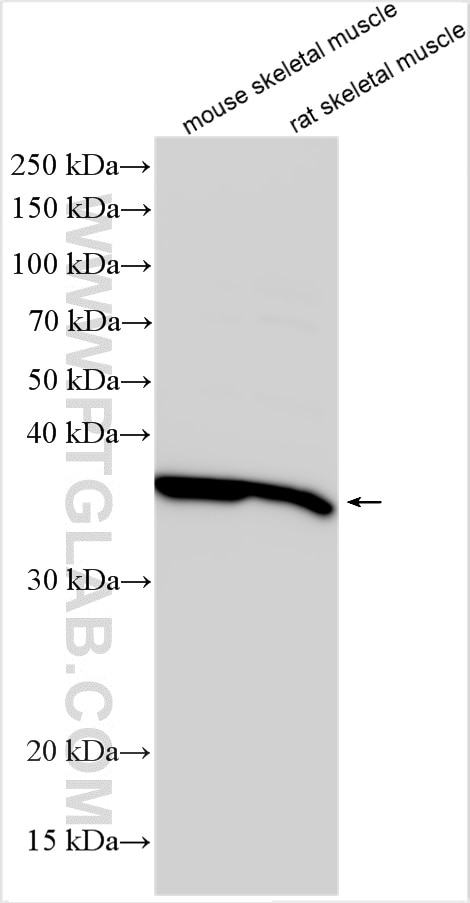
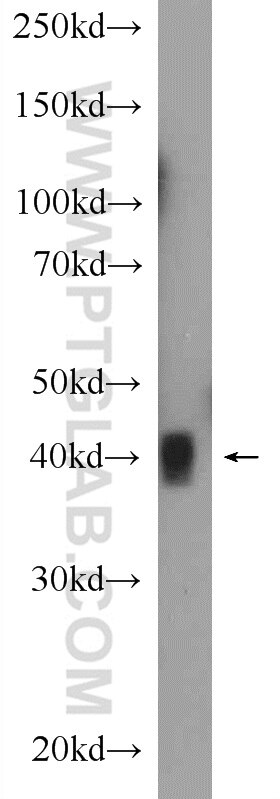
| Positive WB detected in | mouse skeletal muscle tissue, rat skeletal muscle tissue |
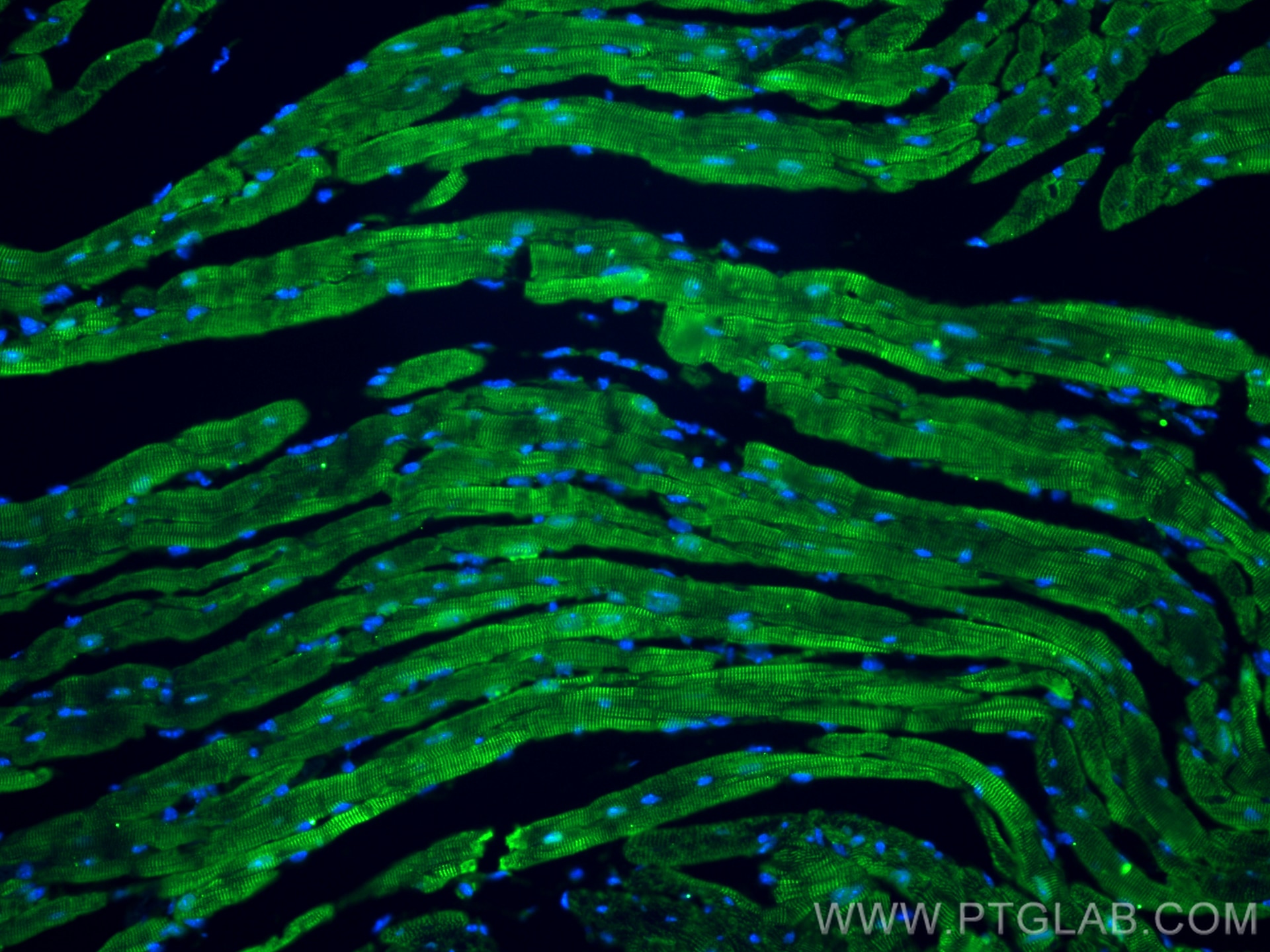
| Positive IF-P detected in | mouse heart tissue |
Recommended dilution
| Application | Dilution |
|---|---|
| Western Blot (WB) | WB : 1:500-1:3000 |
| Immunofluorescence (IF)-P | IF-P : 1:200-1:800 |
| It is recommended that this reagent should be titrated in each testing system to obtain optimal results. | |
| Sample-dependent, Check data in validation data gallery. | |
Product Information
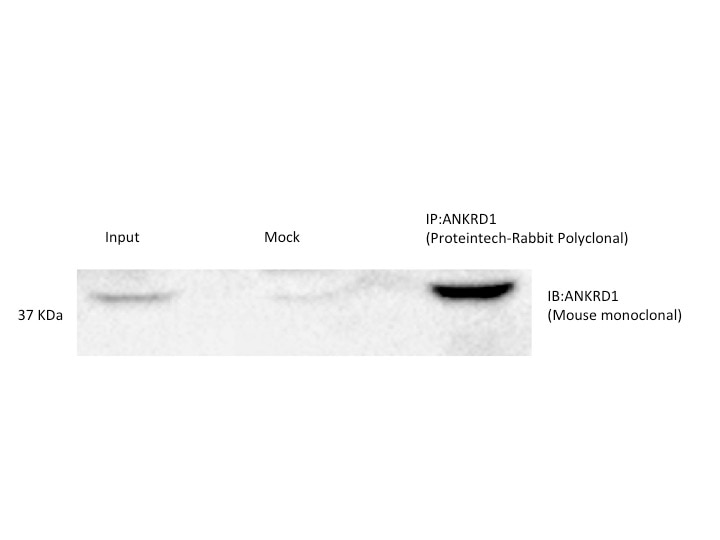
11427-1-AP targets ANKRD1 in WB, IHC, IF-P, IP, RIP, ELISA applications and shows reactivity with human, mouse, rat samples.
| Tested Reactivity | human, mouse, rat |
| Cited Reactivity | human, mouse, rat, canine |
| Host / Isotype | Rabbit / IgG |
| Class | Polyclonal |
| Type | Antibody |
| Immunogen |
CatNo: Ag1970 Product name: Recombinant human ANKRD1 protein Source: e coli.-derived, PGEX-4T Tag: GST Domain: 1-319 aa of BC018667 Sequence: MMVLKVEELVTGKKNGNGEAGEFLPEDFRDGEYEAAVTLEKQEDLKTLLAHPVTLGEQQWKSEKQREAELKKKKLEQRSKLENLEDLEIIIQLKKRKKYRKTKVPVVKEPEPEIITEPVDVPTFLKAALENKLPVVEKFLSDKNNPDVCDEYKRTALHRACLEGHLAIVEKLMEAGAQIEFRDMLESTAIHWASRGGNLDVLKLLLNKGAKISARDKLLSTALHVAVRTGHYECAEHLIACEADLNAKDREGDTPLHDAVRLNRYKMIRLLIMYGADLNIKNCAGKTPMDLVLHWQNGTKAIFDSLRENSYKTSRIATF Predict reactive species |
| Full Name | ankyrin repeat domain 1 (cardiac muscle) |
| Calculated Molecular Weight | 319 aa, 36 kDa |
| Observed Molecular Weight | 36 kDa |
| GenBank Accession Number | BC018667 |
| Gene Symbol | ANKRD1 |
| Gene ID (NCBI) | 27063 |
| RRID | AB_2227402 |
| Conjugate | Unconjugated |
| Form | Liquid |
| Purification Method | Antigen affinity purification |
| UNIPROT ID | Q15327 |
| Storage Buffer | PBS with 0.02% sodium azide and 50% glycerol, pH 7.3. |
| Storage Conditions | Store at -20°C. Stable for one year after shipment. Aliquoting is unnecessary for -20oC storage. 20ul sizes contain 0.1% BSA. |
Background Information
Ankyrin repeat domain-containing protein 1(ANKRD1) belongs to the conserved muscle ankyrin repeat protein(MARP) family, whose expression is induced in response to physiologic stress, injury and hypertrophy. Thus its expression mainly in activated vascular endothelial cells. ANKRD1 may regulate SMC proliferation through the CDKN1A pathway. It functions as a nuclear transcription repressor that regulate cardiac gene's expression. This is a rabbit polyclonal antibody produced by the full-length ANKRD1 of human origin
Protocols
| Product Specific Protocols | |
|---|---|
| IF protocol for ANKRD1 antibody 11427-1-AP | Download protocol |
| WB protocol for ANKRD1 antibody 11427-1-AP | Download protocol |
| Standard Protocols | |
|---|---|
| Click here to view our Standard Protocols |
Publications
What published studies show
ANKRD1 Polyclonal antibody (11427-1-AP) has 27 citations. Papers appear in high-impact journals including Nature Communications, Nat Cell Biol, Autophagy, EMBO J, European Heart Journal, Cell Death Dis, Cell Reports, Clinical and Translational Medicine, Cell Proliferation, Hepatology Communications, FASEB J, Human Molecular Genetics, Int J Mol Sci, J Cell Sci, and others. The research fields span cardiac pacing and myocardial ischemia-reperfusion injury, Hippo/YAP-TAZ signaling, cancers (breast, pancreatic, lung, gastric, hepatocellular, chordoma), skeletal muscle myopathy and atrophy, intervertebral disc degeneration, and heart regeneration.
| Species | Application | Title |
|---|---|---|
Eur Heart J Left bundle branch vs biventricular pacing: mechanistic insights from a canine model. | ||
Autophagy Mechanical stress-mediated ferritinophagy aggravates cartilage endplate degeneration via a PIEZO1-NCOA4-ZBP1 axis. | ||
Nat Commun ICAM1 initiates CTC cluster formation and trans-endothelial migration in lung metastasis of breast cancer. |
Reviews
What customers say
Able is busy answering your previous question. Please try again later.
The reviews below have been submitted by verified Proteintech customers who received an incentive for providing their feedback.
Kristen (Verified Customer) (12-02-2025) | Used to validate increased TEAD signaling in SOX10 knockout melanoma cell lines. Worked as expected, at designated size ~35 kDa
|
Haley (Verified Customer) (10-13-2025) | Works perfectly for Western blot
|
Luigi (Verified Customer) (11-29-2018) |
 |




